 Orcas Island
 West Beach's Exposure: What the Climate Does to Siding Here
West Beach sits close enough to open water that homes here take a different kind of weathering than siding a few miles inland on Orcas Island. Salt-laden air is the constant background condition — it settles on every exposed surface, works into seams and fastener heads, and slowly breaks down finishes and coatings that weren't built to shed it. Add wind-driven rain that comes in sideways during a fall or winter blow, and you've got moisture finding its way into joints and laps that would stay dry on a more sheltered lot.
Then there's the moss and algae season, which on this part of San Juan County isn't really a season — it's most of the year. Cool, damp, and shaded conditions let organic growth get a foothold on any siding surface that stays wet longer than it should, especially on north- and west-facing walls that don't get much direct sun to dry out between storms. Wood-based products soften and feed that growth. Vinyl doesn't feed it, but it also doesn't stand up well to the wind loads that come with unobstructed exposure. This is the combination — salt, driving rain, and sustained dampness — that we install for on every West Beach job.
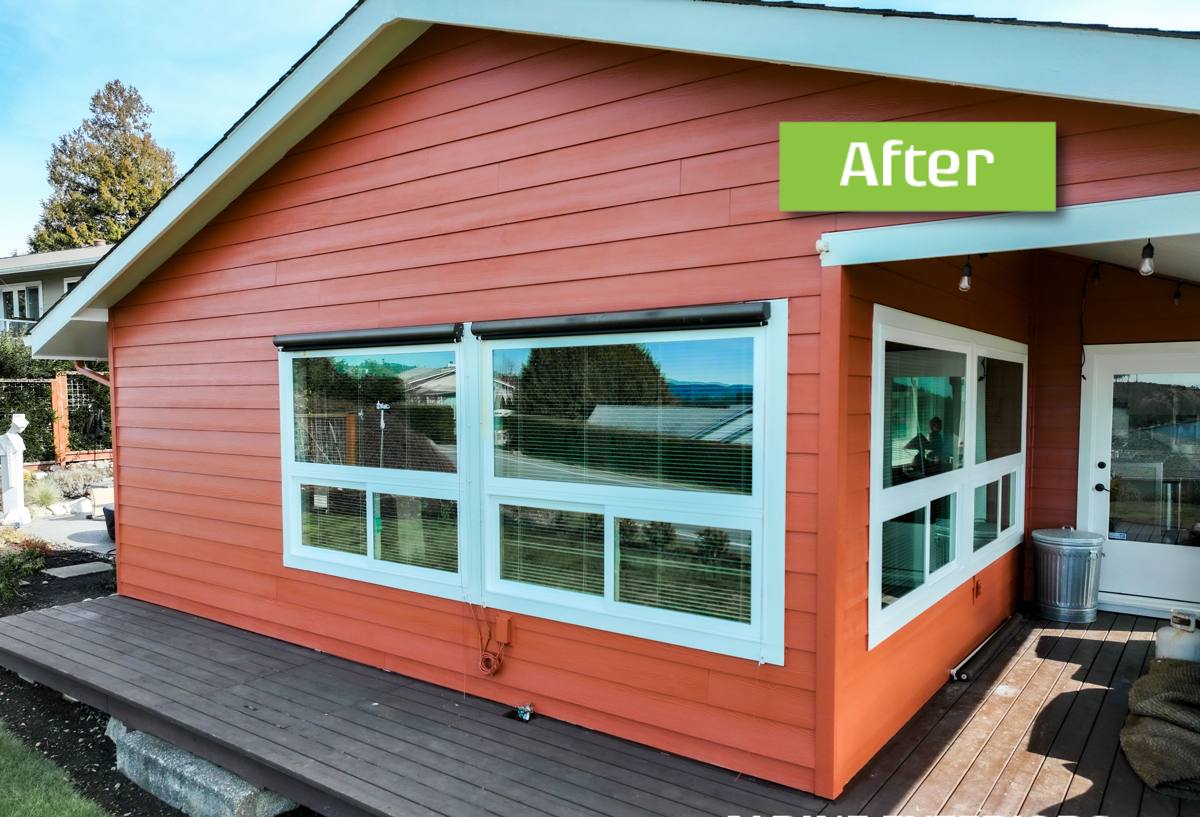
Why James Hardie Fiber Cement Holds Up in This Environment
A Core That Doesn't Feed Rot or Corrode
James Hardie siding is fiber cement — sand, cement, and cellulose fiber, not wood pulp or foam. It doesn't rot, it doesn't provide food for moss and algae the way wood-based siding and trim do, and it isn't affected by salt the way exposed metal fasteners or untreated wood trim can be over time. That's the baseline reason it's the only product we install: it's built to be indifferent to the conditions that wear everything else out faster.
ColorPlus Factory Finish vs. Field-Applied Paint
Most of what fails first on a salt-air property isn't the siding substrate — it's the paint film on top of it. Field-applied paint on wood or fiber cement is only as good as the prep and the conditions it was applied in, and it starts breaking down as soon as UV and salt spray get to work on it. James Hardie's ColorPlus Technology is a factory-applied, baked-on finish designed specifically to resist fading and hold up to weather exposure well beyond what a field-painted job typically manages, backed by its own finish warranty separate from the substrate warranty. For a shoreline-facing home, that difference shows up as years of extra color life before repainting ever becomes a conversation.
Matching the Product Line and Profile to the Site
Not every wall on a West Beach property faces the same exposure, and the right siding choice reflects that. James Hardie makes climate-engineered HZ product lines specifically for regions like the Pacific Northwest, and within that there are different profiles suited to different looks and exposures.
| Product | Best Use | Notes for This Exposure |
|---|---|---|
| HardiePlank Lap Siding | Primary field siding, most elevations | Widest range of exposure options; handles wind-driven rain well when lapped and fastened to spec |
| HardieShingle | Accent gables, dormers, feature walls | Reads well against a natural shoreline setting; needs careful lap detailing to shed water on exposed faces |
| HardiePanel | Modern facades, porch ceilings, accent panels | Fewer horizontal joints to seal; good option where a clean, low-maintenance surface is the priority |
On a property with one wall taking the brunt of the weather and others tucked behind trees or a garage, we'll sometimes recommend the same product line throughout for a consistent look, but pay closer attention to fastening, flashing, and joint treatment on the exposed side. That's a judgment call that comes from knowing how wind and rain actually move across a given lot — not from a spec sheet alone.
What Correct Installation Actually Involves
The Water Management Layer Behind the Siding
Siding is the visible layer, but the water-resistive barrier and flashing details behind it do most of the real work in a wind-driven-rain climate. Every window, door, and penetration needs flashing that directs water out and away from the sheathing, and the weather barrier needs to be lapped correctly, shingle-style, so water sheds downward and outward at every seam. Skipping or shortcutting this layer is the single most common reason siding jobs fail early in exposures like this — not because the Hardie boards themselves gave out, but because water got behind them.
Fastening, Gaps, and Joint Treatment
James Hardie publishes specific fastening patterns, minimum clearances, and gap requirements for a reason — get them wrong and you create pathways for moisture to sit against the board edges, which is exactly where problems start. That means correct nail placement and depth, proper clearance from grade, roof lines, and decks, and gapping or caulking at butt joints and trim according to spec rather than "close enough." On a salt-air site, we also pay attention to fastener material, since corrosion-resistant fasteners matter more here than they would a few miles inland.
Trim and Caulking Details
The trim-to-siding transitions are where a lot of amateur work shows up first — either overcaulked in a way that traps water, or undercaulked in a way that lets it in. We treat these joints as part of the water management system, not just a finishing touch.
Moss, Algae, and the Long Wet Season
No siding is immune to moss and algae taking hold if conditions are right, but a few things make a real difference in how much you'll deal with over the life of the siding. Good drainage behind the cladding and correct clearance at grade keep the bottom courses from sitting damp longer than necessary. Roof overhangs and gutter performance matter too — a gutter that overflows onto a wall below will keep that section wet far longer than the rest of the house, and that's where growth shows up first regardless of what the siding is made of.
James Hardie's factory finish resists the kind of surface breakdown that gives algae and moss something to grip onto, which is part of why it holds up better here than field-painted alternatives over time. It still needs occasional cleaning — a soft wash with the right cleaner, not a pressure washer aimed directly at the surface, which can force water into joints and damage the finish. We'll walk owners through a maintenance schedule that fits their specific exposure rather than a generic one.
Our Process for a West Beach Siding Job
- Site walk and exposure assessment — we look at which walls take the worst of the wind and rain, where moss and staining are already showing, and what that tells us about drainage and sun exposure.
- Tear-off and sheathing inspection — this is where hidden moisture damage from years of prior exposure gets found and dealt with before new siding goes up, not after.
- Weather-resistive barrier and flashing installation — correctly lapped and detailed at every window, door, and penetration.
- James Hardie installation to manufacturer spec — fastening pattern, clearances, and gapping matched to the exposure and product line chosen for each elevation.
- Trim, caulking, and ColorPlus touch-up — finished with manufacturer-matched touch-up product rather than mismatched field paint.
- Final walkthrough — we go over the finished work and a realistic maintenance schedule with the owner before we consider the job done.
What Homeowners Can Do to Maintain It
- Rinse siding a couple of times a year to clear salt residue and organic buildup before it accumulates
- Keep gutters clear so overflow doesn't keep one section of wall wet longer than the rest
- Trim back vegetation that shades a wall and keeps it from drying out between storms
- Inspect caulking at trim and penetrations annually and have gaps re-sealed before they widen
- Use a soft wash approach for cleaning, never a pressure washer aimed directly at siding joints
- Address any staining or discoloration early rather than waiting for it to spread
Cost Factors for a West Beach Project
| Factor | Why It Moves the Price |
|---|---|
| Tear-off condition | Hidden sheathing rot found during removal adds repair scope before new siding goes on |
| Product line and profile | Lap, shingle, and panel products carry different material and labor costs, and mixing profiles adds detailing time |
| Trim and detail work | Homes with more window and door trim, corners, and transitions take more time to flash and finish correctly |
| Site access and logistics | Ferry-dependent material delivery and staging on a shoreline lot affect scheduling and mobilization |
| Exposure-driven fastening | Corrosion-resistant fasteners and extra flashing attention on the most exposed elevations add labor |
Why Local Experience on Orcas Island Matters
Getting materials to a West Beach jobsite means working around ferry schedules, which affects how a crew stages a project and how tightly a timeline can be planned. A contractor who already works this part of San Juan County has that logistics problem solved before the job starts, instead of learning it on the fly. More importantly, they've seen which walls on which types of lots take the worst punishment from wind-driven rain and salt air, and they bring that judgment to product and detailing decisions instead of applying a one-size-fits-all approach.
That local familiarity also matters for permitting and for coordinating around the realities of island scheduling — weather windows, delivery timing, and the fact that a callback for a missed detail is a much bigger deal here than it would be for a crew working a dense mainland subdivision. We'd rather get the water management and fastening right the first time, because we're the ones who'll be back if it isn't.
If you're weighing siding options for a West Beach home, we're happy to walk the property, talk through what your specific exposure needs, and put together a straightforward, no-pressure estimate — just fill out the form below.