 Orcas Island
 The Slow Problem Nobody Notices Until It's Expensive
Siding failure on Orcas Island almost never starts with a dramatic event. There's no single storm that takes a wall down. Instead, it's a slow accumulation of small moisture events — a splash zone that never fully dries, a caulk joint that opened up two summers ago, a corner where wind-driven rain finds its way behind a butt joint. By the time a homeowner notices staining, soft spots, or paint that won't hold, the damage has usually been building for years. Understanding what's actually happening behind the surface is the first step to catching it early, or avoiding it altogether with the right material choice.
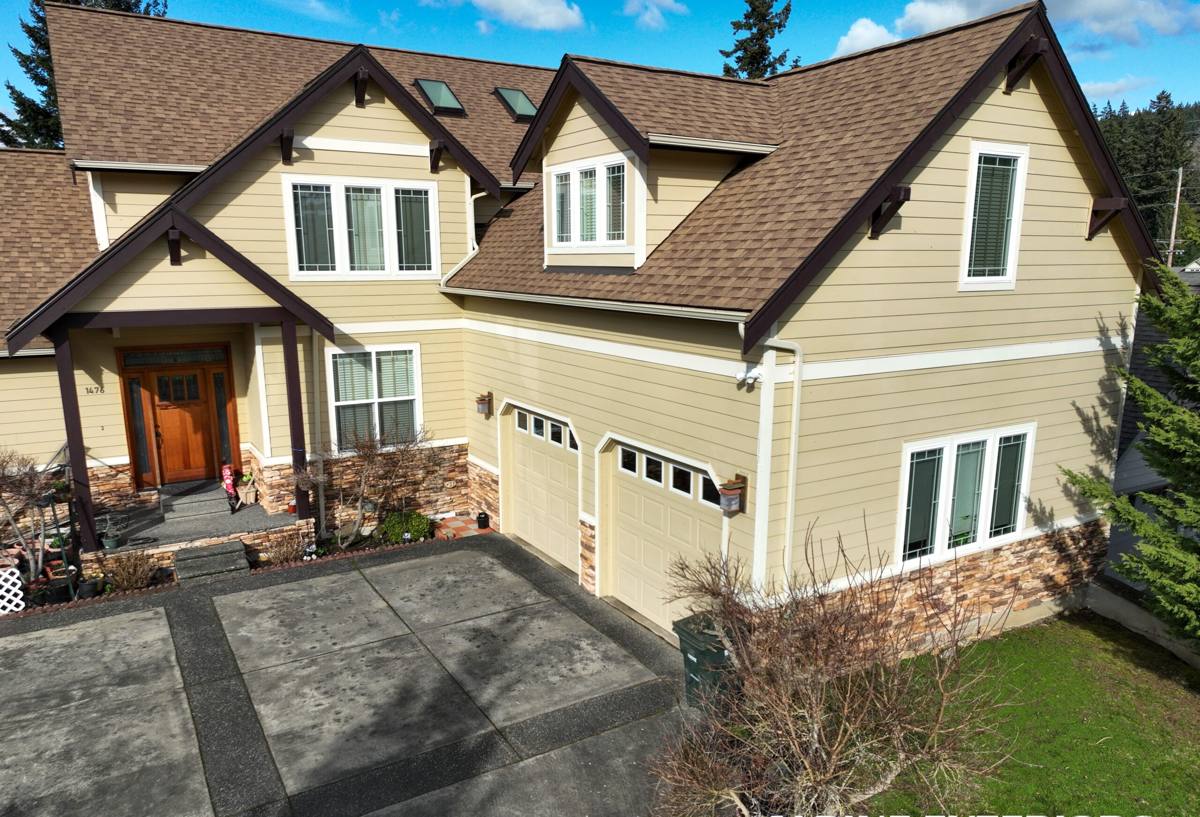
Why San Juan County Siding Takes a Different Kind of Beating
Orcas Island sits in a marine environment that stresses exterior materials in ways that don't show up in a general Pacific Northwest climate discussion. Three factors compound here:
- Salt air: Proximity to the water means airborne salt settles on siding, fasteners, and trim. Salt is hygroscopic — it pulls moisture out of the air and holds it against the surface longer than plain rain would.
- Driving rain: Wind off the water doesn't just fall on siding, it pushes rain sideways and upward under laps, around window flashing, and into any gap that a calmer climate would never test.
- A long moss and lichen season: Shaded, north-facing walls under tree cover stay damp for extended stretches of the year. Moss and lichen don't just look bad — they hold water against the siding surface far longer than bare material would, and their root structures can work into surface irregularities.
None of this means siding is doomed here. It means the margin for error in material choice and installation is smaller than it is in a drier inland climate, and small mistakes compound faster.
How Moisture Actually Gets In
It's Rarely the Field of the Wall
Homeowners often assume failing siding means the material itself is soaking up rain across its face. In practice, the flat field of most siding products sheds bulk water reasonably well. The real entry points are the details: butt joints between courses, inside and outside corners, window and door flashing, penetrations for hose bibs and light fixtures, and the bottom starter course near grade or a deck ledger. Water finds the seams, not the surface.
Capillary Action and Trapped Moisture
Once water gets behind or into a seam, capillary action can draw it further than gravity alone would suggest — pulling moisture sideways along a lap joint or up into an end grain. If the material behind the siding (sheathing, house wrap, or the siding itself) can't dry out between rain events, that moisture sits, and sitting moisture is what causes rot, delamination, and paint failure. A wall that gets wet and dries quickly is far less at risk than a wall that gets wet and stays wet.
Why Material Choice Changes the Whole Equation
Not every siding material handles this cycle of wetting and drying the same way, and this is really the core issue behind most of the failures we see replacing siding around the island.
| Material | How It Behaves With Repeated Moisture | Where It Tends to Fail First |
|---|---|---|
| Primed spruce / wood lap | Absorbs moisture directly into the wood fiber; swells and contracts with wet/dry cycles | Butt joints, bottom edges, anywhere paint film has worn thin |
| Cedar (unfinished or stained) | Naturally decay-resistant but still moisture-permeable; performance depends heavily on finish maintenance | Shaded, moss-prone walls with infrequent recoating |
| Vinyl siding | Doesn't absorb water itself, but doesn't stop water behind it either — relies entirely on drainage plane and flashing | Behind the panel, at seams and penetrations, often invisible until sheathing rot is advanced |
| OSB-based engineered wood (LP SmartSide and similar) | Engineered wood strand core is more moisture-resistant than raw OSB but still a wood product at heart; edge sealing is critical | Cut edges, fastener penetrations, and joints where factory edge treatment has been compromised |
| Fiber cement (James Hardie) | Cement-based composition doesn't swell, rot, or support moss growth the way wood does; engineered to handle wet climates | Only at poor installation details — caulking, flashing, fastening — not the material itself |
The pattern across nearly every siding failure we inspect is the same: the material either absorbed moisture directly (wood-based products) or had no defense once water got behind it (vinyl). Fiber cement doesn't eliminate the need for correct installation — nothing does — but it removes the material itself as a point of failure.
Why We Standardized on James Hardie
We made a deliberate decision to install only James Hardie fiber cement siding, and moisture performance in exactly this kind of marine climate is the core reason. A few specifics worth understanding:
The Material Doesn't Feed the Cycle
Fiber cement is cement, sand, and cellulose fiber, engineered and cured under controlled conditions. It doesn't swell when it absorbs moisture the way wood fiber does, and it doesn't provide an organic food source for the moss and lichen that thrive in our shaded, damp corners the way wood siding can.
Climate-Engineered Product Lines
James Hardie makes HZ5 product specifically formulated for regions with the freeze-thaw cycles and moisture exposure we get here, as opposed to a one-size-fits-all national formulation. That's not a marketing detail — it's a material science response to the exact conditions Orcas Island siding has to survive.
The Factory Finish Matters More Here Than Almost Anywhere
ColorPlus factory-applied finish is baked on under controlled conditions, which gives it better adhesion and UV resistance than field-applied paint. In a salt-air environment where paint failure is often the first visible sign of a deeper moisture problem, starting with a finish that's engineered to hold up — and backed by its own finish warranty — takes one variable out of the equation entirely.
A Warranty Structure Built for the Real World
James Hardie backs its siding with a substantial transferable warranty. That transferability matters on an island where homes change hands and buyers want assurance that the exterior envelope was done right, not just that it looked fine at the time of listing.
Where Installation Quality Still Makes or Breaks Everything
No material, including fiber cement, is moisture-proof if it goes on wrong. The failures we're called to fix are almost always installation issues layered on top of a material that couldn't tolerate the mistake:
- Butt joints without proper flashing or sealant backing
- Siding installed tight to grade or a roof line with no clearance for water to escape
- Missing or incorrect kick-out flashing where a roof meets a wall
- Caulk used as a substitute for flashing instead of a supplement to it
- Fasteners driven incorrectly, cracking the material and creating an entry point
- Inside corners without adequate drainage behind the trim
This is why we treat installation to manufacturer spec as non-negotiable, not a place to save time. A correctly installed lower-tier product will usually outperform a poorly installed premium one — but you get the best odds when both the material and the installation are right.
Signs Your Siding May Already Be Compromised
Most moisture damage is hidden until it isn't. A short self-check homeowners can do from the ground:
- Paint that's peeling, bubbling, or chalking heavily on one section but not others (often points to a localized moisture source)
- Soft or spongy spots when you press on wood-based siding, especially near the bottom courses
- Visible gaps opening up at butt joints or corner trim
- Persistent moss or dark staining that returns quickly after cleaning
- Musty smell or visible staining on interior walls that back up to exterior siding
- Warping or wave patterns visible when you sight down a wall in low-angle light
Any one of these on its own isn't necessarily an emergency, but they're worth having looked at before the next wet season rather than after.
What Reasonable Maintenance Looks Like By Material
Since material choice drives so much of this, it's worth being honest about what ongoing upkeep looks like for what's already on your home, whether or not you're ready to replace it:
- Wood siding: Recoat or repaint on a regular cycle, inspect caulk joints annually, keep vegetation and moss cleared, address any soft spots immediately before they spread.
- Vinyl siding: Check for cracked or warped panels after storms, and be aware that inspecting what's happening behind it generally requires removal, since problems don't show on the surface until they're advanced.
- Engineered wood: Keep an eye on cut edges and any field-applied sealant at joints, since factory edge treatment is where the material's moisture resistance is concentrated.
- Fiber cement: Periodic washing to clear salt residue and organic growth, and an occasional check of caulk joints and flashing — the maintenance burden shifts from the material to the details.
Thinking About a Replacement
If you're seeing early warning signs, or you're simply planning ahead for a home that's due, the conversation is worth having before a problem forces the timeline. A wall that's diagnosed and re-sided proactively, on your schedule, costs less and causes less disruption than one that's discovered only after sheathing damage sets in.
If you'd like an honest look at what's happening on your walls, we offer free, no-pressure estimates — including a straightforward read on whether what you're seeing is cosmetic, maintenance-level, or something that warrants a closer look before it spreads.