 Orcas Island
 Building and Maintaining a Home Near Mountain Lake, Orcas Island
The Mountain Lake area sits inland and up in elevation compared to Orcas Island's waterfront communities, tucked near the forest of Moran State Park. That setting brings its own mix of exterior wear and tear. Homes here get less direct wind-driven salt spray than a place like West Sound or Deer Harbor, but they trade that for heavy tree cover, deep shade for much of the day, and a longer damp season where moisture just sits against north-facing walls and trim. Add in San Juan County's marine climate — driving rain in the fall and winter, cool damp summers, and humidity that never really disappears — and you get a recipe for moss, mildew, and slow rot on the wrong siding material.
We've worked on homes across Orcas Island long enough to know that what works on a sun-exposed lot near the water does not necessarily hold up the same way under a canopy of fir and cedar near Mountain Lake. Shade means slower drying times after every rain. Slower drying means more time for moisture to work into seams, end cuts, and anywhere the original siding wasn't sealed and flashed correctly. That's the backdrop for every recommendation we make out here.
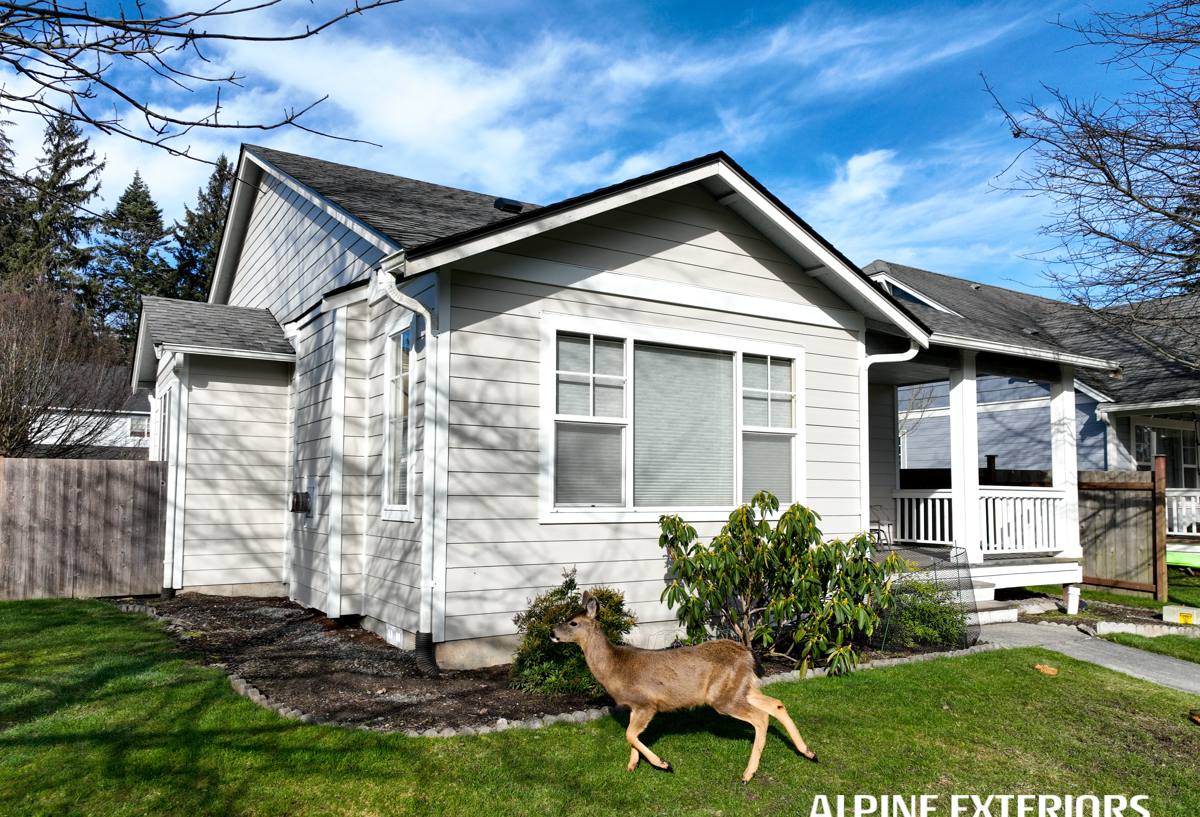
What This Climate Does to Different Siding Materials
Salt air, driving rain, and a long moss season don't affect every siding product the same way. Understanding how each material actually behaves under these conditions — not just how it looks in a brochure — is the whole reason we standardized on one product line.
Wood and Primed Spruce
Cedar and primed spruce siding look right at home in the San Juans, and we understand the appeal. But wood is organic material, and organic material in a shaded, damp environment is exactly what moss, algae, and rot organisms are looking for. Even well-maintained wood siding near Mountain Lake needs regular repainting or restaining, and any gap in that maintenance schedule shows up fast as soft spots, cupping boards, or moss creeping up from the bottom courses.
Vinyl Siding
Vinyl is inexpensive and low-maintenance in dry climates, but it wasn't engineered with the Pacific Northwest's freeze-thaw and prolonged-wet cycles in mind. It can warp or crack in temperature swings, and because it's installed with expansion gaps, wind-driven rain can get behind panels over time. In heavily shaded lots, algae staining on vinyl is common and doesn't wash off as easily as homeowners expect.
LP SmartSide, Cemplank, and Allura
These are legitimate engineered products, and other contractors do good work with them. LP SmartSide is a wood-strand product with a resin coating, which means its long-term performance depends heavily on every cut edge and joint being sealed exactly to spec — a single missed seal near a damp, shaded wall can lead to swelling. Cemplank and Allura are fiber cement, same category as what we install, but we've chosen not to carry them because of differences in factory finish warranty terms and the consistency of the ColorPlus baked-on finish we've come to trust from James Hardie.
Why We Install Only James Hardie Fiber Cement
James Hardie fiber cement is non-combustible, dimensionally stable, and engineered specifically for climates like ours through their HZ5 product line, which is built for regions with significant moisture exposure and temperature swings. It doesn't absorb water the way wood does, it doesn't warp the way vinyl can, and the ColorPlus factory finish is baked on and backed by a real finish warranty — not something we're painting on-site and hoping holds up through a wet Orcas Island winter.
That said, Hardie siding is not maintenance-free, and we won't tell you it is. It still needs to be installed with correct clearances, proper flashing, and factory-specified fastening, and it still benefits from periodic washing to keep moss and organic growth from taking hold, especially on shaded elevations near tree lines. The difference is that when it's installed correctly, the material itself isn't the weak point — installation quality is, which is why we control that end-to-end rather than subcontracting it out.
| Material | Moisture Behavior | Maintenance Near Shade/Moss | Finish Warranty |
|---|---|---|---|
| James Hardie Fiber Cement | Does not absorb/swell; engineered HZ5 for wet climates | Periodic wash; finish holds color | Long-term, transferable ColorPlus warranty |
| Cedar / Primed Spruce | Absorbs moisture; prone to rot in shade | Repaint/restain on a recurring cycle | None on the wood itself |
| Vinyl | Can warp in temp swings; water can migrate behind panels | Algae staining common in shade | Varies, often prorated |
| LP SmartSide | Wood-strand core; sensitive to unsealed cuts/joints | Inspect seams regularly | Manufacturer-specific, install-dependent |
How the Installation Process Works for a Mountain Lake Property
Access and Logistics
Anything built on Orcas Island has to account for ferry scheduling and material delivery lead times, and homes set back in wooded, higher-elevation lots near Mountain Lake sometimes have longer driveways or tighter access than a straightforward waterfront lot. We plan material staging and crew scheduling around that up front, so a job doesn't stall out waiting on a delayed barge or a truck that can't get close to the house.
Moisture Management First
Before any new siding goes up, we look at the building's water management: house wrap condition, window and door flashing, kickout flashing at roof-to-wall intersections, and clearance between the bottom of the siding and grade, decks, or roofing. In a shaded, damp setting like this, those details matter more than the siding brand on the wall — a well-installed product over bad flashing will still fail early.
Cutting, Sealing, and Fastening to Spec
James Hardie siding has to be cut, primed on exposed cut edges, and fastened according to the manufacturer's published instructions to keep the warranty valid and to actually perform the way it's designed to. We follow those specs as a baseline, not an afterthought.
Roofing, Windows, and Decks — Treating the Whole Exterior Together
Siding doesn't work in isolation. Roofing, windows, and decks all interact with the same water and moss pressure that siding faces, and a weak point in any one of them undermines the others. We handle all four so that flashing details, drainage paths, and material choices are coordinated instead of left to whichever trade shows up.
- Roofing: Roof condition drives how much water sheds cleanly away from siding versus how much runs down the wall. Moss buildup on a roof near Mountain Lake's tree cover is common and worth addressing before it contributes to siding staining below.
- Windows: Window flashing integrates directly with siding installation. Reworking siding without checking window flashing is a common way small leaks get sealed in rather than fixed.
- Decks: Deck ledger boards and any siding directly above or adjacent to a deck need proper flashing and clearance, since that's a frequent spot for hidden rot in wet climates.
Signs Your Home's Exterior Needs Attention
Homeowners near Mountain Lake tend to notice the same handful of warning signs, often on the shaded, north- or east-facing walls first.
- Green or black moss buildup that keeps coming back within weeks of cleaning
- Soft, spongy, or bubbling spots on wood or composite siding
- Peeling or bubbling paint, especially near seams and butt joints
- Visible gaps or separation at trim, corners, or window casings
- Dark staining below rooflines or gutters that never fully dries out
- Warped or bowed siding panels, common on vinyl after temperature swings
Any one of these on its own might just need cleaning or a caulk touch-up. Several at once, especially on an older wood or vinyl exterior, usually means moisture has been working behind the surface longer than it looks.
What Affects the Cost of a Siding Project Out Here
Every property is different, but a few factors consistently move the price on Orcas Island jobs, and it's worth understanding them before you start getting estimates.
| Factor | Why It Matters |
|---|---|
| Site access and driveway length | Affects staging, scaffolding, and how efficiently material and equipment move to the house |
| Existing wall condition | Hidden rot behind old siding adds sheathing repair before new siding can go on |
| Home height and roofline complexity | Multi-story walls and cut-up rooflines mean more flashing detail and labor time |
| Material lead time via ferry | Custom Hardie colors and trim profiles need to be scheduled around delivery timing |
| Scope — siding only vs. full envelope | Bundling roofing, windows, or decks with siding can reduce redundant setup costs |
Living With Moss: Realistic Maintenance Expectations
No siding material makes moss disappear entirely in a climate like this — anything with tree cover overhead is going to see organic growth eventually. What changes with James Hardie is how much that growth actually damages the material underneath. Fiber cement doesn't feed rot the way wood does, so periodic gentle washing (never high-pressure blasting directly at seams) keeps the surface looking clean without putting the siding itself at risk. We're happy to walk homeowners through a simple, low-effort maintenance routine once a project is done, tailored to how shaded the specific lot is.
Why a Local Crew Matters Here
A contractor based off-island is working from general Pacific Northwest assumptions. A crew that actually works San Juan County knows the difference between how a waterfront wall in West Sound weathers versus a shaded wall tucked near Mountain Lake's forest, and plans flashing, ventilation, and material choice accordingly. It also means someone is reachable for a warranty question or a follow-up inspection without a ferry trip standing between you and an answer.
Get a Free, No-Pressure Estimate
If you're noticing moss buildup, soft spots, or aging siding on a home near Mountain Lake, we're glad to take a look. There's no obligation and no pressure — just a straight assessment of what your exterior actually needs and what it would take to fix it right. Use the form below to request your free estimate.