 Orcas Island
 What West Sound Homes Are Up Against
West Sound sits on Orcas Island facing water, wind, and weather patterns that are noticeably harder on a home's exterior than what you'd find further inland in San Juan County. The combination of salt-laden air off the water, driving rain that comes in sideways during winter storms, and a long, damp shoulder season that never quite dries out adds up to a punishing environment for siding, trim, roofing, and anything made of wood. Homes here don't fail because owners neglect them. They fail because the wrong materials were used in the first place, or because installation details that matter everywhere else matter twice as much on an island exposed to marine weather.
If you've owned a home in West Sound for more than a few years, you've probably already seen the signs: green-black streaking on north-facing walls, caulk lines that have pulled away from trim, paint that blisters faster than it should, or soft spots where water has been sitting against a wall longer than it should have. None of that is unusual for this part of San Juan County. It's just what happens when a house isn't built and maintained with this specific climate in mind.
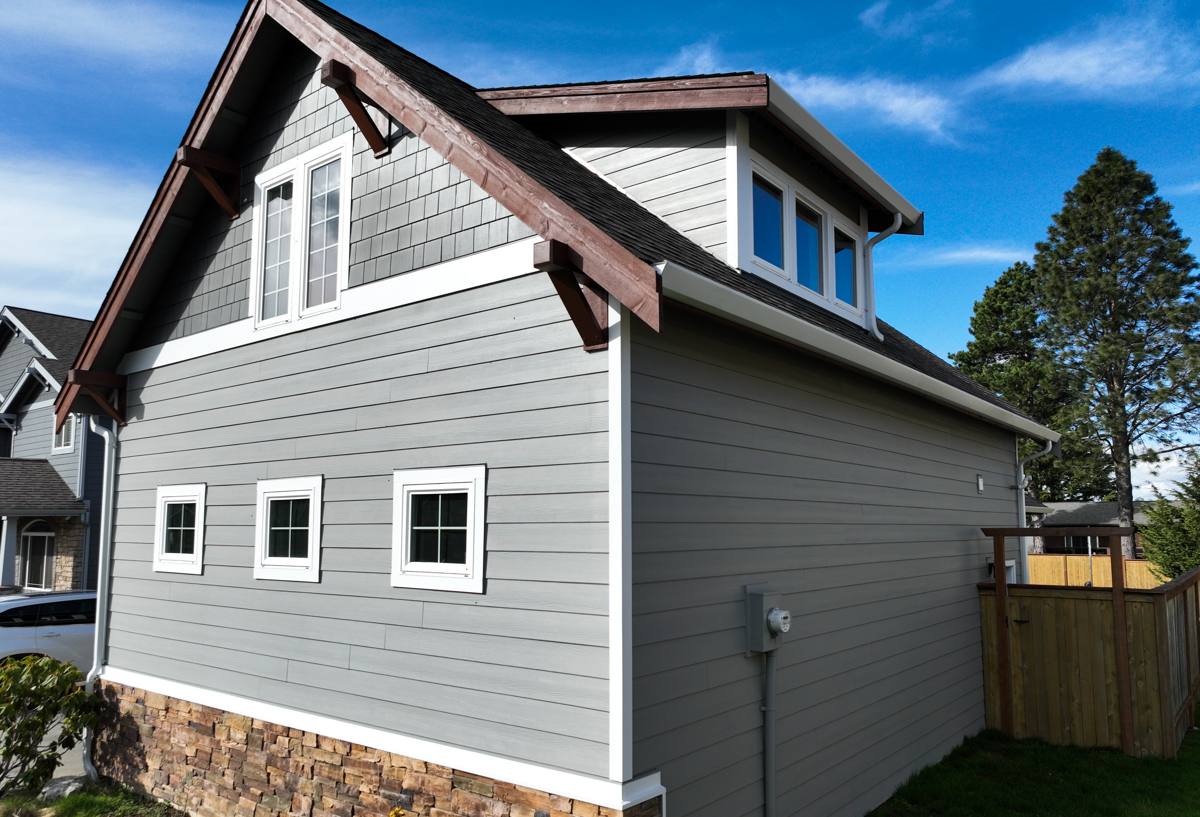
Salt Air, Rain, and Moss — the Three Things That Wear a House Down
Salt Air
Airborne salt from the surrounding waters settles on exterior surfaces and accelerates corrosion of fasteners, flashing, and any metal components on a home's exterior. Over time it also degrades certain coatings and finishes faster than a comparable home would wear inland. This is why fastener choice and flashing details matter as much as the siding material itself out here.
Driving Rain
West Sound catches wind-driven rain that pushes water horizontally into wall assemblies, not just straight down onto rooftops. Siding that relies on face-sealed joints, caulk, or paint film as its primary defense against moisture is working against the odds in this kind of exposure. A proper rain-screen gap and correctly lapped, sequenced flashing behind the siding matter more here than in a drier climate.
Moss Season
San Juan County's damp, shaded microclimates support a long moss and algae season, especially on north- and west-facing walls and rooflines that don't get much direct sun. Moss holds moisture against a surface far longer than open air would, which is exactly the condition that leads to rot in wood-based products and premature wear in coatings that aren't built to handle sustained dampness.
Why We Install Only James Hardie Fiber Cement Siding
We made a decision as a company to install James Hardie fiber cement siding exclusively — not vinyl, not LP SmartSide, not Cemplank or Allura, not primed spruce or cedar. That's not a marketing position, it's a standard we hold ourselves to because of what we've seen play out on homes in exactly this kind of coastal, wet, wood-destructive environment.
Fiber cement is non-combustible and dimensionally stable, meaning it doesn't expand, contract, warp, or cup the way wood-based sidings can when they cycle through wet and dry seasons. Hardie's ColorPlus factory-applied finish is baked on under controlled conditions rather than field-painted, which gives it better adhesion and color retention than site-applied paint typically achieves — a real advantage in an environment where paint film is under constant assault from salt, moisture, and UV. Hardie also engineers regional HZ product lines specifically for climate zones like ours, which affects the plank's resistance to moisture-related issues in wet coastal exposure.
We're not going to tell you every alternative product is bad — each has legitimate uses and honest trade-offs. Vinyl is inexpensive and low-maintenance but can become brittle and fade over time, and it doesn't hold up structurally the way fiber cement does. Engineered wood products like LP SmartSide perform well in many climates but rely on treated wood strand technology that is more sensitive to sustained moisture exposure than fiber cement — a meaningful consideration in a place with a moss season as long as ours. Cedar and primed spruce are beautiful and traditional, but they require a maintenance commitment — regular refinishing, caulking, and moisture vigilance — that most homeowners underestimate until they're several years in. We'd rather put a product on your home that we know can go the distance here with reasonable upkeep than sell you something that looks right on day one and becomes a maintenance project by year five.
| Material | Moisture Behavior in Wet Coastal Climates | Maintenance Burden | Longevity When Installed to Spec |
|---|---|---|---|
| James Hardie Fiber Cement | Dimensionally stable, non-combustible, engineered for climate zone | Low — occasional wash, repaint on a much longer cycle | Long, with strong transferable warranty |
| Vinyl | Doesn't rot, but can warp and become brittle with age | Low, but limited repair options if damaged | Moderate |
| LP SmartSide / Engineered Wood | More sensitive to sustained moisture exposure at edges and cuts | Moderate — needs consistent sealing and inspection | Moderate, installation-sensitive |
| Cedar / Primed Spruce | Absorbs and releases moisture readily; prone to checking and rot without upkeep | High — regular refinishing and caulk maintenance | Variable, heavily maintenance-dependent |
What Correct Installation Actually Looks Like Out Here
The product is only half the story. On West Sound homes exposed to driving rain and salt air, the installation details determine whether siding performs for decades or causes problems within a few years. That includes a proper rain-screen gap behind the siding to let incidental moisture drain and dry, correctly sequenced flashing at every window, door, and roof-to-wall transition, and fastener choices that resist corrosion in a salt-air environment. Manufacturer-specified nailing patterns and clearances aren't fine print — they're what keeps the ColorPlus finish and warranty intact.
This is also where a lot of siding jobs go wrong, and not because the crew was careless — it's because installers who don't work in coastal environments regularly don't always know which details matter most here. A crew that installs on West Sound and elsewhere in San Juan County routinely knows to over-flash the tricky transitions, knows which wall orientations need extra attention for moss and moisture, and knows how island weather windows affect sequencing a job so water-sensitive stages aren't left exposed overnight.
The Whole Exterior: Roofing, Windows, and Decks
Siding doesn't work in isolation. On a West Sound home, the roof, windows, siding, and any exterior decking all have to work together as one weatherproofing system, because water that gets past one component usually ends up testing the next one.
- Roofing: Roof-to-wall flashing details directly affect how much water reaches your siding during wind-driven rain. A roof and siding job coordinated together closes gaps that get missed when they're done as separate, unrelated projects.
- Windows: Window flashing and integration with the siding's water-resistive barrier is one of the most common failure points on coastal homes. Poorly integrated window flashing is a leading cause of hidden rot behind otherwise sound siding.
- Decks: Ledger board attachment and flashing where a deck meets the house is another high-risk transition in a wet climate. It deserves the same attention to detail as the siding itself.
Handling all four trades under one roof means fewer handoffs, fewer gaps between contractors' scopes of work, and a crew that understands how each component affects the others — which matters more on an island where a callback isn't a quick same-day fix.
Working as a Local Crew in San Juan County
Getting materials and crews to Orcas Island takes planning that mainland contractors often don't account for. Ferry schedules affect how a job gets sequenced, material deliveries need to be planned around sailing times rather than same-day trucking, and weather windows for exterior work are narrower here than in a lot of the mainland Pacific Northwest. A local crew builds that into the schedule from the start instead of discovering it mid-project.
Working regularly in West Sound and the surrounding San Juan County communities also means we see how homes here actually age — which orientations collect moss first, which details tend to fail on older builds, and what a well-built exterior looks like ten and twenty years after installation, not just on the day the crew drives off.
Maintaining a Hardie Exterior Through Moss Season
Even a low-maintenance material benefits from a bit of seasonal attention in this climate. A simple annual routine goes a long way toward protecting your investment:
- Rinse siding gently once a year, focusing on north- and west-facing walls where moss and algae tend to establish first
- Keep gutters clear so overflow doesn't run down and pool against siding or trim
- Trim back vegetation and tree cover that keeps walls shaded and slow to dry
- Check caulking at window and door trim annually and re-caulk where it's cracked or pulled away
- Walk the exterior after major winter storms and note any impact damage or loose trim early, before moisture gets behind it
What This Costs to Get Right
Exact numbers depend on your home's size, existing condition, and how much of the underlying wall assembly needs attention once old siding comes off — something we can't responsibly quote without seeing the house. In general terms, budgets are shaped by a few consistent factors:
| Cost Factor | Why It Matters |
|---|---|
| Home size and wall complexity | More corners, dormers, and trim details mean more labor and material |
| Condition of existing sheathing | Rot or water damage found during tear-off adds repair scope before new siding goes on |
| Product line and profile | Hardie offers multiple plank widths, textures, and colors at different price points |
| Access and logistics | Island delivery and scheduling around ferries and weather can affect project timeline |
| Scope beyond siding | Bundling roofing, window, or deck work can improve overall efficiency versus separate projects |
If your West Sound home is due for new siding, or you're weighing whether to bundle in roofing, windows, or deck work while the exterior is already open, we're happy to take a look and give you a straightforward, no-pressure estimate — no invented urgency, just an honest read on what your home needs.