 Orcas Island
 West Beach's Waterfront Exposure Is Different From the Rest of Orcas Island
West Beach sits on the open water side of Orcas Island, and that position changes what a house's exterior actually has to survive year-round. Homes here take a steadier dose of salt-laden wind than properties tucked into the island's interior, and that salt air doesn't just sit on the surface of a wall — it works into seams, fasteners, and any gap in the paint film over time. Add in driving rain that comes in sideways during fall and winter storms, plus a long, shaded moss season on the north- and west-facing walls, and you've got a siding assignment that's noticeably tougher than a typical San Juan County build.
We're not describing a hypothetical. This is the same set of conditions that shows up, house after house, on the water-facing lots we work on around Orcas Island. A siding job that would hold up fine on a sheltered inland lot in a milder microclimate can fail early out here if it wasn't specified and installed with this exposure in mind.
Salt Air and Corrosion
Airborne salt accelerates corrosion on anything metal — fasteners, flashing, trim caps — and it also degrades paint and caulk faster than it would inland. Products and finishes that aren't rated for coastal exposure tend to chalk, fade, or fail at the joints years ahead of schedule.
Driving Rain and Wind-Driven Moisture
West-facing walls on this side of Orcas Island catch wind-driven rain at an angle, which pushes water into laps, seams, and penetrations that would stay dry on a calmer site. That means water management behind the siding matters just as much as the siding itself.
Moss, Shade, and Prolonged Dampness
Tree cover and the marine layer common to San Juan County keep some wall sections damp for extended stretches, especially through the fall and winter. Moss and mildew take hold fastest on materials that hold moisture at the surface or in a porous substrate.
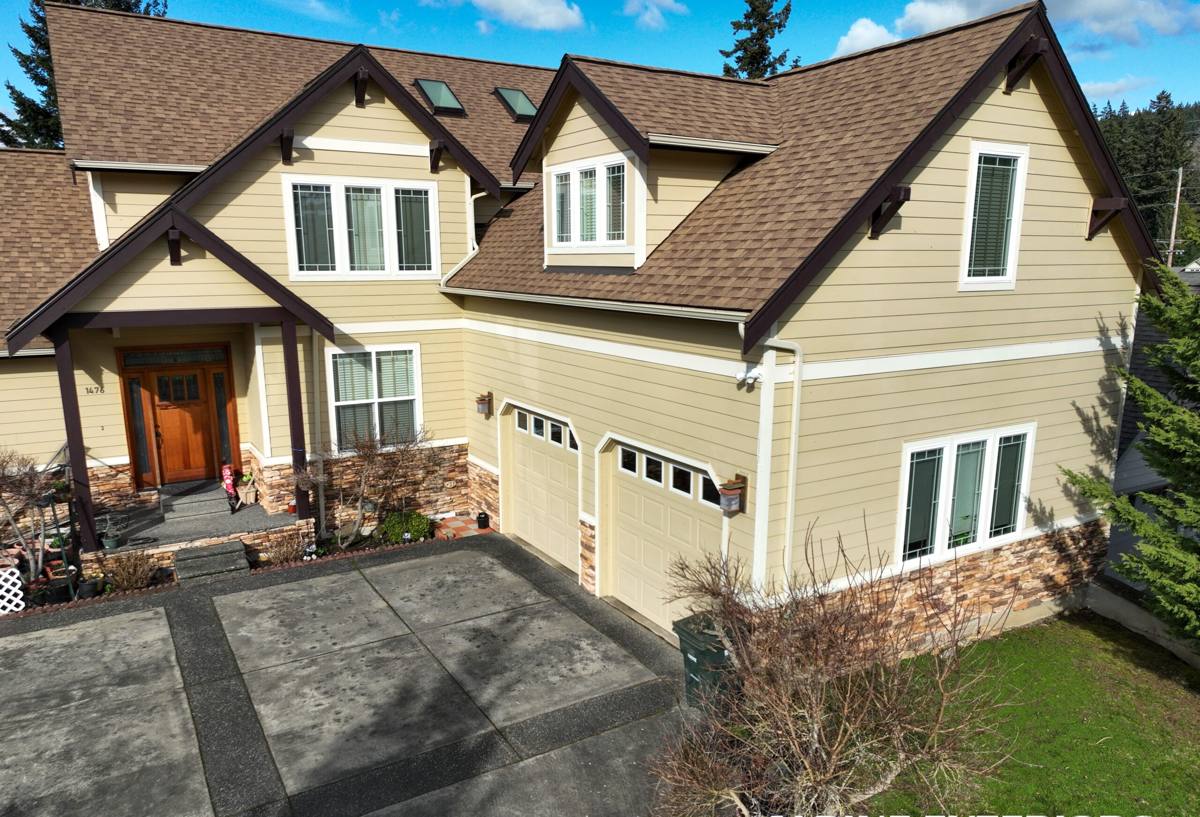
What a Correct Siding Installation Requires in This Environment
The material you choose matters, but the installation details matter just as much — arguably more, since even a top-tier product will underperform if it's put on wrong. For a West Beach home, we treat the following as non-negotiable:
- A continuous, properly lapped water-resistive barrier (WRB) behind the siding, with all seams taped
- Correct head, side, and sill flashing at every window and door opening, integrated with the WRB — not caulked over as an afterthought
- A drainage gap (rainscreen or furring strip approach) where wall orientation and exposure call for it, so any moisture that gets behind the cladding can drain and dry
- Fasteners rated for coastal/corrosive exposure, driven to the manufacturer's spec — not just "close enough"
- Proper clearance at grade, decks, and roof-to-wall intersections so siding never sits in standing water or snow
- Factory-finished panels wherever possible, to reduce reliance on field-applied paint holding up against salt air
Skip any one of these on a West Beach lot and you're building in a failure point that the climate will find within a few years, not a few decades.
Why We Install Only James Hardie Fiber Cement
We've made a deliberate decision to install one product line — James Hardie fiber cement — and to turn down jobs where a homeowner wants vinyl, LP SmartSide, Cemplank, Allura, or bare cedar and primed spruce instead. That's not brand loyalty for its own sake; it's what we've concluded actually holds up to the conditions this stretch of Orcas Island produces.
Fiber cement is non-combustible, which matters on an island where wildfire risk and insurance underwriting both factor into exterior material decisions. It doesn't absorb water the way wood substrates can, so it isn't the moss and rot magnet that untreated or lightly primed wood siding becomes in a shaded, damp environment. And unlike vinyl, it doesn't go brittle and crack in a cold snap or warp and gap as it expands and contracts with temperature swings — movement that becomes very visible on a wall that's already fighting driving rain.
Hardie's ColorPlus factory finish is baked on and warrantied against fading and peeling, which takes the weakest link — field-applied paint fighting salt air — mostly out of the equation. Their HZ product lines are engineered specifically for climate zones like ours, with moisture and freeze-thaw performance built into the formulation rather than bolted on after the fact.
What We're Honest About
Fiber cement is heavier and less forgiving to install than vinyl or LP — it requires correct fastening, proper joint treatment, and installers who know the product. It also costs more up front than vinyl. We think that trade-off is worth it for a house that's going to sit exposed to West Beach conditions for the next 30-plus years, but it's a real trade-off, and we'd rather say so than oversell it.
Siding Material Comparison for This Climate
| Material | Salt air / corrosion resistance | Moisture & moss resistance | Finish durability |
|---|---|---|---|
| James Hardie fiber cement | Strong — non-combustible, stable substrate | Strong — doesn't absorb and swell like wood | Factory ColorPlus finish, warrantied against fade/peel |
| Vinyl siding | Moderate — can chalk and become brittle over time | Fair — moisture can get trapped behind panels if installed loosely | Color molded through material but fades; can warp with heat/cold cycling |
| LP SmartSide (engineered wood) | Fair — wood-based substrate more sensitive to moisture intrusion | Fair — needs strict edge sealing and maintenance to avoid swelling | Factory finish available but wood core is the weak point if breached |
| Cedar / primed spruce | Weak without diligent upkeep | Weak in shaded, damp spots — prone to moss and rot | Field-applied finish needs recoating every few years |
Our Installation Process for West Beach Homes
The steps themselves aren't unique to this neighborhood, but the details we pay closest attention to are shaped by what we've seen fail on comparable water-facing lots.
- On-site assessment — we look at wall orientation, existing moisture damage, roof-wall intersections, and how much direct wind and rain exposure each elevation actually gets, since it's rarely uniform on a single house.
- Tear-off and substrate check — old siding comes off and we inspect sheathing for rot or hidden water damage before anything new goes on. This is where problems that caused the original siding to fail usually show up.
- Water-resistive barrier and flashing — a fully lapped WRB goes on first, followed by correct flashing at every penetration, integrated shingle-style so water sheds outward and down, never behind the barrier.
- Drainage plane — on exposures that need it, we install furring or a rainscreen system so trapped moisture has somewhere to go besides the wall cavity.
- Hardie panel or plank installation — installed to manufacturer spec for fastener type, spacing, and clearance, with corrosion-resistant fasteners throughout.
- Trim, caulking, and touch-up — factory-finished pieces need minimal field paint, which we reserve for cut edges and touch-up only, using products rated for the exposure.
- Final walkthrough and cleanup — we check clearances at grade and decks, confirm flashing details visually, and haul away debris.
Cost Factors on a West Beach Job
Every quote is specific to the house, but the variables that most often move the number on a waterfront lot in this area are the same ones worth asking any contractor about up front.
| Factor | Why it affects cost |
|---|---|
| Substrate condition under old siding | Rot or hidden water damage found at tear-off means added repair before new siding can go on |
| Wall orientation and exposure | Elevations facing prevailing wind and rain may need a drainage plane or heavier flashing detail |
| Access and site logistics | Steep lots, limited staging area, and ferry-dependent material delivery all factor into scheduling and cost |
| Panel vs. lap siding profile | Different Hardie profiles and trim packages carry different material and labor costs |
| Window and door count | Each opening needs correct flashing integration, which adds labor time regardless of material |
Maintenance in a Salt Air, High-Moss Environment
Fiber cement asks for less upkeep than wood or vinyl, but "less" isn't "none." A simple annual routine goes a long way toward protecting the investment:
- Rinse salt residue off exterior walls once or twice a year, especially on the most exposed elevations
- Keep gutters clear so overflow doesn't run down and pool against the siding at corners
- Trim back vegetation and tree cover where it's keeping a wall section shaded and damp longer than the rest of the house
- Check caulking at trim joints and penetrations annually and touch up before gaps let water behind the cladding
- Watch for moss starting at the bottom courses or in shaded corners and address it early with a gentle wash rather than pressure that can drive water behind panels
Why a Crew That Already Works West Beach Matters
Orcas Island logistics aren't like mainland logistics. Materials come over on the ferry, weather windows for exterior work can close fast when a storm system moves through San Juan County, and a crew that hasn't worked this specific stretch of coastline can underestimate how much wind and rain exposure a given wall actually sees. We schedule material deliveries and installation phases around ferry timing and seasonal weather patterns as a matter of course, because we've done it enough times on this island to know where the surprises usually hide — a soft spot in sheathing behind old siding, a flashing detail that was never done right the first time, a wall that gets far more wind-driven rain than its compass direction alone would suggest.
That local familiarity is also why we're comfortable being direct about what doesn't belong on a West Beach house. We'd rather tell a homeowner honestly that a cheaper material will need real upkeep — or won't hold up at all — than install it and let the climate prove us right a few years down the road.
Signs Your Current Siding Is Already Losing the Fight
If your home is on or near West Beach, a few warning signs are worth walking your exterior for before winter storm season sets in:
- Soft or spongy spots when you press on the siding, especially near the bottom courses or under windows
- Persistent moss or dark streaking on north- and west-facing walls that comes back quickly after cleaning
- Peeling, chalking, or bubbling paint, particularly on wood or older vinyl siding
- Visible gaps or warping at panel seams, which often means fasteners or the panels themselves have moved
- Interior signs — musty smell, staining, or soft drywall near exterior walls — that can point to moisture already getting behind the cladding
Catching these early usually means a repair; catching them late usually means a full replacement, so it's worth a look before the wet season is in full swing.
If you're weighing a siding replacement or repair on a West Beach property, we're glad to walk the exterior with you, point out what we see, and put together a straightforward, no-pressure estimate — no obligation either way.