 Orcas Island
 Rosario's Exposure Is Different From "Typical" Pacific Northwest
Rosario sits on the water side of Orcas Island, facing Rosario Strait, which means homes here take a steadier beating than siding a few miles inland ever sees. It isn't one bad storm a year — it's a slow, constant combination of three things working on the same wall: salt-laden air moving off the water, driving rain that hits siding at an angle instead of falling straight down, and a long moss season where surfaces stay damp for weeks at a stretch between dry spells. Any one of those is manageable. Together, they're what actually shortens the life of siding out here.
Salt air is corrosive to exposed metal fasteners and trim, and it accelerates the breakdown of coatings that weren't built to shed it. Driving rain finds every gap in flashing and caulk that a calmer climate would never expose. And moss doesn't just sit on the surface — it holds moisture against the siding face long after the rain has stopped, which is exactly the condition that causes rot, paint failure, and swelling in materials that aren't dimensionally stable. San Juan County's marine climate is mild in temperature, but "mild" doesn't mean easy on a house. It means damp, and damp for a long time is the harder problem to solve.
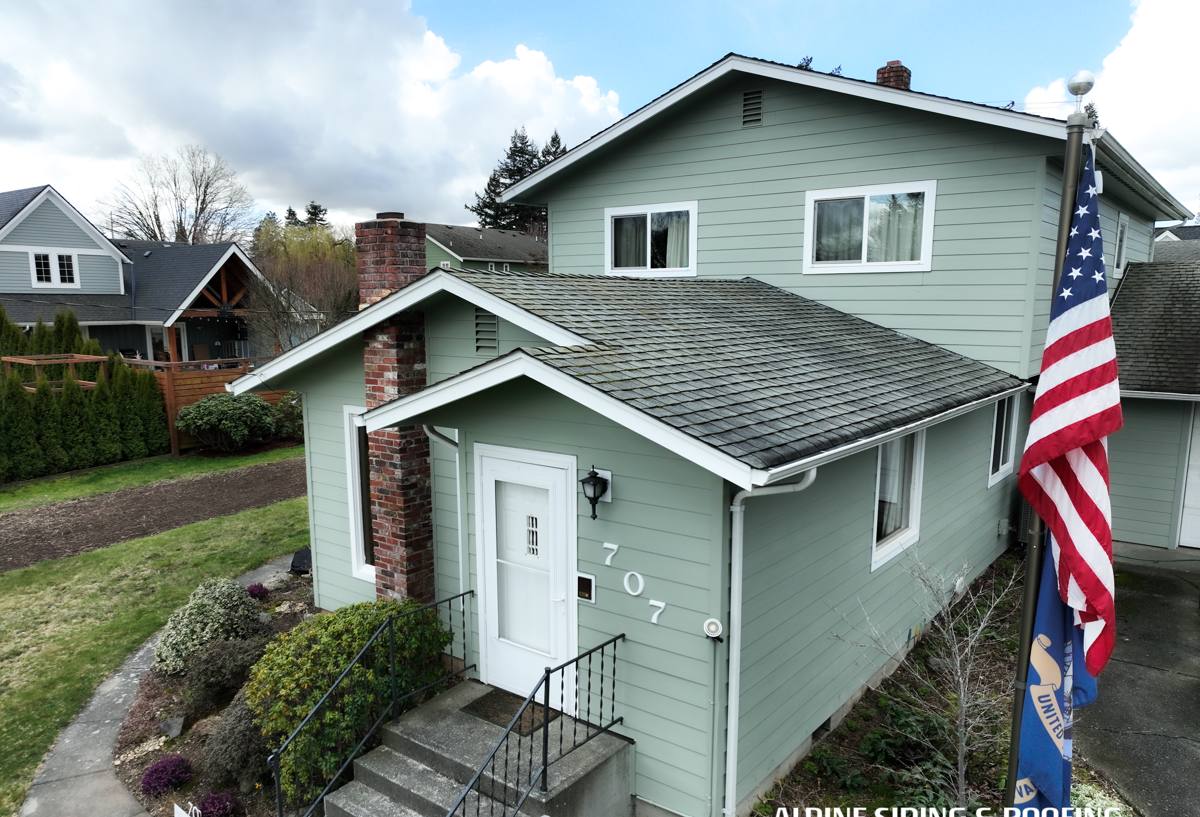
Why Fiber Cement Is the Right Call for This Site
It Doesn't Rot, Swell, or Feed Moss the Way Wood-Based Products Do
James Hardie fiber cement is cellulose fiber reinforced cement — not wood pulp, not wood strand, not a wood product with a coating over it. That distinction matters directly in Rosario's climate. Products with a wood or wood-fiber core can absorb moisture at cut edges and fastener penetrations, and once that moisture is in, the material swells, the paint bond fails, and rot follows. Fiber cement doesn't have that failure path. It's dimensionally stable wet or dry, which is exactly what you want on a wall that spends a good part of the year damp.
Non-Combustible Where Wildfire Risk Is Part of the Conversation
San Juan County isn't immune to wildfire risk, and fiber cement's non-combustible rating is a real advantage over wood-based and vinyl products, which either burn or deform under heat. It's not the main reason we chose Hardie, but it's a legitimate reason we didn't choose the alternatives.
Factory-Applied Finish Instead of a Field-Applied One
ColorPlus finish is baked on at the factory under controlled conditions, not brushed or sprayed on-site in whatever weather Orcas Island gives us that week. That finish is engineered to resist UV fading and hold up under repeated wet-dry cycling — which is the exact stress pattern a moss season creates. A field-applied coating on a humid, salt-air site is fighting the climate from day one; a factory finish already accounted for it.
What "Installed Correctly" Actually Means Here
Fiber cement's reputation is only as good as the installation behind it. Most of the siding failures we get called out to look at aren't a material problem — they're a flashing, clearance, or fastening problem that let water in behind a perfectly good product. In a climate like Rosario's, those details aren't optional extras. They're the whole job.
- Correct clearance from grade, roof lines, decks, and patios — Hardie's minimum clearances exist specifically to keep splash-back and standing moisture off the bottom edge of the panel
- Rain-screen or proper drainage plane behind the siding so incidental moisture has somewhere to go instead of sitting against the wall assembly
- Flashing at every window, door, and penetration, lapped correctly so water sheds outward and down, never inward
- Fasteners driven to Hardie's specified depth and pattern — overdriven or underdriven fasteners are one of the most common causes of early failure
- Factory-cut edges used wherever possible, and any field cuts sealed per manufacturer spec so raw edges aren't left exposed to weather
- Caulking only where Hardie specifies it — not everywhere, since over-caulking can trap moisture just as easily as under-caulking lets it in
Every one of those items is inspectable. If a crew can't walk you through why they did each one on your house, that's worth asking about before they start, not after.
Choosing the Right Hardie Product for This Site
James Hardie engineers its HZ product lines by climate zone, and homes along Orcas Island's exposed shoreline sit squarely in the zone built for high-moisture, high-humidity conditions. That's not a marketing distinction — the formulation and finish are tuned differently for a wet marine climate than for a dry inland one. We spec the product line to match the site, not the other way around.
| Product | Best Use on This Site | Why It Fits Rosario's Exposure |
|---|---|---|
| HardiePlank lap siding | Most wall areas, standard homes and additions | Traditional look, proven track record in wet coastal exposure, wide color range |
| HardiePanel vertical siding | Accent walls, gables, modern or shed-style homes | Fewer horizontal laps means fewer water-entry points on wind-driven rain faces |
| HardieTrim boards | Corners, fascia, window and door trim | Matches the wall system's moisture behavior instead of mixing in a wood trim that ages differently |
| HardieSoffit panels | Eaves and overhangs | Resists the moss and mildew staining that shaded, damp soffits are prone to here |
How Our Process Works, Start to Finish
We keep the process the same whether it's a full re-side or a targeted repair, because skipping steps is how moisture problems get sealed in behind new siding instead of solved.
- On-site assessment — we look at the existing siding, wall assembly, and specifically the areas most exposed to wind-driven rain off the water
- Moisture and substrate check — any soft sheathing, rot, or prior water intrusion gets identified and repaired before new siding goes on, not covered up
- Drainage plane and flashing plan — we plan window, door, and penetration flashing details before the first panel is cut
- Installation to Hardie spec — correct clearances, fastening, and joint treatment, with attention to the site's specific exposure direction
- Final inspection and touch-up — cut edges sealed, caulking checked, and a walkthrough so you know what was done and why
Why a Crew That Already Works Rosario Matters
Siding work on Orcas Island isn't the same logistical job as siding work on the mainland. Material and crew scheduling has to account for ferry timing, and a crew that already builds Rosario and the surrounding island into its regular route isn't improvising that on your project — it's already part of how the job gets planned. That matters for keeping a project moving instead of stalling because a delivery missed a sailing.
It also matters for the work itself. A crew that's done siding up and down this stretch of coastline has already seen which walls take the worst of the wind-driven rain, where moss builds up fastest, and which older installation shortcuts tend to fail first in this specific exposure. That's not something you get from a general contractor doing their first island job — it's pattern recognition built from repetition on this exact climate. We also know San Juan County's permitting expectations for exterior work, so that part of the project isn't a surprise partway through.
Living With Fiber Cement Through a Moss Season
Correctly installed Hardie siding is low-maintenance, but "low" isn't "none," especially here. A yearly rinse-down to clear moss, pollen, and salt residue before it builds up keeps the ColorPlus finish looking like it did the day it went on. Keep an eye on gutters and downspouts feeding water away from the wall rather than down it, and keep vegetation trimmed back so walls get some airflow and sun exposure between rains — moss thrives in the shaded, still-air corners of a property more than anywhere else. None of this is heavy upkeep; it's the difference between siding that still looks new at year fifteen and siding that looks tired at year five.
What Siding Work Tends to Cost in This Area
Every home is different, but these are the factors that actually move the number on a Rosario-area project:
| Factor | Why It Affects Cost |
|---|---|
| Removal of existing siding | Tear-off and disposal adds labor, especially if hidden moisture damage is found underneath |
| Substrate repair | Rotted sheathing or framing found during removal has to be fixed before new siding goes on |
| Product mix | Lap siding, panel siding, trim, and soffit each price differently and most homes use a combination |
| Home accessibility | Ferry-dependent delivery and staging on a tight or waterfront lot can affect scheduling and logistics |
| Wall complexity | Multiple gables, dormers, and cutouts take more time per square foot than a simple rectangular wall |
We give you a real number after seeing the house, not a phone-quote guess — too much of what drives cost here only shows up on-site.
Before You Hire Anyone for Siding Work Out Here
- Ask what happens to soft or rotted sheathing if it's found during tear-off — a real plan should already exist, not get figured out mid-project
- Ask which Hardie product line and HZ formulation they're specifying, and why for your specific exposure
- Ask how they handle flashing at windows and doors — this is the detail that separates a durable installation from one that fails in five years
- Ask whether their crew and material schedule already accounts for ferry logistics, or if that's new territory for them
- Ask for the manufacturer warranty terms in writing, including what voids it — installation errors are the most common reason a warranty claim gets denied
If you're weighing a re-side or repair on Rosario or elsewhere on Orcas Island, we're happy to take a look and give you a straight, no-pressure estimate — no guesswork, no upsell, just what your house actually needs.