 Orcas Island
 Building New in North Beach: Windows Are Not an Afterthought
If you're framing a new home on Orcas Island's North Beach side, the windows are one of the few components that have to perform two jobs at once: keep the house dry for the next 30-plus years, and keep the water management systems built into the walls actually working. On a new build, this is your one real chance to get it right at the source. Once siding, trim, and interior finishes are closed up around a window opening, correcting a bad flashing detail means tearing into finished work — which is exactly the situation retrofit and repair calls come from years later.
North Beach sits close enough to the water that salt-laden air, wind-driven rain, and a long, damp moss season are just part of building here. A window package that would be fine in a drier inland part of San Juan County can underperform on this side of the island if it isn't chosen and installed with those conditions in mind.
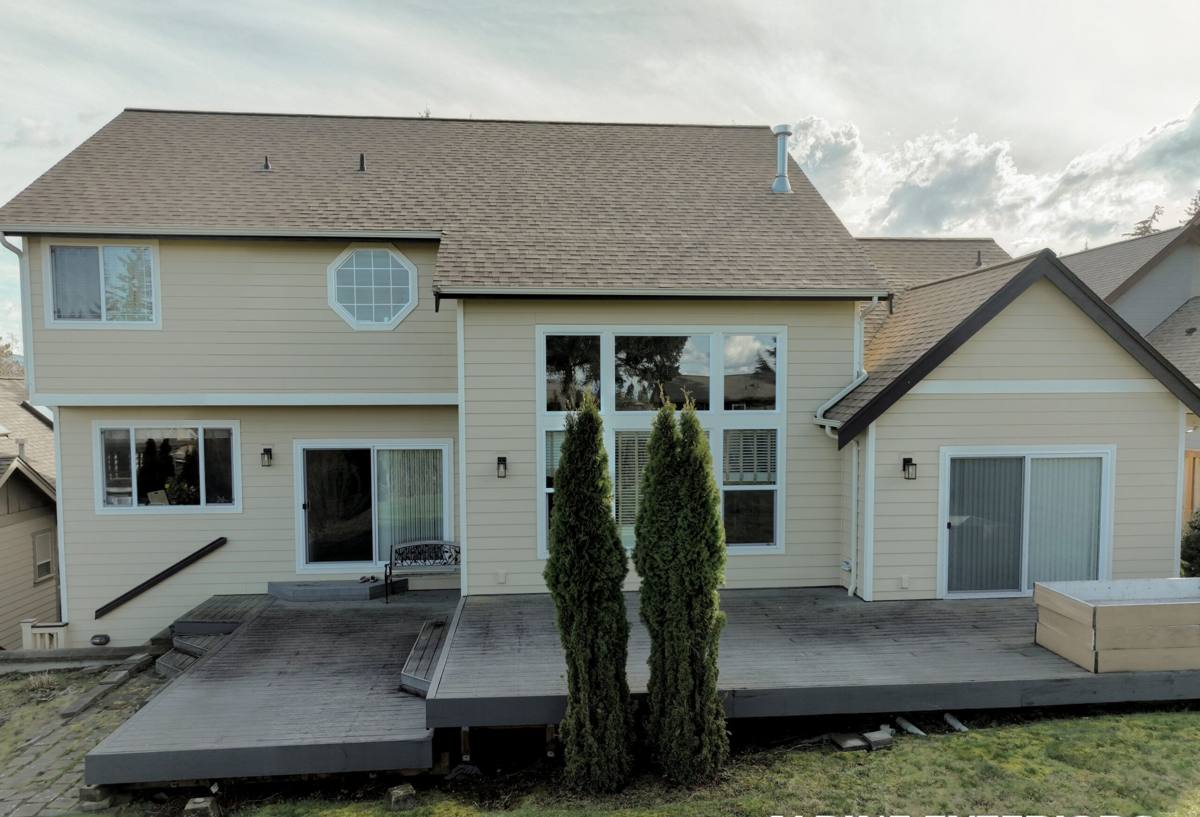
What San Juan County's Climate Actually Does to a Window Assembly
Salt air and hardware
Marine air corrodes exposed fasteners, weep hole screens, and lower-grade cladding over time. It's slow and easy to ignore for the first few years, then shows up as staining, stuck operators, or pitted hardware right when a window is otherwise still serviceable.
Driving rain
Wind off the water doesn't just fall — it pushes rain sideways into wall assemblies. A window that's watertight in a still-air test can still leak on this coastline if the flashing, sill pan, and weather-resistive barrier integration aren't detailed for wind-driven water, not just gravity drainage.
Moss and prolonged moisture
The long wet season here means anything that traps moisture against wood — a poorly lapped flashing, a missing sill pan, a caulk-only seal — has months to do damage before a dry stretch shows up to help it out. Moss and algae growth on sills and trim are also a sign that water is sitting somewhere it shouldn't.
New-Construction Windows vs. Retrofit — Why the Distinction Matters
New-construction windows have a nailing flange designed to be integrated directly into the wall's weather-resistive barrier before siding goes on. That's a real advantage on a new build: the flashing and drainage plane can be built correctly around the window from the start, instead of working around existing siding and trim the way a retrofit install has to.
The trade-off is that a new-construction window is only as good as the sequence it's installed in. Flange windows depend on the WRB, flashing tape, and sill pan being layered in the right order — house wrap under the sides and top, over the bottom flange, with flashing tape lapped shingle-style so water sheds outward at every layer. Get that sequence backward and you can end up with a window that looks fine on install day but directs water into the wall over time.
Choosing a Window Package for a North Beach Build
Frame material matters more on this coastline than it does further inland. Here's how the common options generally compare for a marine, high-rain environment:
| Frame Material | Coastal / Salt-Air Behavior | Maintenance | Typical Fit |
|---|---|---|---|
| Vinyl | Good corrosion resistance; can look dated on higher-end new builds | Low | Value-focused builds, secondary structures |
| Fiberglass | Excellent — dimensionally stable, doesn't corrode or rot | Low | Full-time coastal exposure, long-term ownership |
| Wood interior / clad exterior | Depends entirely on cladding integrity — any breach exposes wood to moisture | Higher — cladding and sealant joints need periodic checks | Homes prioritizing interior wood aesthetics |
| Aluminum | Strong but conducts cold and can corrode without proper coatings | Moderate | Large glass openings, contemporary designs |
None of these is automatically wrong for North Beach — the right call depends on the home's design, budget, and how exposed the specific elevation is to wind and salt spray. We'll walk through the honest trade-offs for your specific lot rather than push one product line.
Glass and performance specs worth asking about
- Low-E coated, argon-filled double or triple glazing for insulation value in our shoulder-season swings
- A Design Pressure (DP) rating matched to the wall's wind exposure, not just a generic "standard" window
- Weep systems that are actually functional, not decorative — check that weep holes aren't painted or caulked shut
- Corrosion-resistant hardware and fasteners, given the salt air
Our New-Construction Installation Process
- Rough opening check: confirm the opening is square, level, and sized correctly before a window ever shows up on site.
- Sill pan flashing: a sloped, sealed pan under every opening so any water that gets past the window drains back out, not into the framing.
- WRB integration: house wrap or building paper lapped correctly with the window flange — sides and head over the barrier, sill flange under it.
- Flashing tape, shingle-lapped: every layer overlaps the one below it so water is always shed outward and downward.
- Shimming and fastening: the unit is shimmed plumb and square at all four sides before it's fastened, so it operates smoothly for the life of the house.
- Interior and exterior sealant: backer rod and sealant at the right joints — sealing every gap solid can actually trap moisture, so this step is done selectively, not blanket-caulked.
- Final operation and water test: we check that every window opens, closes, and locks properly, and that the assembly sheds water as designed before we call it done.
The Flashing Details That Actually Prevent Problems
Most window leaks we get called out to inspect on existing homes trace back to one of a few things: no sill pan, house wrap lapped backward, or a bead of caulk used to compensate for a flashing step that got skipped. On a new build, none of that has to happen, because the sequence can be built correctly the first time. This is the single biggest reason new construction is worth doing right — you're not fighting existing conditions, you're setting the standard the house will live with for decades.
It's also why we don't treat window installation as a quick trade stop between framing and siding. The sequencing has to be coordinated with whoever is running the WRB and siding, so the layers actually integrate instead of just sitting next to each other.
What Drives Cost on a New-Construction Window Package
| Factor | Why It Moves the Price |
|---|---|
| Frame material | Fiberglass and clad-wood run higher than vinyl; performance and longevity trade against upfront cost |
| Window size and count | Large openings and full walls of glass need higher DP ratings and often structural support |
| Exposure of the elevation | Sides facing open water or prevailing wind may warrant upgraded flashing details or higher-spec units |
| Glass package | Triple glazing and specialty coatings add cost but pay back in comfort and condensation control |
| Access and site logistics | Ferry scheduling and site access on Orcas Island can affect delivery timing and labor efficiency |
We're happy to walk through actual numbers for your project once we know the window count, sizes, and the elevations involved — broad online estimates rarely reflect what a specific North Beach lot needs.
A Checklist for Vetting Who Installs Your Windows
- Do they install a true sill pan flashing on every opening, not just caulk and hope?
- Can they explain their WRB lap sequence without hesitating?
- Are they licensed and insured to work in Washington State?
- Do they coordinate directly with your siding and WRB installer, or work in isolation?
- Will they stand behind the installation in writing, separate from the manufacturer's product warranty?
- Have they installed windows on other San Juan County or coastal projects before?
Why Local Experience on North Beach Specifically Matters
A crew that's worked on North Beach knows how exposed a given elevation tends to be, how the moss season affects timing and drying between steps, and what installation details hold up against wind-driven rain year after year. That's not something you can substitute with a generic install guide — it comes from having done this work on this stretch of Orcas Island and having gone back to see how it held up. Getting the flashing and drainage details right the first time, on a new build, is the difference between a window package that quietly does its job for decades and one that starts causing problems in a few wet winters.
If you're planning a new build on North Beach and want to talk through window options, sequencing with your other trades, or a straight-up cost range for your specific plans, reach out for a free, no-pressure estimate using the form below.