 Orcas Island
 Why North Beach Homes Take a Different Kind of Beating
Homes along North Beach sit in one of the more exposed pockets of Orcas Island. Walls facing open water take direct salt spray carried on the wind, and the same exposure that gives these homes their view also means driving rain gets pushed sideways into seams, trim joints, and anywhere a wall isn't detailed correctly. Add San Juan County's long, damp shoulder seasons and the result is siding that has to handle constant moisture cycling, not just an occasional storm.
Salt Air Doesn't Just Affect the Finish
Airborne salt is corrosive to metal fasteners, flashing, and hardware, and it accelerates the breakdown of paint films that aren't formulated to resist it. On a lot of homes we look at, the siding itself is still structurally fine, but the fasteners or field-applied paint failed years before the substrate did. Any material choice for a home in this exposure has to account for what salt air does to every component, not just the panel or plank itself.
Moss Season Is Longer Here Than People Expect
North Beach's tree cover and shaded, north-facing walls hold moisture far longer than a south-facing wall in full sun. That's what feeds moss and algae growth through the wet months. Moss itself isn't usually what destroys siding — it's what moss indicates: a surface staying damp long enough for water to find its way into seams, fastener holes, or unsealed end cuts. Wood-based sidings are especially vulnerable here because they absorb that moisture instead of shedding it.
Why We Only Install James Hardie Fiber Cement
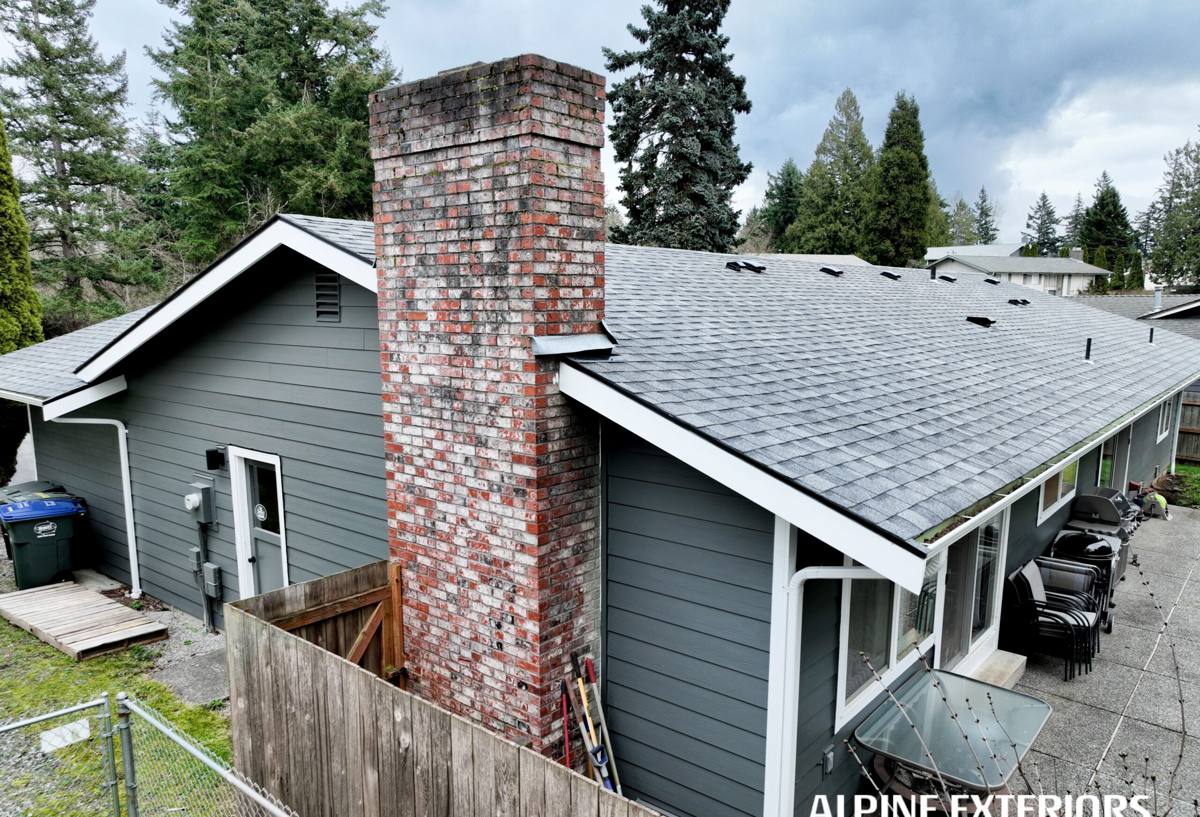
We made a standing decision to install James Hardie exclusively — no vinyl, no LP SmartSide, no cedar, no primed spruce. Fiber cement is made from cement, sand, and cellulose fiber, which makes it dimensionally stable and non-combustible, and it doesn't absorb and swell with moisture the way wood-based products do. For a home taking on salt spray and wind-driven rain for months at a stretch, that difference in how the material handles water is the whole ballgame.
ColorPlus Factory Finish
Most of what we install uses Hardie's ColorPlus finish — a coating baked on at the factory under controlled conditions, rather than sprayed or brushed on site. In a marine climate, field-applied paint tends to chalk and fade faster than a factory finish holds up, which means more frequent repainting. ColorPlus is backed by its own finish warranty and holds color and sheen noticeably longer under the kind of UV and salt exposure North Beach gets.
Climate-Engineered Product Lines
James Hardie engineers its plank and panel lines for different climate zones — the HZ5 line, for example, is formulated for wetter, more humid regions like the Pacific Northwest. Choosing and detailing the right product line for this specific exposure is part of what a correct install looks like here; it's not a one-size-fits-all product even within the Hardie lineup.
What a Correct Installation Actually Requires
The material only performs as well as the install behind it. A Hardie board installed without proper drainage detailing will still trap water and fail early — the product doesn't overcome bad workmanship. This is where most siding problems on exposed homes actually start.
Drainage Plane and Rainscreen Gap
Wind-driven rain will find its way past the outer siding layer eventually — that's true of any cladding. What matters is whether the wall assembly behind it lets that moisture drain and dry out. A properly installed weather-resistant barrier, and in many cases a rainscreen furring gap behind the siding, gives water a path out instead of a place to sit against the sheathing.
Flashing at Every Transition
Water finds its way in at joints — window and door trim, butt joints between boards, roof-to-wall transitions. Correct flashing at every one of those points, including kick-out flashing where a roofline meets a wall, is what actually keeps water out of the wall cavity. This is detail work that doesn't show up in a finished photo but determines whether the siding lasts fifteen years or fifty.
Fastening for Coastal Exposure
Fastener spacing, embedment depth, and corrosion resistance all matter more here than in a drier inland install. Overdriven nails crack the fiber cement at the fastener point and create a spot for water to enter; the wrong fastener material corrodes faster in salt air and can eventually stain or fail. This is a case where following Hardie's fastening schedule to the letter, not just "close enough," is what protects the wall long term.
Comparing Siding Materials for This Exposure
Every siding material has real strengths. The table below is a straightforward look at how the common options hold up specifically against salt air, sustained moisture, and moss-prone shade — the conditions North Beach homes actually deal with.
| Material | Salt Air / Moisture Resistance | Moss & Algae Resistance | Maintenance Here | Typical Lifespan in This Climate |
|---|---|---|---|---|
| James Hardie fiber cement | Strong — doesn't absorb moisture or swell | Good; smooth ColorPlus surface sheds moisture | Occasional rinse, caulk checks | 30+ years with correct install |
| Vinyl | Doesn't rot, but can warp/fade under UV and salt cycling | Moderate | Low, but seams and edges can loosen over time | 15–25 years, exposure-dependent |
| Cedar / wood | Absorbs moisture; needs sealed finish maintained regularly | Poor without frequent treatment | High — refinishing on a repeating cycle | 10–20 years without diligent upkeep |
| Engineered wood (LP-type) | Vulnerable at cut edges and joints if moisture gets in | Moderate | Moderate — edge sealing and inspection matter | Varies widely by install quality |
How We Approach a North Beach Project
We start with an on-site walk of the exterior, paying particular attention to which walls face open water or catch the prevailing wind, where existing moisture damage or moss buildup is showing, and what condition the sheathing is likely in underneath the current siding.
Working Around Island Logistics
Material deliveries, crew scheduling, and even weather windows work differently on Orcas Island than on the mainland. Ferry schedules affect when materials and equipment arrive, and we plan install sequencing so exposed wall sections aren't left open during a stretch of driving rain. A crew that's worked North Beach before already accounts for this in the timeline instead of discovering it mid-project.
The Install Sequence
- Remove existing siding and inspect the sheathing underneath for rot or hidden moisture damage
- Repair or replace any compromised sheathing before anything new goes up
- Install the weather-resistant barrier and rainscreen furring where called for
- Install and flash trim, window and door surrounds, and roof-to-wall transitions
- Install James Hardie planks or panels per the manufacturer's climate-zone nailing and clearance specifications
- Caulk and touch up with Hardie-approved products at every seam and fastener point
Living With It: Maintenance in a Salt-Air, Moss-Prone Climate
James Hardie siding installed correctly needs far less upkeep than wood-based alternatives, but "less" isn't "none." A few habits go a long way toward getting the full lifespan out of the material in this exposure:
- Rinse salt spray and airborne grime off exterior walls once or twice a year with a garden hose
- Keep gutters and downspouts clear so roof runoff isn't sheeting down over siding it wasn't meant to see
- Trim back branches and vegetation that shade walls and keep them damp longer than they need to be
- Check caulking at trim, window, and door joints annually and re-caulk any spots that have cracked or pulled away
- Deal with moss on roofs, decks, or nearby surfaces promptly, since spores spread to adjacent siding
- Touch up any nicks or scratches with Hardie touch-up paint before a bare edge sits exposed through a wet season
Why a Crew That Already Works This Neighborhood Matters
A siding crew that's worked North Beach before already knows which wall orientations take the worst weather, what tends to fail first on island homes versus mainland ones, and how to sequence a job around ferry schedules and weather windows without the project stalling out. That familiarity shows up in fewer surprises once tear-off starts.
Permitting in San Juan County
Siding replacement projects often require a permit through San Juan County, and the requirements can depend on the scope of work involved. A crew that regularly works on the island already knows the process and builds it into the timeline instead of treating it as an afterthought.
What Drives the Cost
Every North Beach quote is scoped around a few honest variables: whether the sheathing underneath is sound or needs repair once the old siding comes off, whether trim and fascia are being replaced along with the field siding, the home's size and number of stories, and how accessible the walls are for staging and installation. We won't know the real number until we've actually looked at the wall assembly — anyone quoting a firm price before that step is guessing.
If you're planning a siding project on North Beach, we're happy to walk the exterior with you and give you a straightforward, no-pressure estimate — including what we find once we look past the surface. Use the form below to get started.