 Orcas Island
 A deck on Lopez Island has a harder job than a deck almost anywhere inland. It's not just outdoor living space — it's a structure sitting outside, exposed to salt-laden marine air, wind-driven rain off the water, and a moss season that can run most of the year on shaded sides of a property. We build custom decks for homeowners across San Juan County, and Lopez Island jobs get planned with that specific climate in mind from the first site visit, not treated as an afterthought once the framing's already up.
This page walks through what actually matters when you're planning a custom deck out here: the materials that hold up, the structural details that get skipped on rush jobs, how we approach design and build, and what it takes to keep a deck performing for decades in this environment instead of five or six years.
What Salt Air, Driving Rain, and Moss Actually Do to a Deck
Three things work against an outdoor deck on Lopez Island every year, and they don't act alone — they compound each other. Salt-laden air off the Salish Sea accelerates corrosion on any exposed metal fastener, hinge, or connector, and it breaks down surface finishes faster than an inland site ever would. Storms coming off the water rarely fall straight down; they drive rain sideways into railings, stair stringers, and the ledger connection where a deck meets the house, which is exactly the joint that has to stay watertight for the structure to last. And a lot of Lopez Island properties sit under fir canopy or in shaded, low-sun spots, which keeps deck boards and framing damp long after a storm passes — the exact condition moss and mildew need to take hold.
None of that means a deck can't hold up here. It means the material choices and structural details have to account for sustained moisture exposure and corrosion, not just a Pacific Northwest "it rains a lot" generalization. A deck built the way you'd build one in a drier inland climate will show problems on Lopez Island years before it should.
Where Decks Actually Start to Fail
In our experience, deck failure out here is rarely dramatic. It's usually a slow, localized process — fasteners weep rust stains into the decking around them, a ledger board stays wet behind the siding because it was never properly flashed, or a shaded corner holds moss long enough that the boards underneath stay damp for weeks at a stretch. Caught early, these are simple fixes. Left alone, they become structural problems, especially at the ledger connection and support posts, which is where a deck failure actually matters for safety.
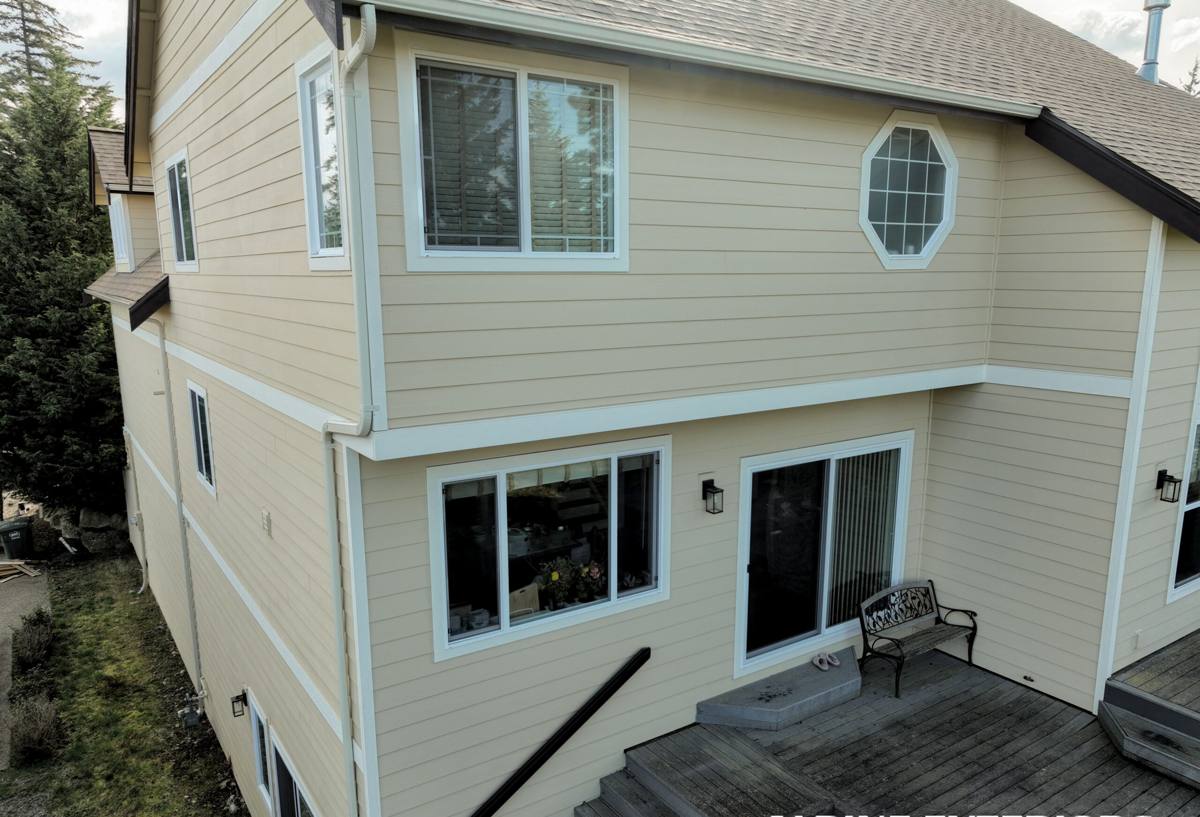
Decking Material Options for This Climate
There's no single "right" decking material for every homeowner, but some hold up to salt air, driving rain, and moss noticeably better than others. Here's how the common options compare for a Lopez Island installation:
| Material | Moisture & salt-air behavior | Maintenance | Typical lifespan here |
|---|---|---|---|
| Pressure-treated lumber | Resists rot when properly sealed; fasteners need to be corrosion-rated | Annual cleaning, resealing every 1-2 years | 10-15 years with upkeep |
| Cedar decking | Naturally decay-resistant but finish breaks down fast in salt air and shade | Cleaning and refinishing every 1-2 years, more on shaded sections | 15-20 years with consistent maintenance |
| Composite decking | Doesn't rot, swell, or feed moss the way wood does; surface can still stay damp longer in shade | Periodic cleaning; no staining or sealing required | 25-30+ years, manufacturer-warrantied |
| PVC decking | Fully synthetic, no organic material for moisture or moss to work into | Lowest maintenance of the group; occasional washing | 25-30+ years, manufacturer-warrantied |
Composite and PVC decking have become the more common choice for Lopez Island homeowners specifically because they remove the recurring refinishing schedule that wood requires — and out here, getting a crew or materials back for touch-up work means working around ferry availability, not just picking a weekend. Wood decking is still a legitimate choice if you want that look and are realistic about the maintenance commitment; we'll build with it if that's what you want, and we'll be straight with you about what it takes to keep it looking right.
What's Underneath Matters More Than What's On Top
Homeowners naturally focus on the decking surface — the color, the board style — but the structure underneath is what determines whether a deck lasts 10 years or 30. A few details we treat as non-negotiable on every job:
- Ledger board flashing that actually sheds water away from the house wall, not caulk alone doing the job
- Joist tape or equivalent protection over framing lumber, so fasteners don't create a direct path for water into the wood
- Corrosion-rated fasteners and hardware throughout — not just at the ledger — given the salt-air exposure
- Footings sized and set to current code for the soil and frost conditions on your specific site
- Proper spacing and airflow underneath the deck so framing can dry out between storms instead of staying damp
- Post-to-beam and beam-to-joist connections using rated structural hardware, not just toe-nailing
A deck can look finished and still have a ledger connection that's slowly rotting the house's rim joist behind the siding, or fasteners that are already streaking rust two years in. Those are the failures that don't show up on a walk-through — they show up on an inspection, or worse, in a structural problem years later.
Designing a Deck for How Lopez Island Homes Actually Get Used
Beyond materials and structure, a good custom deck design accounts for how the site actually sits — sun exposure, wind direction, and how much of the year a family realistically wants to be outside. A few things we talk through with every homeowner:
Orientation and Coverage
Decks facing open water often take the brunt of wind-driven rain, which makes covered sections or partial roofing worth considering if you want the space usable through more of the year, not just the dry months. Shaded, tree-covered sites need the opposite consideration — more attention to airflow and drainage so moss doesn't take over boards that never fully dry.
Railings and Hardware
Railing systems see constant weather exposure and constant hand contact, so we steer homeowners toward railing materials and hardware rated for coastal, salt-air conditions rather than standard-grade hardware that looks fine in the showroom and starts corroding within a couple of seasons here.
Elevation and Views
A lot of Lopez Island properties are built for the view, which often means a raised or multi-level deck. That changes the engineering — taller support posts, more significant footings, and stair design that has to meet code — so it's worth discussing early, not after a design is already set.
Our Deck-Building Process
We keep the process straightforward and give you a clear picture of what's happening at each stage:
- Site visit and assessment — we look at sun exposure, drainage, existing structure (if it's a rebuild), and how the space will actually be used.
- Design and material selection — we walk through decking, railing, and structural options honestly, including the maintenance trade-offs of each.
- Permitting — San Juan County has its own permitting requirements for deck construction, and we handle that process rather than leaving it to you.
- Framing and structural work — footings, ledger flashing, framing, and all connection hardware, built to hold up to this specific climate.
- Decking, railing, and finish work — installed to manufacturer spec so any product warranty stays intact.
- Final walk-through — we go over the finished deck with you, including what maintenance it does and doesn't need going forward.
Deck Maintenance: What It Actually Takes Here
Whatever material you choose, a Lopez Island deck needs some level of ongoing attention to perform the way it's built to. Realistic upkeep looks like this:
- Clear leaves and debris from between boards regularly, especially in shaded areas where moisture collects
- Wash the deck surface at least once or twice a year to keep moss and mildew from establishing
- Inspect railings, stairs, and connection hardware annually for corrosion or loosening
- For wood decking, plan on resealing or refinishing every 1-2 years, sooner on sun- and salt-exposed sections
- Check that drainage and airflow underneath the deck haven't been blocked by landscaping or storage
- Address any soft spots, rust streaks, or loose fasteners right away rather than waiting for the next visit
Composite and PVC decking cut that list down considerably, which is a big part of why they've become the practical choice for a lot of homeowners out here — less because wood can't work, and more because staying on top of a wood maintenance schedule is genuinely harder when a contractor or materials run means coordinating around ferry access.
Why a Crew That Already Works Lopez Island Matters
Building on Lopez Island isn't the same as building on the mainland, and it isn't quite the same as building on Orcas Island either — materials, equipment, and crew all have to move by ferry, and scheduling has to work around that reality rather than fight it. A crew that already works this area knows how to plan material deliveries and crew time efficiently, understands San Juan County's permitting process for deck construction, and isn't learning island logistics on your project. That matters just as much after the build — if a warranty issue or a repair comes up down the road, you want a contractor who can realistically get back out to your property, not one for whom a follow-up visit is a major undertaking.
It also matters for getting the site-specific details right the first time — how a particular lot's sun exposure, tree cover, or wind exposure should shape material choices and design, rather than applying a generic mainland approach to an island property.
If you're planning a new deck or replacing an aging one on Lopez Island, we're glad to come take a look at your property, talk through material and design options honestly, and give you a straightforward assessment of what your site needs. Reach out for a free, no-pressure estimate.