 Orcas Island
 Roofing on Shaw Island Isn't the Same Job as Roofing Inland
Shaw Island sits in the middle of San Juan County, surrounded by salt water on every side, and that changes what a roof has to survive. A roof system that holds up fine forty miles inland can start failing early out here because of three things working together: constant salt-laden air, driving rain that comes in sideways off the water during winter storms, and a long, shaded moss season that never really ends. None of these problems are dramatic on their own. They're slow. That's what makes them dangerous — by the time a homeowner notices a stain on the ceiling, the underlying deck has often been wet for months.
A correct roof replacement on Shaw Island has to account for all three from the start: material selection that resists salt corrosion, water-shedding details that handle wind-driven rain instead of just vertical rain, and a roof plane that doesn't trap moisture under moss and organic debris. Get those three things right and a roof out here can perform for decades. Get them wrong and you're looking at premature granule loss, rusted fasteners, or rot at the eaves well before the shingles are supposed to be done.
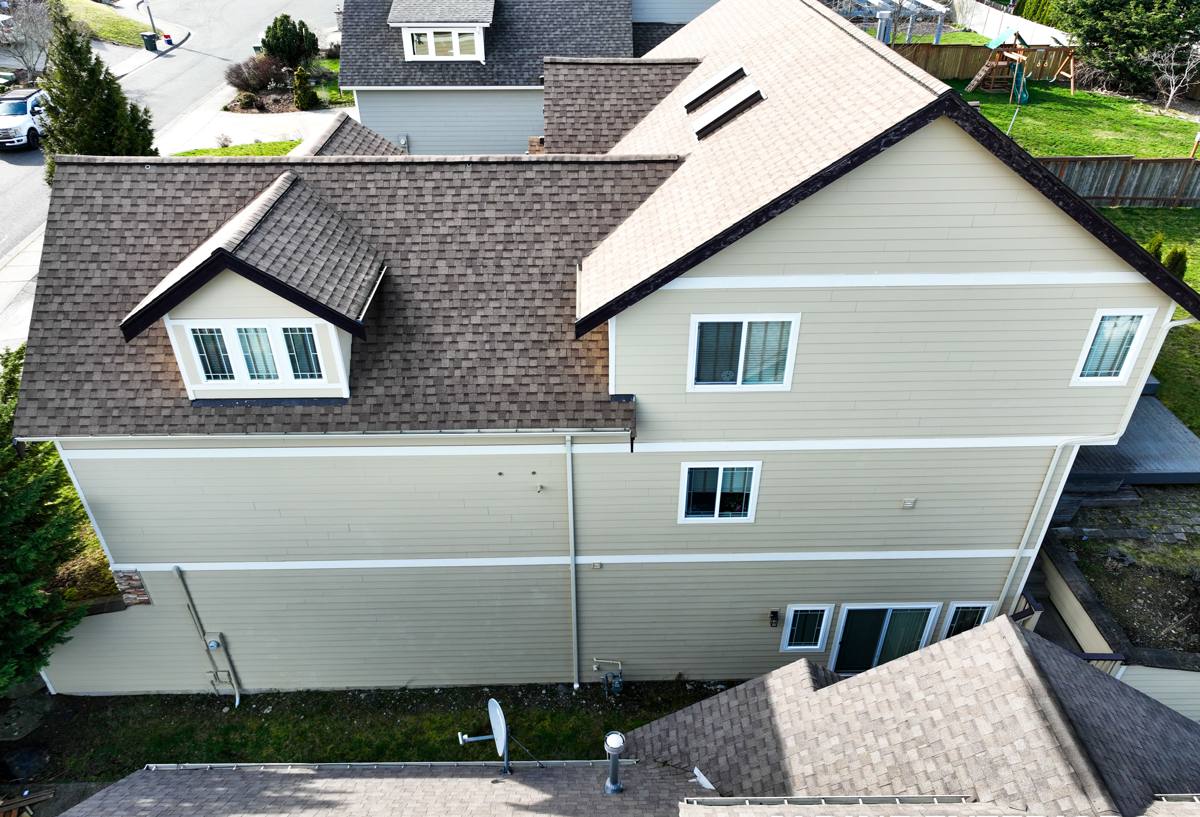
How Salt Air, Rain, and Moss Actually Damage a Roof
Salt Air
Airborne salt settles on every exposed surface and accelerates corrosion on anything metal — nail heads, flashing, drip edge, valley metal, and fasteners. Once corrosion starts on a fastener, it loses holding power long before it looks bad from the ground. This is why fastener and flashing material choice matters more here than in a lot of the county's more sheltered inland lots.
Driving Rain
San Juan County storms often push rain horizontally, not straight down. That means water gets forced up under shingle tabs, into laps that were only designed for gravity-fed water, and around penetrations that would stay dry in a calmer climate. Underlayment coverage and flashing detail at every transition — chimneys, skylights, wall intersections, roof-to-wall step flashing — carry more of the waterproofing load here than they would on a typical inland roof.
Moss and Shade
Shaw Island's tree cover keeps a lot of roof surfaces shaded for large stretches of the day, especially on north-facing slopes. Shade plus moisture is exactly what moss needs. Moss doesn't just sit on top of shingles — its root structure lifts shingle edges and holds water against the roofing surface long after a storm has passed, which shortens the life of the material underneath it.
Signs a Shaw Island Roof Needs Replacement, Not Another Repair
- Granule loss heavy enough that you can see bare, shiny patches on asphalt shingles
- Moss or algae that keeps returning within a season or two of cleaning
- Soft or spongy spots when walking the roof, which usually means the deck underneath has taken on water
- Rust staining running down from nail heads, flashing, or valley metal
- Curling, cupping, or cracked shingles, especially on south- and west-facing slopes exposed to weather off the water
- Daylight visible through the roof deck from the attic, or water stains on attic sheathing
- Multiple past repairs in the same area — a sign the underlying problem was never actually solved
Any one of these on its own might just call for a repair. Several together, especially on a roof that's already in its second half of expected life, usually means repair costs will outpace what a full replacement would have cost.
What a Correct Roof Replacement Actually Involves
Full Tear-Off and Deck Inspection
We remove existing roofing down to the deck rather than layering over old material. That's the only way to actually see the condition of the sheathing, check for soft or delaminated spots, and replace any damaged deck sections before new roofing goes down. Roofing over a compromised deck just hides the problem for another few years.
Moisture Barrier and Underlayment
Given the amount of wind-driven rain Shaw Island sees, underlayment coverage matters as much as the shingle or panel on top. We use synthetic underlayment across the full field and self-adhered ice-and-water membrane at the eaves, valleys, and any low-slope transitions where wind-driven water is most likely to find a way in.
Ventilation
Proper intake and exhaust ventilation keeps the attic space closer to outdoor temperature and humidity, which reduces condensation on the underside of the deck and slows moss growth by keeping the roof surface drier overall. A lot of older San Juan County homes were built with minimal or blocked ventilation, and we address that as part of the replacement rather than leaving it as-is.
Flashing and Roof-to-Wall Details
This is where most leaks actually start, not in the open field of the roof. We replace flashing at chimneys, skylights, dormers, and any wall intersections with new material sized and lapped correctly for the pitch and exposure, rather than reusing old flashing that's already corroding.
Material Installation to Manufacturer Spec
Fastener pattern, nail placement, and exposure all affect wind resistance and warranty validity. We install to the manufacturer's published specification, not a shortcut version, because a roof that's under-fastened or has exposed nail heads is a roof that fails early in exactly the wind-driven conditions common out here.
Choosing a Roofing Material for Shaw Island Conditions
There's no single "best" roofing material for every home — it depends on the home's style, budget, roof pitch, and how much maintenance the owner wants to take on. Here's how the common options actually compare under salt air, driving rain, and moss pressure.
| Material | Salt Air Resistance | Moss Resistance | Maintenance | Notes |
|---|---|---|---|---|
| Architectural asphalt shingle | Good, with corrosion-resistant fasteners | Moderate; benefits from periodic cleaning | Low to moderate | Most common choice; wide range of price points and warranties |
| Standing seam metal | Very good with proper coating/fastener spec | Very good — moss struggles to hold on a smooth panel | Low | Higher upfront cost, long service life, sheds water fast in driving rain |
| Cedar shake | Fair; needs regular treatment | Poor without diligent upkeep | High | Traditional look, but organic material struggles most with this island's shade and moisture combination |
| Composite/synthetic shake | Good | Good | Low to moderate | Mimics wood appearance without the same moisture vulnerability |
We'll walk through which option fits a given roof's pitch, sun exposure, and your maintenance appetite during the estimate — there's no reason to pay for a higher-maintenance material if you don't want the upkeep, and no reason to under-spec a roof that faces the water directly.
Our Process for a Shaw Island Roof Replacement
Getting to the Island
Working on Shaw Island means coordinating crew, materials, and equipment around ferry scheduling, so we plan logistics up front rather than discovering a problem on install day. Materials get staged and confirmed before the crew mobilizes, so once we start, the job runs continuously instead of stalling out waiting on a delivery.
On-Site Assessment
Before we quote anything, we walk the roof (or inspect from the ground and attic when the roof isn't safely walkable) to check deck condition, ventilation, flashing points, and moss or moisture damage. That's what the estimate is actually based on — not a guess from a satellite photo.
Clear, Written Scope
You get a written scope covering material, underlayment, flashing approach, ventilation work, and cleanup — no verbal-only promises. If something changes once tear-off reveals deck damage, we show you before proceeding, not after.
Cleanup and Site Protection
We protect landscaping and driveways during tear-off and do a magnetic sweep for nails and debris before we consider the job finished. On an island where a dumpster trip or supply run means more logistics than it would on the mainland, we plan disposal and cleanup as part of the schedule, not an afterthought.
Living With a New Roof: Moss and Maintenance
A new roof reduces moss pressure but doesn't eliminate it, especially on shaded north slopes common on wooded Shaw Island lots. A few habits keep a new roof performing for its full expected life:
- Keep overhanging branches trimmed back to reduce shade and debris buildup on the roof surface
- Clear gutters and valleys of needles and leaves at least twice a year, since clogged water has nowhere to go but under the shingles
- Have moss or algae growth removed early using methods appropriate to the material — pressure washing is often too aggressive for asphalt shingles and can strip granules
- Schedule a periodic roof check after major windstorms, since driving rain can loosen flashing or debris that isn't visible from the ground
What Affects the Cost of a Shaw Island Roof Replacement
Every roof is different, and we won't quote a number without seeing the actual roof, but the main cost drivers are consistent:
- Roof size and number of planes, valleys, and penetrations
- Pitch and walkability, which affect labor time and safety setup
- Deck condition — how much sheathing replacement is needed once tear-off exposes it
- Material choice, from standard architectural shingle up through standing seam metal
- Ventilation and flashing upgrades needed to bring an older roof up to current standards
- Site logistics specific to island access and material staging
Broadly, a straightforward asphalt shingle replacement runs on the lower end of the range, while standing seam metal or a roof needing significant deck repair runs higher. We'll give you real numbers, not a placeholder estimate, once we've actually looked at the roof.
Why Hire a Crew That Already Works Shaw Island
A contractor who regularly works San Juan County understands the logistics of getting a crew and materials to an island job without wasted trips, knows how driving rain off the water behaves differently than a typical inland storm, and has already seen how moss and shade patterns play out on wooded island lots. That experience shows up in fewer surprises during the project and a roof detailed correctly for the conditions it actually has to survive, not a generic mainland install.
If your roof is showing wear, or you just want an honest opinion on whether repair or replacement makes sense, we're happy to come take a look. Reach out for a free, no-pressure estimate using the form below.