 Orcas Island
 Building a Deck That Actually Holds Up in Friday Harbor
A deck in Friday Harbor gets a different kind of workout than a deck fifty miles inland. Salt-laden air moves in off the water and settles into every exposed fastener and joint. Rain doesn't just fall here, it drives sideways for days at a stretch during the wet months. And when things finally dry out, moss and algae take over anything horizontal that doesn't get direct sun or airflow. A deck built to a generic mainland spec will show its age fast in this environment — cupping boards, rust streaks around nail heads, green film on the treads, soft spots where water sat too long. A deck built for this specific climate will still look and perform like a deck fifteen years in.
We build and repair decks for homes throughout the San Juan Islands, and Friday Harbor jobs make up a steady share of that work. The fixes below aren't theoretical — they're the details that separate a deck that needs replacing in seven years from one that just needs a wash and a re-seal.
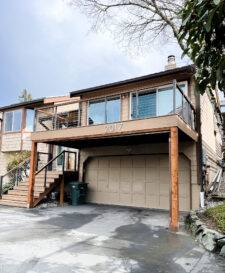
What Marine Climate Does to an Ordinary Deck
Three things drive almost every deck failure we see out here:
- Salt air corrosion — standard zinc-coated fasteners and hardware pit and rust within a few seasons of coastal exposure, and a rusted fastener loses grip strength long before it looks obviously bad.
- Moisture that doesn't fully leave — driving rain gets pushed into ledger connections, under fascia boards, and into end grain that isn't sealed, and the marine layer keeps humidity high even between storms so wood never fully dries out.
- Moss and biofilm on horizontal surfaces — shaded decks, north-facing decks, and anything under tree cover develop a slick green coating that isn't just cosmetic; it holds moisture against the board surface and makes stairs and landings genuinely slippery underfoot.
None of this means a deck can't be built well here — it means the build has to account for all three from the framing up, not just at the surface.
Framing and Fasteners: The Part Nobody Sees
Most deck problems start below the decking boards, where nobody looks until something gives. For framing in this climate we treat a few things as non-negotiable:
Fasteners and connectors
Stainless steel or a marine-rated coated fastener for anything exposed to weather — not standard hot-dip galvanized, which corrodes faster in salt air than most people expect. Joist hangers, hurricane ties, and ledger bolts all get the same treatment. This costs more up front than a big-box fastener kit, but it's the single cheapest insurance against a deck that loosens up structurally in ten years instead of thirty.
Footings and post bases
Footings need to sit below frost depth and on undisturbed soil, and post bases should hold the post above the decking surface so end grain isn't sitting in standing water. On sites with any slope toward the water — common on island lots — we also pay attention to drainage around the footings themselves so runoff doesn't undermine them over time.
Joist protection
Joist tape over the top of every framing member before decking goes down. It's a small material cost that keeps rainwater from soaking directly into the top of the joist through fastener holes, which is one of the most common hidden rot points we find when we tear off an old deck.
Choosing Decking Material for This Climate
There's no single "best" decking material — there's a best material for a given budget, sun exposure, and maintenance appetite. Here's how the common options actually behave in a salt-air, high-moisture, moss-prone setting:
| Material | Salt-air durability | Moss/mildew resistance | Maintenance | Typical lifespan here |
|---|---|---|---|---|
| Cedar | Good if sealed regularly | Fair — needs cleaning | Re-seal every 1-2 years | 15-20 years |
| Pressure-treated fir/hem-fir | Good with coated fasteners | Fair — needs cleaning | Re-seal every 1-2 years | 15-20 years |
| Composite (capped) | Excellent | Good, but surface film still needs washing | Periodic wash, no sealing | 25-30+ years |
| Tropical hardwood (ipe and similar) | Excellent | Good | Occasional oiling for color, otherwise low | 30+ years |
We're honest with clients about the trade-offs: composite costs more up front but essentially removes the sealing chore, which matters a lot to owners of vacation or second homes who aren't on-island every month to maintain a wood deck. Cedar and treated wood cost less initially and can look great, but they need someone actually keeping up with the re-seal schedule — skip two cycles in a row here and the board surface starts to gray and check faster than it would inland. Neither choice is wrong; it depends on how much upkeep you actually want to sign up for.
The Ledger Connection: Where Most Water Damage Starts
If a deck attaches to the house, the ledger board connection is the single highest-risk point on the whole structure. Water that gets behind a poorly flashed ledger doesn't just damage the deck — it can work its way into the house's wall framing and siding, which turns a deck repair into a much bigger and more expensive fix. A correct ledger installation includes proper flashing that directs water out and away from the house, a gap or drainage plane between the ledger and the wall so water doesn't get trapped, and fasteners rated for the load and the exposure. This is also the area we check first on any older Friday Harbor deck we're asked to inspect, because it's the spot most often installed wrong the first time.
Permits and Site Considerations Specific to This Area
San Juan County has its own permitting process for decks, and waterfront or near-shore properties can involve additional shoreline review depending on setback distance and site specifics — worth checking with the county early rather than after materials are ordered. Island logistics also shape the build schedule in ways that don't apply on the mainland: material deliveries run on ferry schedules, so lead times for specialty decking or custom hardware need to be planned further out than a mainland job would require. We build that reality into our scheduling up front rather than surprising a homeowner with it mid-project.
Our Process for a Friday Harbor Deck Project
- Site visit and assessment — we look at sun exposure, drainage, existing structure (for repairs or rebuilds), and how the site handles wind-driven rain.
- Material and layout discussion — matching decking material and fastener spec to your maintenance preference and budget, not a one-size template.
- Permitting — we handle the county paperwork so the project isn't held up by something that should've been filed on day one.
- Framing built to marine-exposure spec — corrosion-resistant fasteners, joist protection, proper footing depth and drainage.
- Ledger flashing done correctly — the step that protects both the deck and the house behind it.
- Decking installation and finish work — including any sealing or capping appropriate to the material chosen.
- Walkthrough — so you know exactly what maintenance schedule keeps your specific deck looking right.
Keeping a Deck Ahead of Moss Season
Even a well-built deck needs some seasonal attention here, especially anything shaded or under tree cover. A yearly wash before moss and algae get a foothold — pressure washing on the right setting for the material, not so aggressive it damages the board surface — goes a long way. Wood decking needs its sealer checked annually and reapplied roughly every one to two years depending on sun exposure. Composite and hardwood decks need far less, but a periodic wash still keeps the surface from building up the slick biofilm that makes stairs unsafe in wet weather. Clearing debris out of gaps between boards also matters more here than in a dry climate, since trapped organic matter holds moisture right against the wood.
Quick maintenance checklist
- Wash the deck surface annually, before moss establishes rather than after
- Check and reapply sealer on wood decking every 1-2 years depending on exposure
- Clear leaves and debris from between boards each fall
- Inspect fasteners and ledger flashing yearly for rust or gaps
- Check stair treads and landings for slip risk after wet weather
- Confirm footings and post bases haven't been undermined by drainage changes
What Drives the Cost of a Deck Project Here
Every project is different, but a few factors consistently move the price up or down on island jobs:
| Factor | Effect on cost |
|---|---|
| Decking material (wood vs. composite vs. hardwood) | Material cost varies significantly; composite and hardwood cost more upfront but less over time |
| Site access and slope | Difficult access or steep lots add labor time |
| Ferry-dependent material delivery | Custom or specialty materials need longer lead times, which can affect scheduling more than base cost |
| Ledger vs. freestanding structure | Ledger-attached decks need more careful flashing work; freestanding decks avoid that risk but need their own footing system |
| Permitting and shoreline review | Waterfront proximity can add review time and documentation requirements |
We give straightforward, written estimates broken down by these factors so you know what you're actually paying for, not just a bottom-line number.
Why a Crew That Already Works This Area Matters
A contractor who mostly works inland can build a structurally sound deck and still miss the details that matter here — the fastener grade, the flashing detail, the material choice for a shaded north-facing site. We work in San Juan County regularly, we already know the county's permitting process, and we've seen what driving rain and a long moss season do to decks built without those details accounted for. That's the difference between a deck project you deal with once and one you're patching every couple of years.
If you're planning a new deck, a rebuild, or want an honest look at whether an existing deck's framing is still sound, we're happy to come take a look. Fill out the form below for a free, no-pressure estimate.