 Orcas Island
 Why Crow Valley Decks Age Differently
Crow Valley sits inland enough to avoid the harshest wind off the water, but it still gets the same San Juan County weather pattern that wears down every deck on Orcas Island: salt-laden air drifting up from the shoreline, long stretches of driving rain in fall and winter, and a moss season that can run six months or more in shaded, tree-covered lots. Add in the valley's mix of open pasture and dense fir cover, and you get decks that see very different conditions from one yard to the next — some baking dry in summer sun, others staying damp under canopy nearly year-round.
That variation matters more than most homeowners expect. A deck on a sunny, exposed lot fails differently than one tucked under trees. The sunny deck tends to show UV-driven surface checking, dried-out fasteners, and boards that cup as they dry unevenly. The shaded deck shows the opposite problem: trapped moisture, moss and algae growth on the boards and structure, and rot that starts underneath where nobody looks until a board gives way. Most Crow Valley properties have some of each — a deck that gets morning sun and afternoon shade, for example — which is why a repair plan built for this specific area looks different than a one-size-fits-all approach.
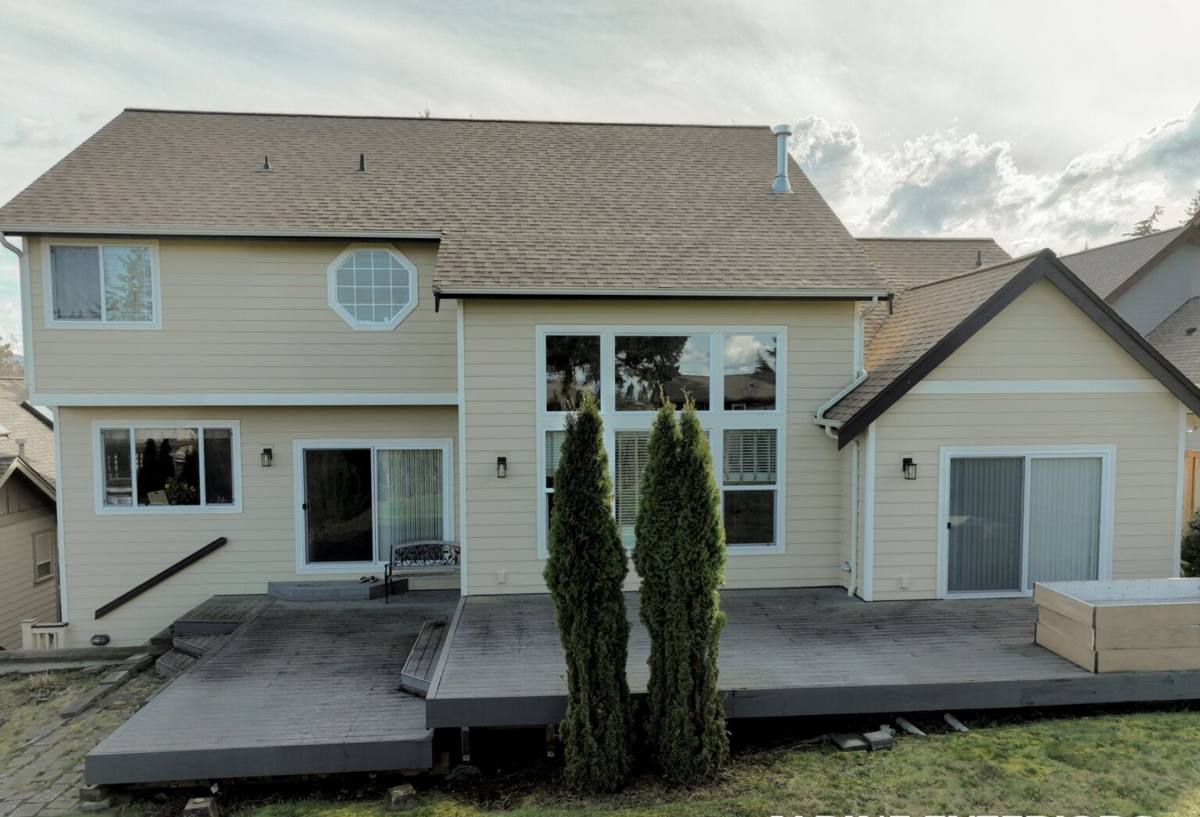
Signs Your Deck Needs Repair — And What They Actually Mean
Not every soft spot means a full teardown, and not every deck that looks fine underneath is actually sound. Here's what we look for and what each sign usually points to:
- Soft or spongy decking boards — usually localized rot from trapped moisture; often repairable board-by-board if the framing underneath is dry
- Green or black film on boards, especially in shaded areas — moss and algae growth, common in Crow Valley's wetter, tree-covered lots; a maintenance and drainage issue more than a structural one, but left unaddressed it accelerates wood breakdown
- Rust streaks around fasteners — a sign the wrong-grade hardware was used originally, or that coastal salt air has started corroding standard fasteners faster than expected
- Gaps or movement where the deck meets the house (the ledger board) — one of the most serious issues we see; a failing ledger connection is a safety issue, not cosmetic
- Wobbly railings or posts — often a sign of rot at the post base where water pools, even when the rest of the deck looks solid
- Boards that cup, crown, or have visible checking (splits along the grain) — weathering from repeated wet-dry cycles; cosmetic at first, but it accelerates water intrusion over time
- Stairs that feel less solid than the deck itself — stringers take more direct weather exposure and often need attention before the main deck does
What a Correct Deck Repair Actually Involves
A repair that just replaces the boards you can see and skips everything underneath is a repair that fails again within a few years. We treat every deck repair as an inspection first, repair second — because in this climate, the damage that matters most is usually the damage you can't see from the top.
Substructure and Framing
Joists, beams, and posts take the brunt of long-term moisture exposure because water runs off the decking and collects where boards meet framing. We check for soft wood, check the crown and level of joists, and confirm posts are still bearing weight correctly — not just standing in place. Framing repairs done now are far cheaper than framing repairs done after a full collapse of the decking above it.
Ledger Board and House Connection
This is where the deck attaches to your home, and it's the single most safety-critical connection on the structure. Flashing here has to shed water away from the house, not into it. We see ledger boards on older Crow Valley decks that were never properly flashed to begin with — a common gap in decks built before current code expectations — and that's often the root cause of rot that looks like it's coming from "the deck" when it's actually coming from water getting behind the ledger and into the house rim joist.
Decking Boards and Fasteners
We match replacement boards to the existing decking where reasonable, or recommend a full resurface if enough boards have failed that patch-matching won't look right or hold up evenly. Fasteners get upgraded to stainless or coated hardware rated for coastal exposure — standard interior-grade screws corrode faster than most homeowners realize once they're exposed to salt air year-round.
Railings, Stairs, and Guards
Railings get checked for post rot at the base and for loose connections at the top rail — both common failure points. Stairs get the same substructure check as the main deck, since stringers see more direct weather exposure than most of the deck surface.
Repair vs. Full Replacement — How We Help You Decide
Most homeowners call us assuming they need a full replacement when a targeted repair would do, or assuming a repair will hold when the deck is actually past that point. We give a straight answer either way — a repair that won't last isn't a favor to you, and a replacement you don't need isn't either.
| Factor | Favors Repair | Favors Replacement |
|---|---|---|
| Framing condition | Joists and beams are dry and solid | Widespread soft or rotted framing |
| Extent of damage | Isolated boards, posts, or connections | Damage spread across most of the deck |
| Deck age | Under 15-20 years, built to reasonable standards | Older deck nearing the end of its service life |
| Ledger connection | Sound, properly flashed | Failing or never flashed correctly |
| Your plans for the space | Happy with current layout and size | Want a different size, shape, or material |
In many cases the honest answer is a hybrid: replace the ledger connection and worst framing sections while keeping sound framing and decking elsewhere. We'll tell you which category your deck falls into after a physical inspection — not a guess from a photo.
Material Choices and Why We Make the Calls We Do
Crow Valley homes run the full range from traditional cedar decks to newer composite installs, and each has real trade-offs worth understanding before you decide on repair materials.
Pressure-Treated Framing
For structural framing — joists, beams, posts — we use pressure-treated lumber rated for ground contact where relevant, regardless of what decking material sits on top. This isn't negotiable on our jobs; framing is the part you can't easily inspect again for years, so it has to be right the first time.
Wood Decking
Cedar and other wood decking still make sense for a lot of Crow Valley homes, especially where matching an existing deck or maintaining a specific look matters. The trade-off is honest: wood needs periodic sealing or staining to perform well in this climate, and skipping that maintenance is what leads to the moss and rot issues we get called out for. If you want wood, we'll tell you the real maintenance schedule up front, not a rosy version of it.
Composite Decking
Composite decking lowers the maintenance burden considerably and resists moss growth better than untreated wood, which makes it a reasonable option for shaded, damp Crow Valley lots. The trade-offs: higher upfront material cost, and composite still needs a properly built and ventilated substructure underneath — it doesn't fix bad framing, it just sits on top of it. We install it to the same substructure standard as wood, because moisture problems below the surface don't care what the surface is made of.
Our Repair Process
1. On-Site Inspection
We walk the full deck — top, underneath, and at every post and ledger connection — before quoting anything. This is where we find the difference between what's visible and what's actually happening structurally.
2. Written Scope and Honest Options
You get a clear description of what's failing, why, and the repair options that actually apply to your deck — not an upsell menu. If a smaller repair will genuinely hold up, we say so.
3. The Repair Itself
Framing and connection work happens first, since decking and rail work depends on a sound structure underneath. We use coastal-rated fasteners and flashing throughout, matching or improving on what should have been used originally.
4. Final Check and Maintenance Guidance
Before we call a job finished, we walk it with you and explain what maintenance — if any — will keep it performing well given your specific lot's sun and shade pattern.
Why Local Crow Valley Experience Matters Here
San Juan County's island logistics mean materials, permits, and scheduling all work differently than they do on the mainland — ferry schedules affect delivery timing, and a crew that already routes through Crow Valley regularly doesn't add ferry lag to every trip for a follow-up visit or a forgotten part. Beyond logistics, a crew that's worked multiple decks in this specific area has already seen how the valley's mix of open and shaded lots plays out over time — which lots need moss-resistant material choices, which need extra drainage detailing at the ledger, and which framing details tend to fail first given the local rain pattern. That's knowledge you don't get from a general contractor doing one job on the island and leaving.
Keeping a Repaired Deck Sound Longer
A good repair buys you years, but a few habits stretch that further in this climate:
- Clean moss and algae off boards at least once a year, more often on shaded sections — a stiff brush and mild cleaner is usually enough; avoid pressure washers on wood decking, since they can drive water into the grain and wear down soft fibers
- Keep gutters and downspouts clear so runoff isn't draining directly onto or under the deck
- Reseal or restain wood decking on the schedule appropriate to the product — skipping this is the single biggest cause of repeat repairs we see
- Trim back vegetation that keeps sections of the deck shaded and damp longer than necessary
- Check railings and stair connections for movement once a year — catching a loose post early is a five-minute fix; catching it late is a rebuild
If your Crow Valley deck has soft spots, rust streaks, moss buildup, or just feels less solid than it used to, we're glad to take a look and give you a straight assessment — no pressure, and no assumption that repair means replacement. Reach out for a free estimate using the form below.