 Orcas Island
 Why West Sound Siding Takes a Different Kind of Beating
West Sound sits close enough to open water that homes here deal with a combination most inland San Juan County properties don't: salt-laden air moving off the sound, driving rain that comes in sideways during winter storms, and a long, damp shoulder season that keeps siding wet longer than it should ever stay wet. Any one of those on its own is manageable. Together, over years, they're what turns a small siding problem into a rot pocket behind the wall.
Salt air is corrosive to fasteners and hardware, and it accelerates the breakdown of finishes that aren't built to handle it. Driving rain doesn't just wet the surface of your siding — on an exposed West Sound elevation, wind-driven water gets pushed up under laps and around trim in ways that vertical rain never would. And the moss and algae that thrive in this region's shoulder seasons hold moisture against the siding surface far longer than open air alone would, which is exactly the condition wood fiber and cellulose-based products struggle with most.
None of this means West Sound homes are doomed to constant repairs. It means the repairs need to be diagnosed and done correctly the first time, with materials and methods that actually account for the exposure, not just patched over with caulk and paint.
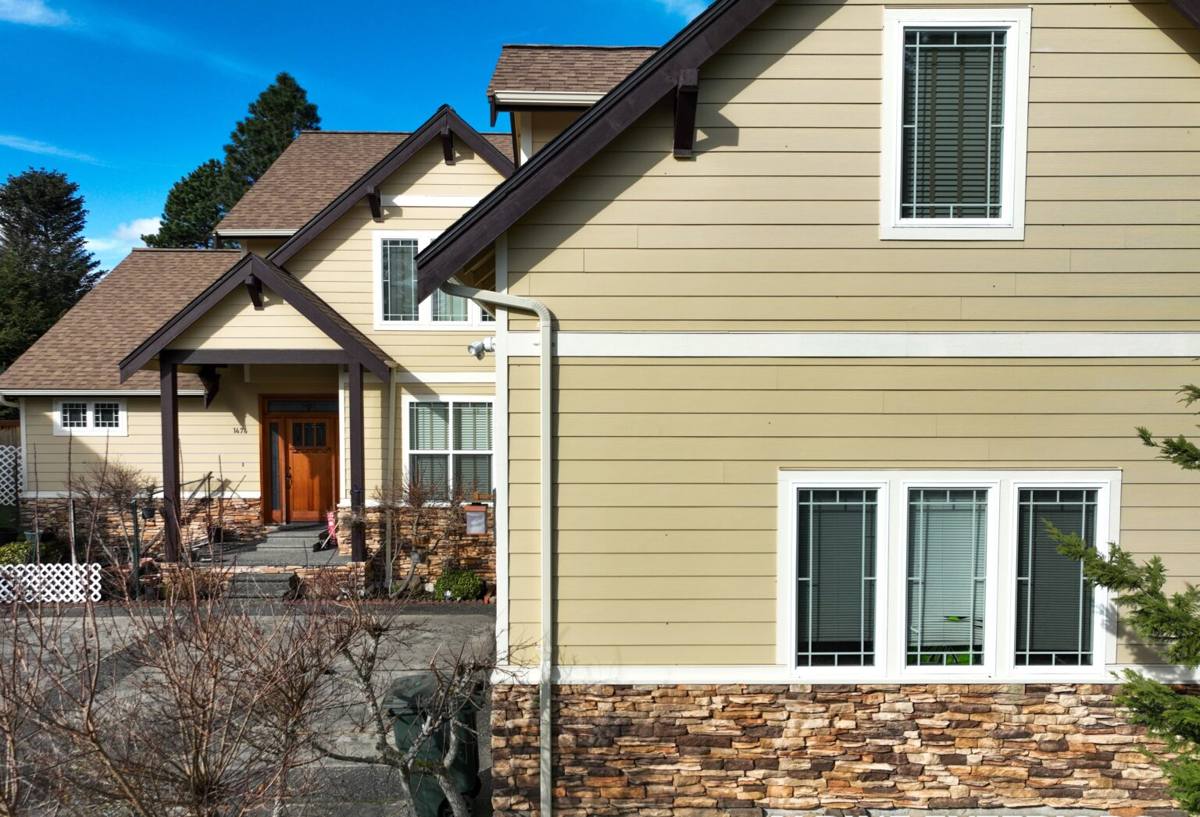
Signs Your Siding Needs Attention
Most siding problems on Orcas Island show themselves in small ways long before they become expensive ones. Homeowners in West Sound should walk their exterior at least once a year — ideally after the wettest stretch of winter — and look for:
- Soft or spongy spots when you press on siding, especially near the bottom courses and around windows
- Visible gaps, cracks, or separated seams at butt joints and corners
- Paint that's bubbling, peeling, or failing in one localized area rather than evenly across a wall
- Persistent moss or dark streaking that keeps coming back in the same spot even after cleaning
- Staining or discoloration on interior walls near an exterior corner — a sign water has already gotten past the siding
- Fasteners that have backed out, rusted, or left streaking below them
- Warping, cupping, or bowing panels, particularly on the side of the house that takes the most wind and rain
Any one of these on its own is usually a straightforward repair. Several of them clustered in the same area, or showing up on an interior wall, usually means water has been getting behind the siding for a while and the repair needs to include what's underneath, not just what's visible.
Why Repairs Get Missed Until They're Bigger Jobs
Siding damage on a West Sound home is often on an elevation that faces water or prevailing wind — not the side people walk past every day. It's common for a homeowner to notice a problem only once it's visible from the inside, which usually means the damage has been developing for a season or more. Catching it earlier, while it's still a localized repair, is the difference between a few hours of work and pulling siding off half a wall.
What a Correct Siding Repair Actually Involves
A siding repair that only replaces the damaged board and calls it done is a repair that's likely to fail again. Doing it right means treating the visible damage as a symptom and checking the cause before closing the wall back up.
Diagnosis Before Demolition
Before any siding comes off, a correct repair starts with figuring out how water got in. That could be a failed piece of flashing above a window, a gap where trim meets siding, a nail hole that was never sealed, or simply a joint that was never lapped correctly during the original install. Replacing the siding without finding this doesn't fix the problem — it just delays the next repair.
Checking What's Behind the Siding
Once damaged siding is removed, the housewrap or building paper underneath needs to be inspected. If it's torn, deteriorated, or missing where it should be lapped over flashing, that gets corrected before new siding goes back on. Any sheathing that's gone soft or delaminated from sustained moisture needs to be identified and addressed — patching over compromised sheathing is one of the most common ways a "repair" turns into a callback within a year.
Matching Material and Method
Repairs need to match the existing siding's profile, reveal, and finish closely enough that the patch doesn't stand out, and they need to be integrated with correct flashing and fastening — not just caulked at the edges. Caulk is a detail, not a repair strategy; on its own it's a temporary fix that fails again once it dries out and cracks, which happens faster in a marine climate than most people expect.
Repair or Replace? How to Think About It
Not every siding problem in West Sound calls for a full re-side, and not every problem should be patched indefinitely either. The honest answer depends on how widespread the damage is and what's causing it.
| Situation | Repair usually makes sense | Replacement usually makes sense |
|---|---|---|
| Extent of damage | Isolated to one or two areas | Recurring across multiple elevations |
| Age of siding | Siding is otherwise sound and mid-life | Siding is at or past its expected service life |
| Cause | One identifiable failure point (flashing, trim, fastener) | Systemic issue — original install, wrong product for the exposure |
| Underlying structure | Sheathing and framing test dry and sound | Rot has spread into sheathing or framing in more than one spot |
| Material | Durable material (fiber cement) with a contained issue | Moisture-sensitive material with damage in multiple locations |
If a repair keeps recurring in the same spot even after being fixed, that's usually telling you the material or the original detailing isn't suited to that wall's exposure — and West Sound's water-facing walls are exactly where that shows up first.
Why the Original Material Matters for How a Repair Holds Up
What the siding is made of has a lot to do with how well a repair lasts in this climate. Wood siding that's taken on moisture damage once is more likely to take it on again in the same spot, because the fibers that swelled and softened don't fully recover. Vinyl siding doesn't rot the same way, but it becomes brittle with age and UV exposure, and matching an older run of vinyl for a repair gets harder every year as colors fade and product lines get discontinued. Engineered wood products with a cellulose core are particularly sensitive to the kind of prolonged dampness that moss and shaded, wind-driven-rain walls create in the San Juans — once moisture gets past the coating at an edge or fastener point, it can spread through the substrate before it's visible on the surface.
This is a large part of why we install James Hardie fiber cement siding exclusively and don't install LP SmartSide, vinyl, or other engineered wood or cellulose-based products. Fiber cement doesn't rot, doesn't support moss growth the way wood does, and holds up to sustained coastal moisture without the swelling and softening that drives most of the repair calls we see on wood and engineered products in this area. When a repair on a Hardie-sided home is needed, it's almost always tied to an installation or flashing detail rather than the material itself failing — which makes for a repair that actually solves the problem instead of buying a season or two.
Our Repair Process
- Inspection. We look at the full exterior, not just the spot you called about — problems on a West Sound water-facing wall often show up in more than one place once you know what to look for.
- Diagnosis. We identify the actual entry point for moisture before removing anything, so the repair addresses the cause.
- Opening it up. We remove only what needs to come off, and check housewrap, flashing, and sheathing underneath.
- Correcting the cause. Flashing gets replaced or added where it's missing, housewrap gets properly lapped, and any compromised sheathing gets addressed before new siding goes back on.
- Matching and finishing. New siding is matched to the existing profile and finish as closely as possible, fastened and sealed to spec, not just caulked at the seams.
- Walkthrough. We show you what we found and what we did about it, including anything we think is worth keeping an eye on.
Why It Matters That We Already Work in West Sound
A crew that regularly works West Sound homes already knows which elevations take the worst of the wind and rain, how fast moss reestablishes on a shaded, north-facing wall out here, and what the salt air does to fasteners and finishes over a few winters. That's not something you learn from a single job — it's something that shows up in how a crew diagnoses a problem the first time they look at it, rather than guessing and hoping the first fix holds. For a homeowner, that translates into fewer repeat visits and a repair that's built around this specific exposure, not a generic fix pulled from a drier, more sheltered part of the county.
After the Repair: Keeping Moss and Salt Air From Coming Back
A repair is a good time to get ahead of the conditions that caused the damage in the first place. Gentle, regular cleaning to keep moss and algae from re-establishing on shaded or water-facing walls goes a long way, as does trimming back vegetation that keeps a wall shaded and damp longer than it needs to be. Checking caulking and sealant at trim joints once a year — especially heading into the wet season — catches small gaps before they become the next repair call. None of this is difficult, but it's the kind of maintenance that matters more here than it would on a drier, inland property.
If you're seeing any of the signs above on a West Sound home, or you just want an honest read on whether it's a repair or something bigger, we're happy to take a look. Reach out for a free, no-pressure estimate using the form below.