 Orcas Island
 Why West Sound's Waterfront Climate Is Hard on Siding
West Sound sits on the water side of Orcas Island, and that location cuts both ways. The views and the tree cover are part of why people live there, but the same conditions that make it beautiful also make it one of the tougher spots on the island for exterior materials. Homes close to the water take on salt-laden air that settles on siding, trim, and fasteners day after day. Add San Juan County's long wet season — driving rain that comes sideways off the water during winter storms — and you have siding that stays damp far more of the year than most homeowners realize.
Then there's the tree canopy. A lot of West Sound properties sit under mature fir and cedar cover, which means shade, slower drying times, and a near-constant supply of organic debris landing on roofs and siding. That combination — moisture that lingers, plus organic material to feed on it — is exactly what moss and algae need. On the wrong siding material, that moss season isn't cosmetic. It holds moisture against the surface, and over years that leads to soft spots, paint failure, and in wood-based products, rot.
None of this means West Sound is a bad place to build or maintain a home. It means the siding choice matters more here than it does in a drier, more open part of the county, and it means the installation details — the ones nobody sees once the job is done — matter even more.
What Siding Actually Needs to Do in This Setting
Strip away the marketing and a siding product covering a West Sound home has three real jobs:
- Shed water fast and keep it from tracking behind the cladding at seams, corners, and penetrations
- Resist the slow corrosive effect of salt air on the material itself and on every fastener holding it up
- Hold its finish and dimensional shape through repeated wet-dry cycles without swelling, cupping, or losing paint adhesion
Wood-based and wood-adjacent products struggle with the second and third points in particular. Engineered wood siding relies on resin-treated strand board that performs well when it's built and flashed correctly and detailed water can't reach the edges — but any gap in that detailing, and moisture finds the wood fiber underneath. In a climate where siding rarely gets a long stretch to fully dry out, that margin for error shrinks. Cedar has the same exposure, plus the added maintenance of refinishing on a schedule most owners don't keep up with once the initial excitement of a new exterior wears off.
Why We Install Only James Hardie Fiber Cement
We standardized on James Hardie products for every siding job we take on, including in West Sound, and we don't install vinyl, LP SmartSide, Cemplank, Allura, primed spruce, or unfinished cedar. That's not a marketing position — it's what we've concluded after years of servicing exteriors in this exact climate.
Fiber cement is a mix of cement, sand, and cellulose fiber, pressed and cured into a dense, stable board. It doesn't have wood fiber for moisture to migrate into, it doesn't expand and contract the way vinyl does in temperature swings, and it's non-combustible — a real consideration on a wooded island where wildfire risk and insurance underwriting increasingly factor into exterior material choices. James Hardie engineers its products by climate zone, and the HZ5 formulation used in the Pacific Northwest is built specifically for high-moisture, freeze-thaw-adjacent conditions like San Juan County's marine climate.
Product Lines That Fit West Sound Homes
Hardie's lineup gives us options depending on the home's style and exposure:
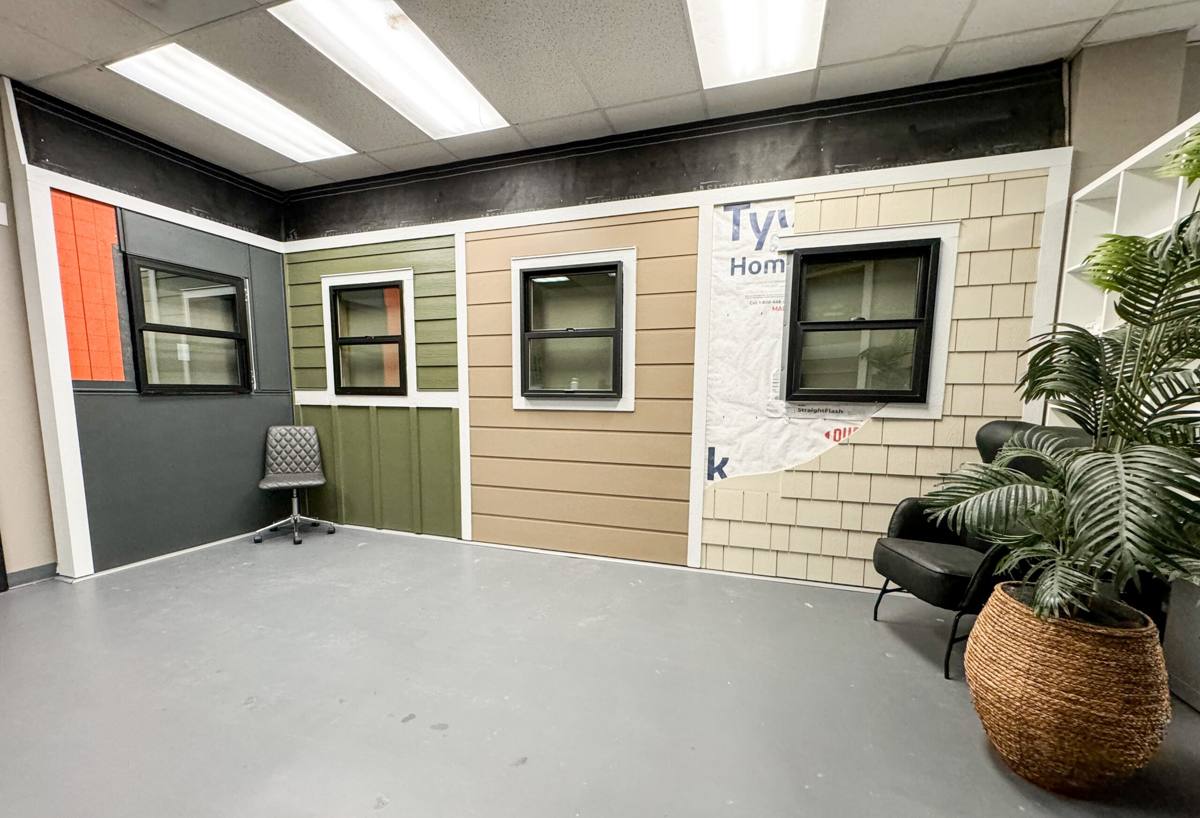
- HardiePlank lap siding — the most common choice, available in several exposure widths and textures, and the right fit for the traditional and craftsman-style homes common around the island
- HardiePanel vertical siding — often used on gable ends, accent walls, or in combination with lap siding for a board-and-batten look
- HardieShingle — a shaped-shingle profile for homes that want a cedar-shake look without the maintenance cedar requires near the water
- HardieTrim — matched trim boards so corners, fascia, and window surrounds hold up at the same rate as the field siding, instead of becoming the weak point
ColorPlus Factory Finish
Where possible, we spec ColorPlus finished product rather than field-painted primed board. The finish is baked on at the factory in a controlled environment, which gives it better adhesion and UV resistance than a coat applied on site — a real advantage in a spot that gets a lot of both salt exposure and long stretches of damp weather between paint jobs. It also comes with its own finish warranty separate from the substrate warranty, so touch-up and repainting cycles stretch out considerably longer than with site-painted siding.
What a Correct Installation Involves
Fiber cement is only as good as the installation behind it. Hardie's own warranty is conditioned on installation to their published specifications, and in a wet climate like this one, the details that get skipped on a rushed job are exactly the ones that cause problems three or five years down the line.
Water-Resistive Barrier and Flashing
Every job starts with a continuous water-resistive barrier behind the siding, lapped correctly at seams, with flashing integrated at every window, door, deck ledger, and roof-to-wall transition. On a home taking direct rain off the water, this layer — not the siding face — is the real first line of defense. We treat it as non-negotiable even when it means slowing the schedule down.
Fasteners and Hardware
Salt air corrodes fasteners faster than it damages the siding itself. We use corrosion-resistant, Hardie-approved fasteners throughout, and we're deliberate about fastener spacing and placement — over-driven or under-driven nails are one of the most common causes of premature siding failure, and it's a detail that's invisible once the job is painted.
Clearances and Joints
Hardie specifies minimum clearances from grade, roof lines, and decks, and those clearances exist for a reason: they keep splash-back and standing moisture away from the bottom edge of the siding. We also keep butt joints sealed and back-primed where the manufacturer calls for it, rather than relying on caulk alone to do the job over time.
How Siding Options Compare for a West Sound Property
| Material | Salt Air / Moisture Behavior | Ongoing Maintenance | Fire Classification |
|---|---|---|---|
| James Hardie fiber cement | Engineered for marine/high-moisture zones (HZ5); dimensionally stable when wet | Low — factory finish holds color and adhesion for years | Non-combustible |
| Vinyl | Can warp or become brittle with temperature swings; seams are a moisture entry point | Low, but color fades and can't be refinished — full replacement when it fails | Combustible |
| Engineered wood (LP SmartSide) | Performs well if perfectly detailed; strand-board core is vulnerable if water reaches it | Moderate — depends heavily on flashing quality and upkeep | Combustible |
| Cedar | Natural material, absorbs and releases moisture; prone to cupping and rot near salt water | High — refinishing on a regular cycle to prevent decay | Combustible |
Our Process for West Sound Projects
The steps don't change much from home to home, but the pace and sequencing usually do, since ferry and barge logistics affect how material gets staged for island jobs:
- On-site assessment of the existing exterior, including a check for moisture intrusion behind current siding, trim, and around penetrations
- Material takeoff and product selection — plank profile, exposure, and finish color, matched to the home's style and exposure to wind and rain
- Scheduling material delivery to the island with enough lead time that weather windows aren't wasted waiting on product
- Tear-off and inspection of the sheathing underneath — this is where hidden rot or past water damage gets caught and addressed before it's covered back up
- Installation of water-resistive barrier, flashing, siding, and trim to Hardie's published specifications
- Final walk-through so the homeowner can see the completed clearances, caulk lines, and finish before we consider the job done
Living With Fiber Cement Siding in a Moss-Prone Climate
Even the right material benefits from basic upkeep, especially under tree cover. A short annual routine goes a long way toward protecting the investment:
- Rinse siding down once or twice a year to clear salt residue and organic debris before it builds up
- Keep gutters and downspouts clear so overflow doesn't run down the siding face repeatedly in one spot
- Trim back branches and foliage that keep sections of the wall shaded and slow to dry
- Check caulk lines at trim and penetrations every couple of years and have any cracked sections redone
- Address any moss or algae growth promptly with a gentle wash rather than letting it establish and hold moisture against the surface
Compared to a wood-based exterior, this is a light routine — but skipping it entirely on any siding material, including fiber cement, shortens its service life.
Why a Crew That Already Works West Sound Matters
Island jobs have logistics that don't exist on the mainland. Material has to be barged or ferried over on a schedule, and a crew that doesn't plan for that ends up with delays or scrambling for last-minute freight. A contractor who already works West Sound knows how to stage a job so weather and ferry timing don't stall the work halfway through a wall.
There's also the site-specific knowledge that only comes from being on these properties repeatedly: which exposures on the water side take the worst of the winter storms, where tree cover creates the slowest-drying walls, and how San Juan County's permitting process applies to a full re-siding versus a repair. Most full re-siding projects in the county require a building permit, particularly when the work goes down to the sheathing — that's something we account for in the schedule rather than something the homeowner has to sort out separately.
If you're planning a siding project on a West Sound home, we're happy to take a look and talk through what your home's exposure actually needs — no pressure, no obligation. Reach out for a free estimate using the form below.