 Orcas Island
 Why North Beach Decks Wear Differently
North Beach sits close enough to the water that salt-laden air is part of daily weather, not an occasional event. Add San Juan County's long wet season — months of driving rain followed by low winter sun that never quite dries things out — and you get a deck environment that's harder on materials than most inland Washington neighborhoods. Wood decking here doesn't just gray, it holds moisture in the grain, feeds moss and algae, and starts to cup and split faster than the same board would twenty miles inland. Fasteners corrode. Framing rots from the underside up, often before the surface boards show any obvious damage.
Composite decking earns its keep in exactly this kind of climate, but only when it's specified and installed with that climate in mind. A composite deck built to a generic spec sheet, without accounting for salt exposure and standing moisture, will still underperform. The material choice matters, but the installation details matter just as much — sometimes more.
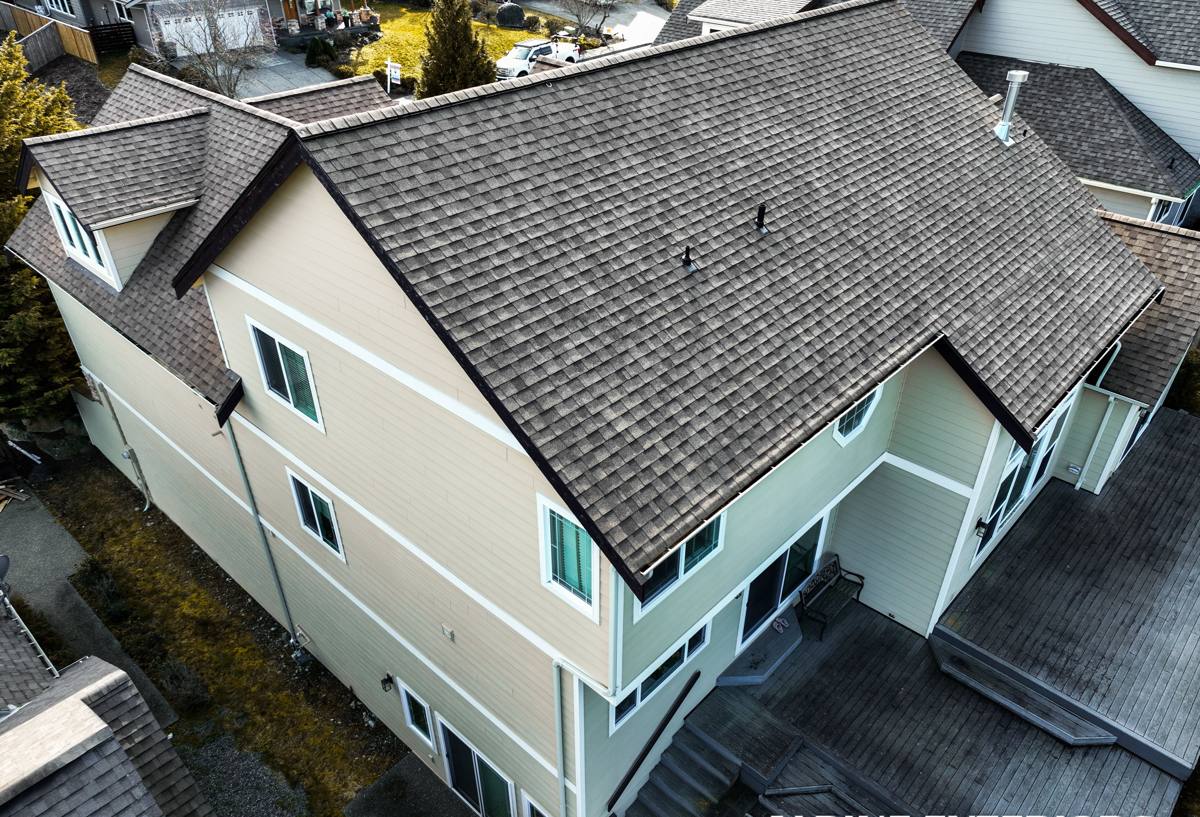
What Salt Air and Moss Actually Do to a Deck
Salt Air
Airborne salt accelerates corrosion on any exposed metal — screws, joist hangers, railing brackets, post bases. Over a few seasons, untreated or poorly coated hardware can weaken enough to compromise structural connections, even while the decking surface still looks fine. This is why fastener and hardware selection is a bigger deal near the water than it is a few miles inland.
Driving Rain
Wind-driven rain doesn't fall straight down — it gets pushed sideways under railings, into ledger connections, and into any gap where flashing was skipped or done poorly. On a sloped lot, water that isn't directed away from the house foundation and deck substructure will find the lowest point and sit there, which is usually right where framing meets the house.
Moss and Algae
San Juan County's damp season runs long, and shaded or north-facing decks stay wet for extended stretches. That's ideal moss and algae growth conditions. On wood, moss holds moisture against the fiber and speeds decay. On composite boards, moss and algae are mostly cosmetic, but only if the board has the right surface treatment and the deck has enough airflow underneath to let things dry between rains.
Composite vs. Other Decking Options for This Climate
| Material | Salt Air Behavior | Moss/Algae Resistance | Maintenance Load |
|---|---|---|---|
| Pressure-treated wood | Fasteners and framing corrode faster; boards absorb salt spray | Low — moss takes hold quickly in shade | High — annual cleaning, periodic staining/sealing |
| Cedar or other natural wood | Grays and weathers quickly near salt air | Low to moderate | High — sealing, sanding, board replacement over time |
| Capped composite | Cap layer resists salt-driven fading and moisture uptake | Moderate to high, depending on brand and surface texture | Low — periodic washing, no sealing or staining |
| PVC decking | Fully synthetic, unaffected by salt exposure | High | Low — similar to capped composite, higher material cost |
We install capped composite decking on most North Beach projects because it strikes a practical balance: it holds up to salt air and repeated wetting far better than any wood option, it doesn't need staining or sealing, and it's priced more reasonably than full PVC systems while still carrying a manufacturer warranty on the cap layer against fading and staining. We'll talk through PVC as an option too — it has its place, particularly on decks with heavy shade and moisture exposure — but for most homes it's not a meaningful upgrade over a good capped composite for the added cost.
What a Correct Composite Deck Build Looks Like Here
The decking boards themselves get the attention on most projects, but the parts you don't see are what determine whether a deck lasts fifteen years or thirty in this climate.
Substructure and Ledger Flashing
Any deck attached to the house needs a properly flashed ledger board — flashing that sheds water away from the house sheathing, not just a bead of caulk. This is one of the most common shortcuts we see on older or lower-bid decks, and it's usually the reason a deck-to-house connection rots from the inside before anything looks wrong on the surface.
Joist Protection
Untreated or under-protected joists sitting under composite decking in a wet climate are a slow-motion problem. We use joist tape or an equivalent barrier on top of framing members to keep moisture from wicking into the wood through screw penetrations and cut ends, and we treat cut ends of pressure-treated lumber before they go into the structure.
Hardware Selection
Near-water sites call for coated or stainless fasteners and hardware rated for corrosive exposure, not the cheapest fastener that happens to fit. This is a small line-item cost difference that has an outsized effect on how the substructure holds up over ten-plus years.
Drainage and Airflow
Deck height above grade, joist spacing, and any skirting need to allow air to move underneath the deck. A composite deck that's boxed in tight to the ground with no ventilation will stay damp longer after every rain, which is exactly the condition that encourages moss and algae on the underside and around board edges.
Board Spacing and Fastening
Composite boards expand and contract with temperature and moisture more than people expect. Gapping and fastening need to follow the manufacturer's specification for our climate, not a generic rule of thumb — too tight and boards can buckle; too loose and you get a sloppy-looking deck that traps debris in oversized gaps.
Our Process for North Beach Composite Decking Projects
- On-site assessment of the existing structure (if replacing decking) or the framing plan (if building new), including drainage, sun/shade exposure, and proximity to salt spray
- Product selection — walking through composite and PVC options, colors, and warranty terms based on your budget and exposure
- Substructure inspection or build-out, including ledger flashing, joist protection, and corrosion-resistant hardware
- Decking installation to manufacturer spec — fastening, spacing, and drainage detailing
- Railing, stair, and trim work matched to the decking system
- Final walkthrough covering care and what to expect in year one as the deck settles in
Maintaining a Composite Deck in a Moss-Prone, Salt-Air Climate
Composite decking is low-maintenance, not no-maintenance. In this climate, a little seasonal attention goes a long way toward keeping a deck looking and performing the way it should.
- Rinse or sweep the deck surface periodically through the wet season to keep organic debris from sitting and feeding moss growth
- Wash with a soft-bristle brush and a manufacturer-approved deck cleaner once or twice a year, focusing on shaded areas and spots under furniture
- Keep gutters and downspouts clear so roof runoff isn't dumping extra water onto or near the deck
- Check railing posts and hardware annually for corrosion, especially on decks with direct water views
- Trim back overhanging vegetation to improve airflow and sun exposure on shaded sections
- Avoid pressure-washing at close range or high PSI, which can damage the cap layer on composite boards
Cost Factors for a North Beach Composite Deck
| Factor | Why It Affects Cost |
|---|---|
| Substructure condition | Rotted or under-built framing found during tear-off adds repair scope before decking can go down |
| Decking tier (basic capped composite vs. premium/PVC) | Higher-tier products cost more per square foot but often carry stronger fade and stain warranties |
| Height and access | Elevated decks or difficult site access add labor time and equipment needs |
| Railing system | Composite or aluminum railing with glass or cable infill costs more than basic baluster systems |
| Hardware and flashing upgrades | Corrosion-resistant fasteners and proper ledger flashing add modest cost but protect the structure long-term |
| Square footage and layout | Complex shapes, multiple levels, and stairs increase both material waste and labor |
Composite decking projects in this area typically land somewhere between a straightforward wood deck replacement and a full PVC system in overall cost, once you factor in the substructure work that a salt-air, high-moisture site usually needs. We'll always break the estimate down by scope so you can see where the money goes and where there's room to adjust.
Why It Matters That We Already Work North Beach
A crew that only occasionally works this stretch of coastline can still install a technically fine deck on a calm, dry day. What's harder to get right without local experience is anticipating the things that don't show up until year three or four: which fastener grades actually hold up here, how much airflow a given lot really needs given its tree cover and sun exposure, and where driving rain tends to find its way into a structure on this kind of terrain. We've built and repaired enough decking around Orcas Island and San Juan County to know these patterns, and we build to them from the start rather than fixing them later.
If you're considering composite decking for a North Beach property, we're happy to take a look and put together a straightforward, no-pressure estimate. There's a form below — tell us a bit about your project and we'll get back to you with next steps.