 Orcas Island
 Shaw Island's Climate Is Harder on a Deck Than It Looks
Shaw Island sits in the middle of San Juan County's marine weather pattern, and that pattern is not gentle on outdoor building materials. Salt-laden air drifts off the water and settles on every exposed surface, wood-framed lots under fir and cedar canopy stay damp for weeks at a stretch, and driving rain off Puget Sound finds every gap in flashing or fastening that isn't done right. Add a moss season that can run from fall through spring, and a deck built to a generic mainland spec often shows problems within a few years: swollen boards, corroded fasteners, slick green surfaces, and soft spots where water sat instead of shedding.
Composite decking, installed correctly for this environment, handles that combination far better than untreated or even pressure-treated wood. But "installed correctly for this environment" is the key phrase — a lot of what separates a deck that looks good for two seasons from one that holds up for twenty comes down to details most homeowners never see: fastener metal, ledger flashing, airflow underneath the boards, and how the framing handles the specific way Shaw Island weather attacks a structure.
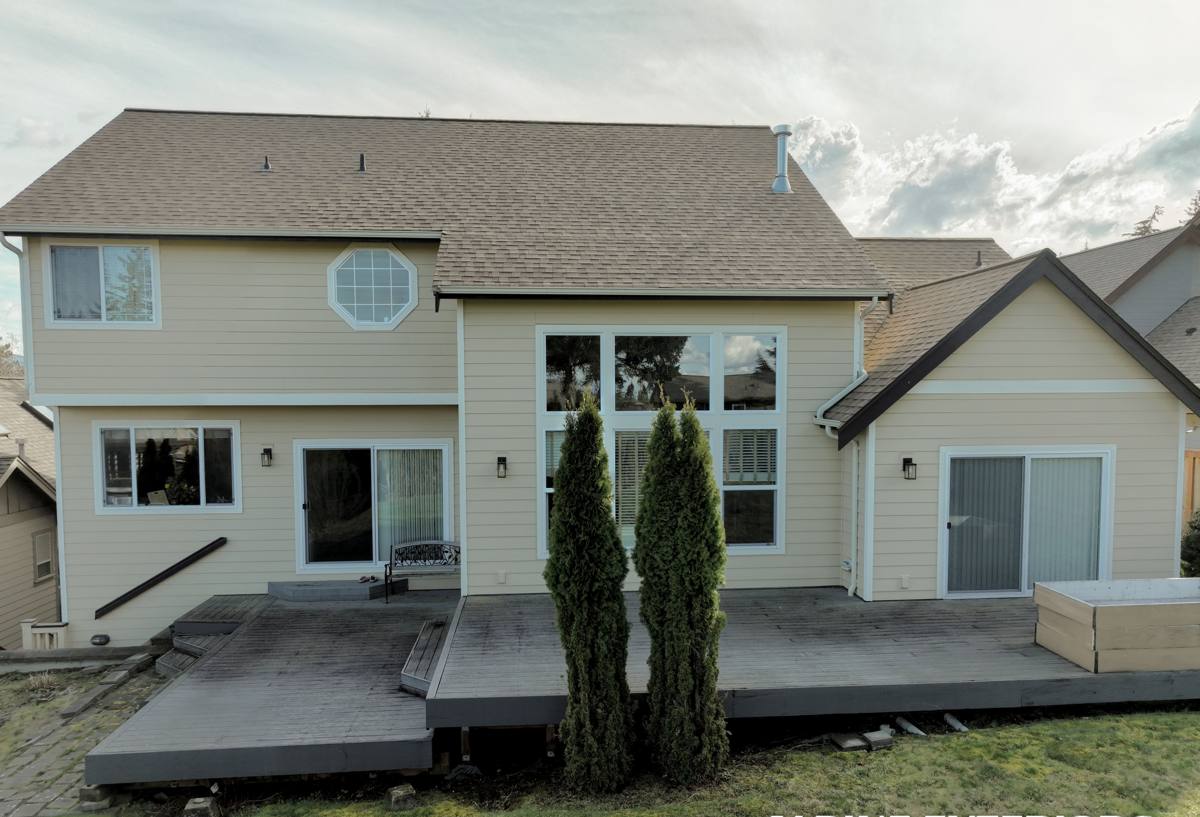
Why Composite Makes Sense for a Shaw Island Deck
Composite decking is made from a blend of wood fiber and polymer, and most quality products today are capped — meaning a polymer shell wraps the board and keeps moisture, salt, and organic growth from getting into the core. That matters a lot here. Wood decking on Shaw Island needs regular sealing or staining to keep water out, and once that maintenance schedule slips even one season — which happens easily on a property that isn't lived in year-round — moisture gets in and the clock starts on rot, cupping, and mold.
Capped vs. Uncapped Composite
Not all composite is built the same, and this is one place we're upfront with clients rather than letting a lower price tag make the decision. Uncapped or partially capped composite boards can still absorb moisture at cut edges and in humid, shaded conditions, which is exactly what a tree-covered Shaw Island lot delivers for months at a time. Fully capped composite costs more up front but resists moisture absorption, staining, and mold growth on all sides, which is why it's our standard recommendation for island properties rather than a generic upsell. We'll walk you through the real trade-offs — material cost, appearance over time, and maintenance burden — so you're deciding with full information, not a sales pitch.
What Composite Doesn't Solve By Itself
Composite boards resist moisture and rot better than wood, but the board is only one part of the system. A capped composite deck built over corroding fasteners, unflashed ledger boards, or a framing cavity with no airflow will still fail — just in different ways than a wood deck would. That's the part of the job that actually determines how the deck performs here.
What a Correct Composite Deck Build Involves Here
Fasteners and Hardware
Salt air corrodes standard hardware faster than most homeowners expect. We use stainless steel or marine-rated coated fasteners and hidden fastener clip systems rated for coastal exposure, not the cheapest hardware that happens to fit the board manufacturer's spec sheet. This is one of the most common corners cut on decks that were built by crews unfamiliar with island conditions — the board looks fine for years while the screws underneath are quietly rusting.
Ledger Attachment and Flashing
Where a deck attaches to the house, the ledger board and its flashing are the single biggest point of failure in a driving-rain climate. Water that gets behind an improperly flashed ledger doesn't show itself right away — it shows up as rot in the band board or sheathing a few years later, hidden behind the deck itself. We flash this connection to shed water away from the house structure, not just seal it and hope.
Airflow and Drainage Underneath
Composite boards don't rot, but the framing underneath them still can, and trapped moisture underneath a deck feeds the same moss and mold that grows on north-facing roofs here. We build in ventilation gaps and, where the deck sits low to grade or over a living space, a drainage layer so water moves off the site instead of pooling in the joist bay.
Footings for Island Terrain
San Juan County properties often mix shallow soil over bedrock with sloped or wooded lots, and Shaw Island is no exception. We assess footing needs on-site rather than assuming a standard concrete pier pattern will work — sometimes that means helical piers, sometimes it means working around exposed ledge rock. Getting this wrong shows up later as a deck that shifts or a railing that's no longer plumb.
Composite vs. Wood Decking in This Climate
| Factor | Composite (capped) | Wood (cedar/pressure-treated) |
|---|---|---|
| Moisture absorption | Very low with a full polymer cap | Absorbs water without regular sealing |
| Moss/algae resistance | Resists surface growth; occasional wash-down keeps it clean | Moss and algae take hold quickly in shaded, damp spots |
| Salt air effect on hardware | Same risk as wood — fastener quality is what matters | Same risk as composite — fastener quality is what matters |
| Maintenance routine | Periodic cleaning, no staining or sealing | Sealing or staining every 1-3 years to stay protected |
| Upfront cost | Higher material cost | Lower material cost |
| Long-term cost | Lower — minimal upkeep over the deck's life | Higher when factoring in recurring maintenance and earlier replacement |
Neither material is wrong for every situation, but for a property that isn't watched closely year-round — a common pattern on Shaw Island — composite's lower maintenance demand tends to be the deciding factor.
Cost Factors for a Shaw Island Composite Deck
| Factor | Why it moves the price |
|---|---|
| Existing framing condition | Rotted or undersized joists need sistering or full replacement before decking goes down |
| Decking tier | Fully capped composite costs more than partial-cap or mineral-based composite, but needs less upkeep |
| Square footage and layout | Diagonal or picture-frame patterns need tighter joist spacing and more cutting |
| Railing choice | Composite, cable, or metal railing systems vary widely in material and labor cost |
| Footing type | Helical piers or work around bedrock cost more than standard concrete footings |
| Removal and haul-away | Tearing out an old wood deck and getting debris off-island adds cost versus new construction |
| Delivery logistics | Ferry scheduling for materials and equipment factors into project timelines and cost |
How Our Process Works
- On-site evaluation of the existing structure (if any), soil/bedrock conditions, and sun/shade/moss exposure specific to your lot
- Written estimate breaking out material tier, framing work, railing, and any structural repair separately, so you know what you're paying for
- Permit coordination with San Juan County where the project requires it
- Materials and equipment scheduled around ferry logistics so the job isn't delayed by a missed sailing
- Demolition and haul-away of old decking, if applicable
- Framing repair or upgrade, ledger flashing, and fastener installation to marine-grade standards
- Composite decking installation with proper gapping for expansion and hidden fastening where the product allows it
- Final walkthrough covering care and cleaning specific to your deck's exposure
Permits and County Basics
Most attached decks and any deck built above a certain height above grade require a permit through San Juan County, and guardrail height and baluster spacing follow standard residential building code unless the county has adopted a local amendment. We handle the permit application and inspection scheduling as part of the job rather than leaving you to sort it out, but every property is different — lot coverage limits, shoreline setback rules, and septic or well locations can all affect what's allowed where. We confirm the specifics for your parcel before finalizing a design rather than assuming a standard layout will clear review.
Keeping a Composite Deck Ahead of Moss Season
Capped composite needs far less attention than wood, but "low maintenance" isn't "no maintenance," especially with a moss season this long. A short seasonal routine keeps a composite deck looking and performing the way it should:
- Sweep off fir needles and leaf litter regularly — trapped organic debris holds moisture against the board surface
- Rinse the deck a few times a year with a garden hose and a soft-bristle brush to keep early moss and algae from getting a foothold
- Avoid pressure washing at high pressure directly on the board surface, which can damage the cap over time
- Check railing posts and stair connections annually for movement, especially after a hard winter
- Keep gutters and downspouts near the deck clear so runoff isn't dumping extra water onto or under the structure
- Trim back overhanging branches where practical to cut down on shade and debris that feed moss growth
Why It Matters to Hire a Crew That Already Works Shaw Island
A lot of what makes a deck project on Shaw Island go smoothly has nothing to do with the decking itself. Getting materials, a crew, and equipment to the island means working around the ferry schedule, not against it — a contractor unfamiliar with that reality can turn a straightforward job into a stretched-out one. Knowing where San Juan County's permitting will require extra documentation, understanding how bedrock and thin soils on island lots affect footing choices, and recognizing which parts of a property sit in a higher salt-drift zone near the water versus a more sheltered, wooded interior lot — these are things you learn by doing the work here repeatedly, not by reading a spec sheet. A crew that already knows the island's rhythm shows up on schedule, prices the job accurately the first time, and builds a deck sized to the actual conditions on your property rather than a generic template.
If you're weighing a new composite deck or need an existing one evaluated for salt air or moisture damage, we're glad to take a look and put together a straightforward, no-pressure estimate. Use the form below to get started.