 Orcas Island
 Why Lopez Village Decks Wear Out Faster Than You'd Expect
A deck in Lopez Village doesn't fail the same way one does further inland. Salt-laden air off the water works on every metal fastener and connector year-round, not just during storms. Driving rain — the kind that comes in sideways off the water rather than straight down — finds its way under boards and behind ledger flashing that would stay dry in a more sheltered spot. And the long moss season here, often running from fall through spring, keeps deck surfaces damp for weeks at a stretch, which accelerates wood rot and makes boards slick and unsafe well before they look obviously bad.
None of that means a deck can't last here — it means the build has to account for those three things from the start: corrosion-resistant hardware, water management at every joint, and a decking surface that doesn't hold moisture against the framing underneath it.
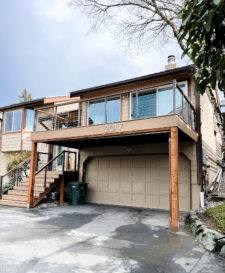
Signs a Deck Needs Full Replacement, Not Just a Patch
Homeowners often ask us to "fix a few boards" and that's sometimes the right call. But on San Juan County homes, especially decks that have gone a decade or more without attention, the framing underneath is usually further along than the surface lets on. A few boards holding up fine doesn't tell you much about the joists and ledger board hidden beneath them.
- Boards feel soft, spongy, or flex noticeably underfoot, especially near the house
- Rust streaks bleeding out from screw heads or joist hardware
- Any gap or dark staining where the ledger board meets the house siding
- Railing posts that wobble or have visible rot at the base
- Water pooling on the deck surface instead of draining off
- Moss or algae established directly on structural members, not just the walking surface
- Stair stringers that have visibly shifted or separated from the deck frame
If you're seeing two or more of these, a resurface will likely mask a structural problem rather than solve it. That's the point where full replacement is the honest recommendation.
What a Correct Deck Replacement Actually Involves
Full tear-off, not board-swapping
We pull the old decking and inspect the framing before deciding what stays. On older decks in this climate, joists and the ledger board have usually absorbed more moisture damage than the surface boards show. Building new decking on top of compromised framing just hides the problem for a year or two.
Ledger flashing done right
The ledger board — where the deck attaches to the house — is the single most common failure point we see locally, and it's almost always a flashing problem, not a decking problem. Water gets behind the ledger, into the band joist, and starts rotting the house structure itself. A correct replacement includes proper flashing tape and a physical gap or flashing detail that sheds water away from the house, not just a bead of caulk.
Fasteners that match the climate
Galvanic corrosion between mismatched metals is a real problem in salt air. We use stainless steel or coated fasteners rated for contact with treated lumber, and we match hardware to the decking material — composite and PVC systems often call for hidden fastener systems that also need to be corrosion-rated, not just the visible screws.
Drainage and slope
The deck surface should slope slightly away from the house so water doesn't sit against the siding or pool on the boards. It's a small detail that's easy to skip and expensive to fix later.
Footings sized for island soil
Soil conditions around Lopez Village and the surrounding islands can hold more moisture than mainland sites, especially in low-lying areas. Footings need to be sized and set to code for that, not just poured to whatever got a deck through inspection thirty years ago.
Choosing a Decking Material for Salt Air and a Long Wet Season
There's no single "best" decking material — there's a best fit for your budget, your maintenance appetite, and how exposed the deck is to weather. Here's how the common options actually behave in this climate.
| Material | Moisture Behavior | Maintenance | Typical Local Lifespan |
|---|---|---|---|
| Pressure-treated wood | Absorbs and releases moisture; prone to cupping if not sealed regularly | Annual cleaning and resealing recommended | 10–15 years with upkeep |
| Cedar | Naturally rot-resistant but still needs sealing in a wet climate | Sealing every 1–2 years, more if fully exposed | 12–18 years with upkeep |
| Capped composite | Doesn't absorb water into the core; shrugs off moss better than wood | Occasional washing, no sealing or staining | 20–25+ years |
| PVC/cellular decking | Fully moisture-resistant, best for splash zones near hot tubs or ground level | Lowest maintenance of the group | 25+ years |
We don't push one product on every job. Wood is a legitimate choice if you like the look and don't mind the upkeep — the trade-off is honest maintenance, not a defect. Composite and PVC cost more up front but make sense for homeowners who want to spend weekends doing something other than resealing a deck every spring, or for decks that sit low to damp ground where moss and moisture are constant.
Permits, Guardrails, and Code in San Juan County
Most deck replacements that involve new framing, footings, or a change in height require a permit, and San Juan County has its own review process separate from mainland jurisdictions. A few code basics that trip people up:
- Guardrails are generally required once a deck surface is a certain height above grade, with a minimum rail height and maximum gap between balusters
- Stair rise and run have to stay within a consistent range, step to step
- Ledger attachment and footing depth are both subject to inspection, not just the finished surface
We handle the permit application and inspection scheduling as part of the job so you're not the one tracking down the county office or guessing at requirements.
Our Deck Replacement Process
- On-site assessment of the existing deck, ledger, and framing condition
- Written scope and material selection, with pricing before anything is torn out
- Permit application where required, filed before work begins
- Full tear-off and haul-away of the old deck
- Inspection and repair of framing, ledger board, and flashing before new decking goes down
- Installation of new framing, decking, and railing to current code
- Final walkthrough with you and county inspection sign-off where applicable
- Site cleanup — we don't leave old lumber or fasteners behind
Cost Factors for a Lopez Village Deck Replacement
Every deck is priced on its own scope, but the same handful of factors move the number up or down on nearly every job we quote out here.
| Factor | Why It Matters |
|---|---|
| Deck size and shape | Square footage plus any angles, curves, or multiple levels add material and labor |
| Decking material | Pressure-treated wood sits at the low end; PVC and premium composites at the high end |
| Framing condition | If joists, beams, or the ledger need replacement, that's structural work beyond surface decking |
| Railing and stairs | Custom railing, multiple stair runs, or code-driven rail upgrades add cost |
| Site access | Material delivery to island properties, including ferry logistics, factors into scheduling and cost |
| Permitting | County permit and inspection fees, plus any engineering if footings or spans are non-standard |
As a broad range, straightforward wood deck replacements tend to land at the lower end of typical regional deck pricing, while larger composite or PVC decks with custom railing sit at the higher end. We'll give you an actual number, not a guess, once we've seen the deck.
Why a Crew That Already Works Lopez Village Matters
Getting materials, equipment, and a crew onto the islands isn't the same as pulling into a mainland driveway. Lumber, footings material, and decking all have to be staged and moved on a ferry schedule, and a crew that already does that routinely doesn't burn your project's budget relearning it. We also already know the county permitting contacts and typical review timelines, which keeps a permit-required job from stalling for weeks.
There's a weather-timing piece too. Driving rain and the onset of moss season aren't the same calendar here as on the mainland, and a crew that works these islands regularly plans tear-off and framing work around those windows so your deck isn't sitting open to the weather longer than it needs to be. A contractor coming over for a single job doesn't have that local pattern to work from.
Caring for Your New Deck Through Moss Season
A correctly built deck still needs some upkeep to get its full lifespan out of this climate.
- Sweep debris and standing moss off the surface before it establishes, especially in shaded corners
- Keep gutters and downspouts directing water away from the deck and ledger area
- Check exposed fasteners and hardware annually for early rust, especially on wood decks
- Reseal or restain wood decking on the schedule the product actually calls for, not "whenever it looks dry"
- Wash composite or PVC decking with a soft-bristle brush rather than a high-pressure washer, which can damage the surface texture
If you're weighing whether your current deck needs a patch or a full replacement, or you're ready to plan a new one built for this climate from the ground up, we're happy to take a look and walk you through what we find. Reach out for a free, no-pressure estimate using the form below.