 Orcas Island
 Window Replacement in Eastsound: Built for This Bay's Climate
Eastsound is the hub most Orcas Island homeowners think of first when something exterior needs attention, and windows are one of the most common calls we get here — not because Eastsound homes are unusually neglected, but because windows take more direct abuse from this climate than almost any other part of a house. A window opening is where the building envelope has the most seams, the most moving hardware, and the most chances for water to find a way in if the original installation wasn't done right. Salt-laden air off the water, winter storms that drive rain sideways instead of straight down, and a moss season that can run most of the year on shaded walls all work against a window's seals and frame, year after year.
We install siding, roofing, windows, and decks for homes across Orcas Island, and on window jobs specifically we treat the flashing and installation detail as at least as important as the window unit itself. A premium window installed with rushed flashing will eventually leak in this climate. A solid, correctly installed window will usually outlast it. This page covers what Eastsound's climate actually does to windows, how we decide between repair and replacement, and how a window project runs from first look to final walkthrough.
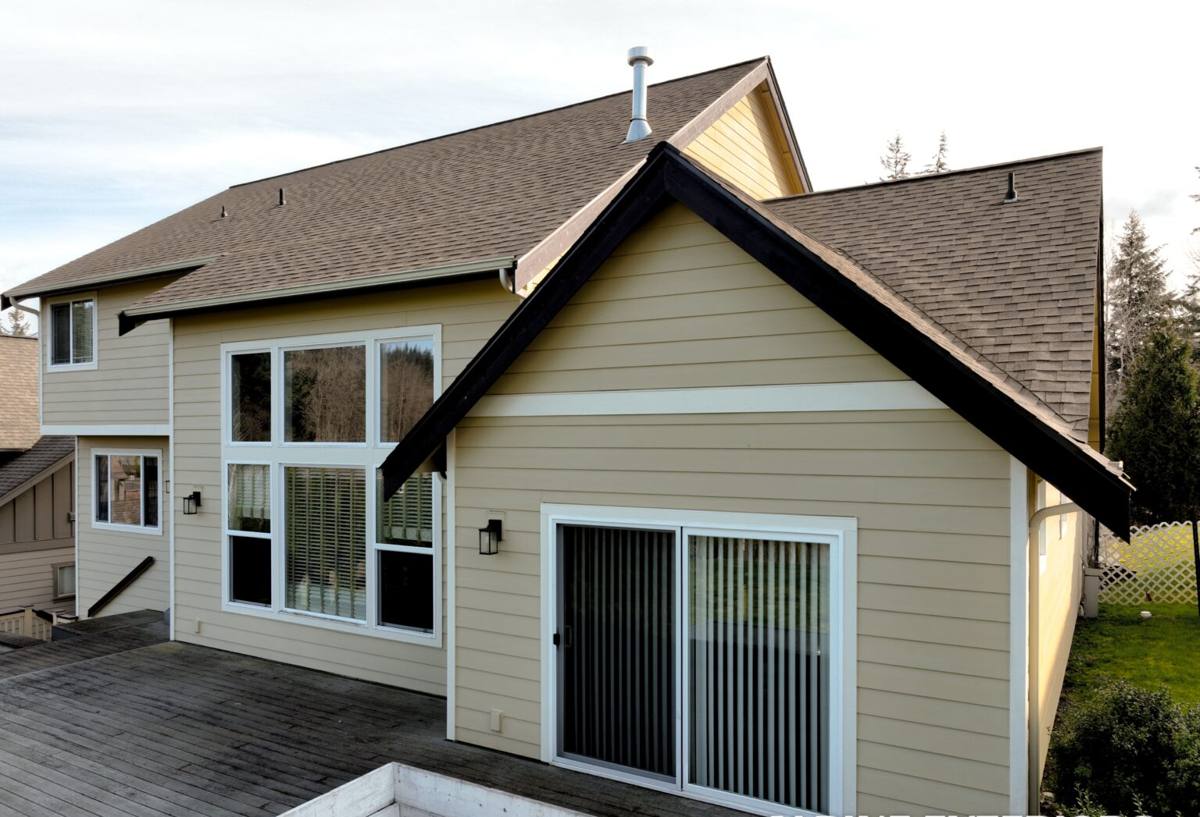
What Eastsound's Climate Puts a Window Through
Salt Air Off the Water
Eastsound sits at the head of a protected bay, which means calmer water than Orcas Island's more exposed shorelines — but the salt-laden air itself still moves inland across the whole area, protected bay or not. Over years, that exposure accelerates corrosion on window hardware, fasteners, and lower-grade frame components. It's a slow process, which is exactly why it gets missed until a lock starts sticking or a hinge won't hold a window open anymore.
Driving Rain and Wind
Winter storms in San Juan County don't drop rain straight down. Wind pushes it sideways into wall assemblies and around window openings, reaching gaps and seams that would stay dry in a calmer climate. The window unit itself is only half the equation — flashing that laps correctly into the surrounding wall is what actually keeps that wind-driven rain from tracking behind the trim and into the framing.
A Long Moss and Mildew Season
Eastsound's mix of open, sun-exposed lots and heavily treed properties means moss and mildew pressure varies house to house, but it's rarely absent entirely. Mild temperatures combined with near-constant moisture add up to a growing season that can run close to year-round on north-facing or shaded windows and sills. Wood sills and trim that stay damp longer than they should are exactly the surface moss and mildew take hold on.
Condensation From Temperature Swings
The gap between a heated interior and a cold, wet Orcas Island winter puts real condensation pressure on glass and frames. Older single-pane windows and early double-pane units show this constantly — fogging, moisture trapped between panes, or water pooling on an interior sill. That's usually a sign a seal has failed, not just a cosmetic annoyance to live with.
Signs an Eastsound Home Needs Window Replacement
- Fogging or visible moisture trapped between the panes of a double-pane window
- Noticeable drafts or cold spots near the frame even with the window fully closed and locked
- Sills or trim that feel soft, look discolored, or show visible rot
- Windows that stick, won't stay open on their own, or are hard to lock the way they used to
- Visible daylight or gaps where the frame meets the surrounding siding or trim
- Paint or finish peeling and bubbling faster on window trim than on the rest of the exterior
- Rust staining running down from hardware or hinges
Repair vs. Replacement: How We Make the Call
Not every window on an Eastsound property needs to come out. A window with a failed seal but a sound frame and working hardware is often a reasonable repair or reglaze candidate. A window with rotted framing, a warped sash, or hardware that's been failing for years usually isn't — at that point the labor spent patching it keeps adding up until a proper replacement would have cost less overall.
| Condition | Repair Usually Makes Sense | Replacement Usually Makes Sense |
|---|---|---|
| Fogged glass, sound frame | Yes — reglaze or seal replacement | Only if the frame is also compromised |
| Stiff or broken hardware | Yes — hardware replacement | Not on its own |
| Soft or rotted sill or frame | Rarely a lasting fix | Yes |
| Persistent drafts despite sealing | Sometimes, if flashing is the actual cause | Yes, if the unit itself is the source |
| Single-pane, no storm window | Possible short-term patch | Yes, for real energy and comfort gains |
We'll give you a straight read on each window individually rather than a blanket recommendation for the whole house — it's common on an Eastsound property to replace two or three problem windows in one visit while others still have years of service left in them.
Flashing: The Detail That Determines Whether a New Window Performs
We spend more time talking with homeowners about flashing than about window brands, because in this climate flashing is the difference between a window that stays dry for decades and one that starts leaking within a few wet seasons. Correct installation means the flashing laps properly with the weather-resistive barrier and siding around it, water is directed out and away from the rough opening instead of trapped behind it, and every seam is sealed with materials rated for sustained moisture. That's standard practice on every window we install, not an upgrade a homeowner has to ask for.
Where We See Flashing Go Wrong on Older Eastsound Homes
On repair and replacement calls around Eastsound, the water damage we find almost never traces back to the window unit itself failing — it traces back to flashing that was never lapped correctly to begin with, or caulk that got used as a substitute for flashing instead of a supplement to it. Caulk alone cracks and breaks down over time; it was never meant to be the only barrier standing between wind-driven rain and the wall framing behind it.
Choosing the Right Window for This Climate
We install vinyl and fiberglass window systems suited to the Pacific Northwest's wet, mild, salt-influenced conditions, and we walk homeowners through the real trade-offs rather than pushing one brand as the only correct answer. What matters most for an Eastsound property is a tight, well-engineered frame, a glazing package that handles both energy performance and condensation, and hardware rated to hold up under sustained marine air — not the name printed on the frame.
| Factor | Vinyl Frames | Fiberglass Frames |
|---|---|---|
| Upfront cost | Generally lower | Generally higher |
| Moisture and rot resistance | Strong — does not absorb water or rot | Strong — does not absorb water or rot |
| Dimensional stability | Can expand and contract more with temperature swings | More stable across temperature swings |
| Color and finish options | Fixed color, limited repainting options | Can be painted, more finish flexibility over time |
| Typical fit for Eastsound homes | Solid, economical choice for most replacements | Worth the added cost on larger openings or where finish flexibility matters |
Glazing and Hardware
Double or triple-pane glazing with a low-E coating helps on both ends of an Orcas Island winter — cutting heat loss during cold, damp stretches while reducing unwanted solar gain in summer, and it typically cuts down on the interior condensation that older single-pane windows are known for. Hardware grade matters just as much as glazing here: corrosion-resistant hardware holds up longer against this island's salt-influenced air than standard-grade hardware, which is worth confirming specifically rather than assuming every quoted window includes it.
Why We Don't Install Only One Window Brand
On siding, we install James Hardie fiber cement exclusively, because one product installed to a consistently high standard beats spreading a crew thin across several. Windows are a different kind of decision — opening sizes, configurations, and budgets vary enough house to house that locking into a single brand would mean talking some homeowners into a product that isn't actually the best fit for their opening or their budget. So on windows, our standard is the installation detail and the frame, glazing, and hardware specification, not a single manufacturer's name.
How Window Replacement Fits Into the Rest of an Eastsound Home's Exterior
Windows rarely fail on their own. A roof with flashing that's starting to let go at a wall transition, or siding with a gap near a window opening, shows up later as water damage around that window — long after the original cause has been forgotten. Because we handle siding, roofing, windows, and decks, the crew doing your window flashing understands exactly how it needs to tie into the siding and roofline around it, instead of treating the window as an isolated job someone else has to make sense of later.
Our Process, Start to Finish
- On-site assessment — we look at each window's frame condition, seal integrity, hardware function, and how the existing flashing ties into the siding around it
- Honest repair-or-replace read — a window-by-window recommendation, not a blanket answer for the whole house
- Written scope and estimate — what's being replaced, what product and glazing package is specified, and what's covered under the installation warranty versus the manufacturer's product warranty
- Ordering and lead time — a realistic timeline for the windows to arrive, factoring in ferry-dependent delivery to the island
- Removal and opening prep — old units come out carefully, and any hidden rot or flashing failure at the opening gets addressed before the new window goes in
- Installation and flashing — the new unit is set, shimmed, and flashed to standard practice, not treated as an optional upgrade
- Final walkthrough — we confirm operation, review care expectations, and make sure the finished work matches what was estimated
What Affects Window Replacement Cost and Timeline in Eastsound
Every estimate is specific to the house, but a few factors consistently move the number: how many windows are involved, whether openings are standard sizes or require custom units, the condition of the framing and sill once the old window comes out, and which glazing and hardware package fits the home. Island logistics matter too — window orders and material deliveries to Orcas Island run around ferry schedules more than a mainland job would, and that's a planning factor we build into the timeline upfront rather than a surprise that shows up mid-project.
Quick Checklist Before Hiring for Window Work in Eastsound
- Ask how they handle flashing integration with the existing siding, not just which window brand they sell
- Confirm current Washington contractor licensing and active liability insurance
- Get a written scope that separates the product warranty from the installation warranty
- Ask for a repair-or-replace recommendation on each window individually, not a blanket answer
- Get a realistic lead time in writing, accounting for ferry-dependent delivery
- Ask whether they can also address related roofing, siding, or trim issues found during the project
Why a Crew That Already Works Eastsound Regularly Matters
A contractor who works Orcas Island regularly already knows how wind-driven rain and salt air behave here compared to a drier, more sheltered climate, and that shows up in the small decisions — how much lap a flashing detail gets, whether caulk is treated as a real seal or just a backup, which hardware grade gets specified for a given wall's exposure. It also means that when a warranty question comes up years later, it's a call to a crew still working in the same area and scheduling around the same ferry, not a company that quoted the job once and moved on.
If you're dealing with drafty, foggy, or stubborn windows on an Eastsound home — or you're just not sure whether repair or replacement is the right call — we're glad to take a look and give you a straightforward, no-pressure estimate. Reach out using the form below to get started.