 Orcas Island
 Eastsound sits at the center of Orcas Island's daily life — the harbor, the main shopping area, and a lot of the island's older and newer homes cluster around it. It's also fully exposed to everything that makes siding a harder problem here than it is on the mainland: salt-laden air moving off the water, wind-driven rain that hits walls sideways during fall and winter storms, and a moss season that can run most of the year on shaded lots. We install James Hardie fiber cement siding exclusively, and this page is about what that actually means for a fiber cement job on an Eastsound home specifically — not a generic rundown of the product, but what it takes to get a fiber cement installation right on this stretch of the island.
What Eastsound Homes Are Actually Up Against
Eastsound's location on the water means most homes here deal with more sustained moisture exposure than a comparable house set back from the shoreline. Salt air corrodes exposed fasteners, flashing, and trim faster than it would inland, and it works on any finish that isn't formulated to resist it. Storms coming off the Salish Sea don't fall straight down — they drive rain sideways into walls, testing every seam, corner, and window opening at once, and homes facing the water or open exposure take the brunt of it. And because a lot of Eastsound properties sit under fir, cedar, and madrona canopy or in low-lying, shaded spots near the village, walls can stay damp for days after a storm passes — exactly the condition moss and mildew need to take hold and spread across a wall face.
None of those three factors is unusual on its own. Together, and applied continuously across a marine climate that doesn't really have a dry season the way inland Washington does, they add up to real, sustained stress on a home's exterior. That's the baseline every fiber cement installation in Eastsound has to be built to handle — not as a worst-case scenario, but as normal weather.
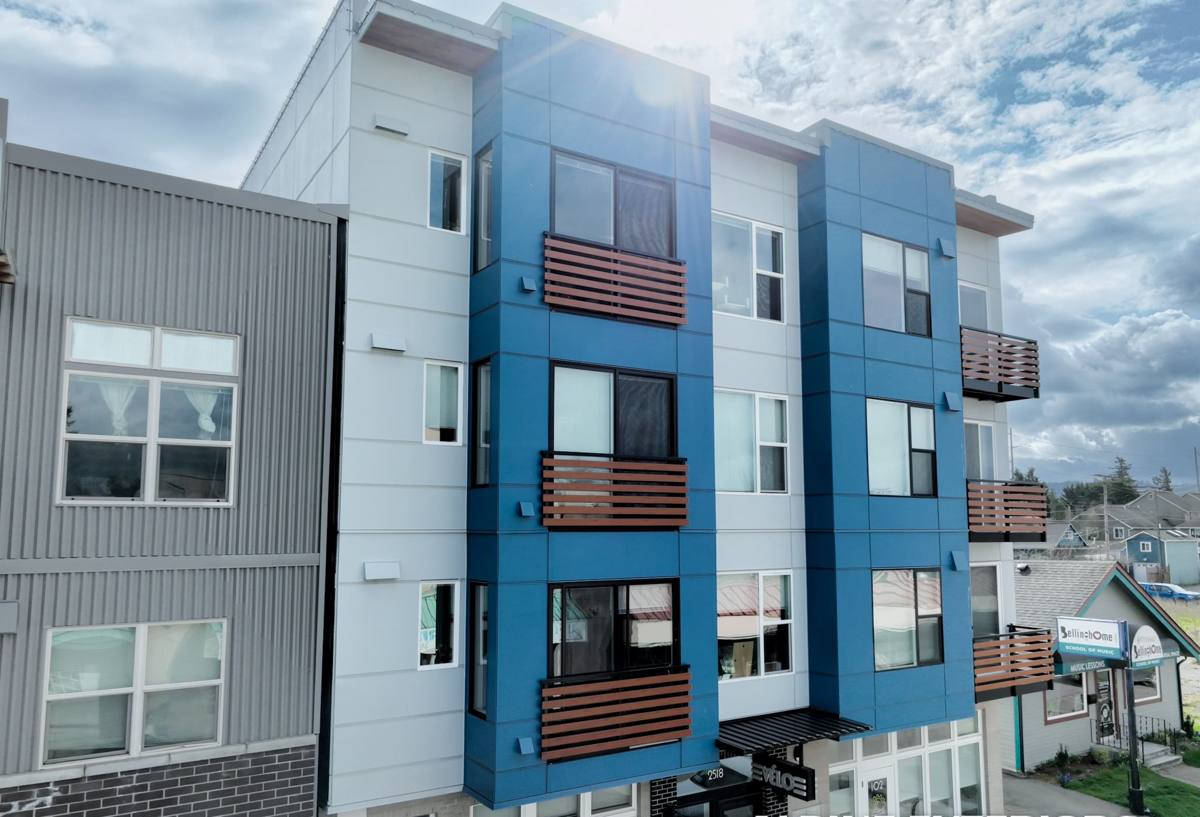
Why Fiber Cement Is the Right Base Material Here
James Hardie fiber cement is made from cement, sand, and cellulose fiber, cured into a dense, dimensionally stable board with no organic wood core. That matters directly in this climate for a few reasons:
- It doesn't absorb moisture into its fiber structure the way wood-based or wood-composite siding does, so it isn't swelling, cupping, or delaminating from repeated wet-dry cycling at cut edges and seams
- It has no organic core for moss and mildew to feed on directly, unlike wood, which supports growth once a finish starts to break down
- It's non-combustible, which matters on a wooded island where wildfire risk is a real seasonal concern alongside the moisture side of the equation
- James Hardie manufactures region-specific formulations — homes in our climate get the HZ5 product line, engineered for high-humidity, high-moisture-exposure conditions rather than a generic one-size formulation
Fiber cement isn't immune to water problems. A poorly installed Hardie job can still leak, still corrode fasteners, still let water track behind the cladding. What it doesn't do is give you a material that's working against you from the inside the way an absorptive wood-based product can. That's a meaningful head start in a climate like Eastsound's, but it only pays off if the installation behind it is done correctly.
What a Correct Fiber Cement Installation Involves
Most of what determines whether fiber cement siding performs for twenty-plus years or starts showing problems in five happens behind the boards, in details a homeowner can't see once the job is finished. A correct installation in this climate includes:
The Water-Resistive Barrier and Drainage Plane
A continuous, properly lapped house wrap or building paper behind the siding, with no gaps or reversed laps, is what catches whatever moisture gets past the cladding and directs it back out. On a site with the kind of wind-driven rain Eastsound sees, a drainage gap or rainscreen detail that lets that incidental moisture actually drain — rather than trapping it flat against the sheathing — makes a real difference over the life of the siding.
Flashing at Every Penetration
Windows, doors, and any wall penetration need flashing installed in the correct sequence with the water-resistive barrier, shedding water outward and downward rather than behind the barrier. This is the detail that fails most often on rushed work, and it's also the hardest one to catch after the fact without pulling siding.
Fastener Selection
Salt air corrodes the wrong fastener faster than most homeowners expect. Fasteners rated for marine, salt-air exposure, driven to the correct depth and spacing per James Hardie's fastening specification, keep the siding secure and avoid the streaking and loosening that comes with corroding fasteners over time.
Clearance and Cut-Edge Sealing
Proper clearance between the bottom of the siding and grade, decks, and roof lines keeps splash-back and standing water away from the material's most vulnerable edge. Any field-cut edge gets sealed per Hardie's spec, since an unsealed cut edge is one of the few places fiber cement can take on water at the fiber level.
ColorPlus Finish, Applied and Handled Correctly
James Hardie's ColorPlus finish is baked on in a factory setting through multiple coats, which holds up to sustained gray, wet stretches and salt exposure far better than field-applied paint. Getting the benefit of that finish also means using ColorPlus-matched caulk and touch-up products where trim work requires it, so the finish stays consistent at every seam.
Our Process for an Eastsound Job
Fiber cement work on the island runs on a slightly different rhythm than a mainland job, mostly because of logistics rather than the install itself:
- Walk-through and assessment — we look at sun exposure, prevailing wind direction, moss risk from canopy or shading, and the condition of the existing siding and trim before pricing anything
- Material planning — because getting materials and crew onto the island takes advance planning around the ferry, we plan orders with enough lead time to avoid mid-project delays
- Tear-off and inspection of the sheathing — once the old siding is off, we check the sheathing and water-resistive barrier underneath for any existing moisture damage before closing the wall back up
- Installation to Hardie's fastening, flashing, and clearance specifications — the details covered above, done in sequence, not shortcuts taken to save a day
- Final walkthrough — trim, caulking, and touch-up checked against the finished elevations before we consider the job done
Because we already work this island regularly, we're not treating an Eastsound job as a special trip that requires re-solving the logistics from scratch every time. That matters for scheduling, and it matters even more if something needs a follow-up visit after the job is complete.
Fiber Cement vs. Other Siding Options for an Eastsound Home
| Material | Moisture Behavior in This Climate | Finish Durability | Island Servicing |
|---|---|---|---|
| James Hardie fiber cement | Dimensionally stable, no organic core to absorb moisture | Factory-baked ColorPlus, resists fade and chip from salt and UV | Minimal follow-up maintenance needed over the life of the siding |
| Cedar or primed wood | Absorbs and releases moisture continuously; prone to cupping and checking | Field-applied stain or paint, needs recoating every 2-4 years | Recurring refinishing visits, each one scheduled around ferry access |
| Vinyl siding | Doesn't absorb water but distorts with temperature swings; seams can let wind-driven rain behind panels | Color is through-body but fades and chalks under sustained UV | Lower material cost but limited repair options if panels crack or fade unevenly |
| LP SmartSide / engineered wood | Wood-fiber core absorbs moisture readily at cut edges | Factory or field coatings with shorter service life than baked-on finishes | Edge sealing and moisture checks need more frequent attention here |
Why a Crew That Already Works Orcas Island Matters
Getting a contractor and materials onto Orcas Island isn't a same-day errand — it takes ferry scheduling, freight planning, and a crew that's factored island logistics into how they bid and staff a job in the first place. A mainland crew treating an Eastsound job as a one-off trip has every incentive to move fast and leave, which is exactly when flashing details and fastener spacing get rushed. A crew that already works this island regularly has a different set of incentives: we're back on Orcas often, our reputation here depends on jobs holding up, and a callback isn't a logistical nightmare that makes us want to avoid it.
That matters for the installation itself, and it matters just as much afterward. If a window flashing needs a second look two years in, or a section of trim needs touch-up after a hard winter, getting someone back out shouldn't be a bigger project than the original job.
What to Ask Before Hiring for a Fiber Cement Job in Eastsound
- Are they James Hardie certified installers, and can they show it — not just a general contractor's license
- What fastener type are they using, and is it rated for salt-air, marine exposure
- How do they handle flashing sequencing at windows, doors, and roof-to-wall intersections
- What's their plan for follow-up visits or warranty service given the ferry schedule
- Do they carry a manufacturer warranty they're actually certified to back, in writing
- Have they worked on Orcas Island before, and can they speak specifically to how the local climate affects the installation
These questions matter more here than they would for a mainland job, because a wrong answer on any of them turns into a much bigger problem when the fix requires a ferry trip.
Maintenance Expectations Once It's Installed
One of the real advantages of a correctly installed Hardie system on an island is how little it asks of a homeowner afterward. Realistic upkeep looks like an occasional rinse to clear salt residue and general grime, a visual check after major storms for any trim or flashing that may have shifted, keeping landscaping and sprinklers from spraying directly onto the base of the wall, and touch-up only where physical damage occurs rather than on a routine repainting schedule. Compared to the recurring refinishing cycle a wood-based product needs — each visit requiring its own trip to the island — that's a meaningful difference in what a homeowner has to manage over the life of the siding.
If you're weighing a fiber cement project for a home in or around Eastsound, we're glad to walk the property, talk through sun exposure, wind direction, and moss risk specific to your lot, and put together a free, no-pressure estimate.