 Orcas Island
 Metal Roofing for Deer Harbor Homes
Deer Harbor sits close to the water, and that changes what a roof has to deal with day in and day out. Salt-laden air moves off the harbor and settles on every exposed surface, driving rain comes in sideways during winter storms, and the tree cover that makes this part of Orcas Island so pleasant also keeps roofs shaded, damp, and slow to dry. A metal roof handled correctly is one of the better answers to that combination. A metal roof installed without those conditions in mind can develop problems years earlier than it should.
This page covers what we look at, what materials hold up, and what a correct installation actually involves for a Deer Harbor property — not a generic rundown of metal roofing in general.
What the Deer Harbor Climate Does to a Roof
Salt Air and Corrosion
Homes within a mile or two of saltwater in San Juan County see accelerated corrosion on anything metal that isn't rated for it — fasteners, flashing, gutters, and the panels themselves. Salt air doesn't need direct ocean spray to do damage; it travels on wind and settles as fine airborne salt on any exposed metal, and it works on that metal continuously, not just during storms.
Driving Rain
Winter storms here often push rain sideways rather than straight down, which means water gets tested at every seam, lap, and penetration on a roof, not just the flat field of it. A roof that would be fine in a calmer inland climate can leak at Deer Harbor if the fastening pattern, flashing, and underlayment weren't built for wind-driven water.
Moss Season
Shaded, tree-covered lots hold moisture longer than open ones, and that means a longer moss and lichen season than you'd get further inland. Metal roofing resists moss far better than asphalt shingles, but it isn't immune — moss and organic debris still collect in valleys, at panel laps, and on north-facing slopes that don't get much sun, and left alone it holds moisture against the coating and fasteners.
Choosing a Metal Roofing System That Actually Fits This Location
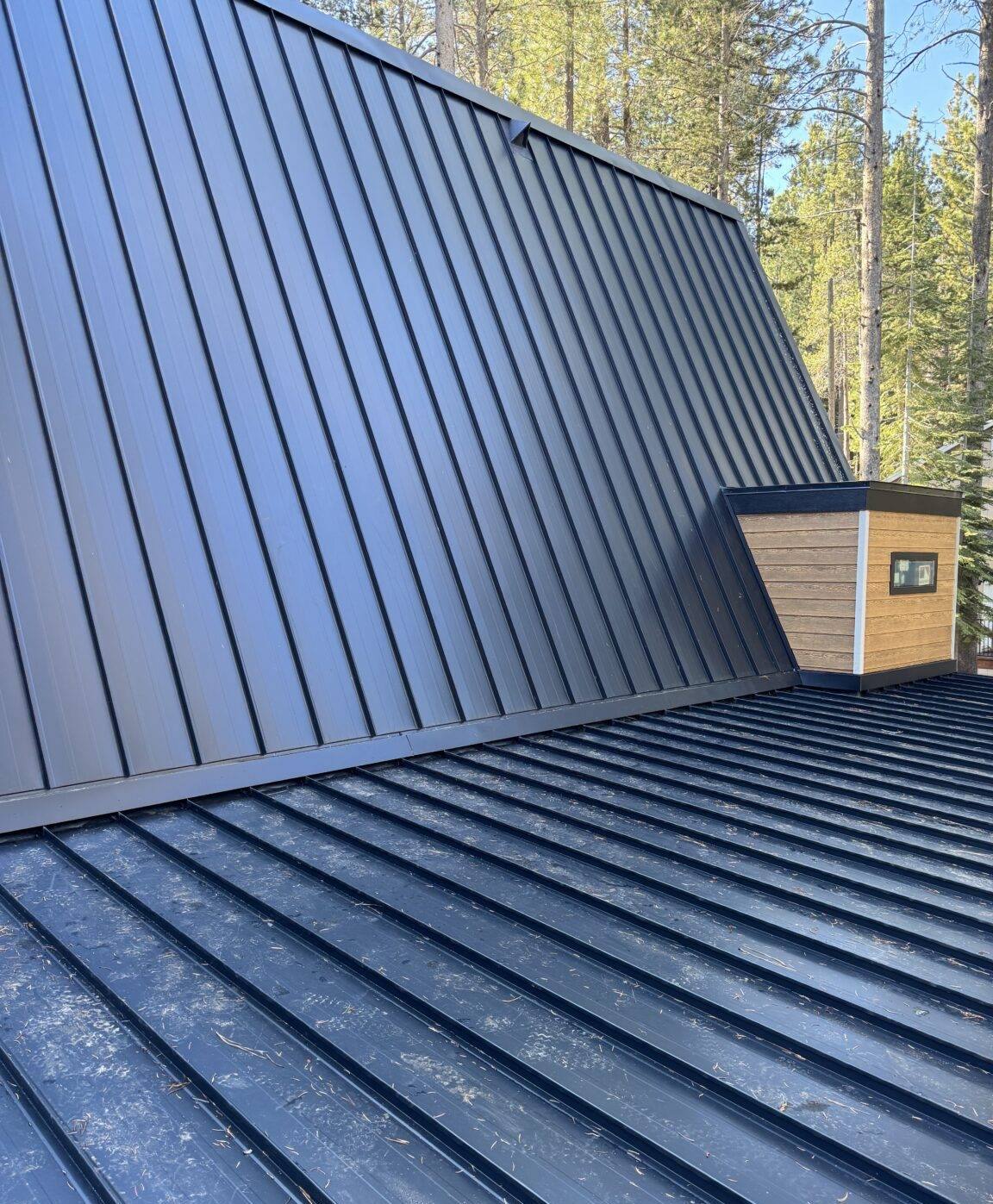
Not every "metal roof" is built the same way, and the differences matter more here than they would in a dry inland climate. The two systems we install most on Orcas Island are standing seam and exposed-fastener (screw-down) panels, and the right choice depends on the roof, the budget, and how close the home sits to the water.
| Factor | Standing Seam | Exposed-Fastener |
|---|---|---|
| Fasteners | Hidden under interlocking seams | Screws through the panel face |
| Salt-air durability | Very good — fewer penetration points for water and salt to reach | Good, but exposed screws and washers are the first thing to wear and need future attention |
| Upfront cost | Higher | Lower |
| Expected lifespan | Longest of the two, with proper install | Solid, shorter than standing seam |
| Maintenance | Minimal once installed correctly | Occasional check and re-torque of fastener screws over time |
| Best fit | Waterfront-adjacent or high-exposure roofs | Outbuildings, budget-conscious projects, lower-exposure sites |
For homes close to the harbor, we generally steer people toward standing seam because it has far fewer places for wind-driven rain and salt to work their way in. Exposed-fastener panels are still a legitimate, cost-effective option — the trade-off is more maintenance points, not a lower-quality roof.
Metal Type Matters as Much as the Panel Style
Steel, aluminum, and copper all behave differently near saltwater. Aluminum resists salt-air corrosion better than uncoated or lightly coated steel and is a common choice for coastal San Juan County properties. Galvalume and painted steel systems can perform well too, but the coating quality and how well cut edges and fasteners are sealed matters more here than it would inland. We also avoid mixing incompatible metals — for example, the wrong fastener or flashing metal in contact with the panel can set off galvanic corrosion that eats away at the roof from a single contact point, regardless of how good the panel itself is.
What a Correct Metal Roof Installation Involves
A metal roof is only as good as what's underneath it and how the details are handled. On a Deer Harbor project, we pay particular attention to:
- Deck inspection and repair before anything goes down — trapped moisture under a metal roof is worse than under shingles because it has less chance to breathe out
- A quality synthetic underlayment, with self-adhered ice-and-water membrane at eaves, valleys, and any low-slope transitions
- Fastener spacing and clip selection matched to the wind exposure of the specific roof, not a one-size pattern
- Flashing at every penetration, valley, and wall intersection — this is where the majority of metal roof leaks actually start
- Corrosion-appropriate fasteners and flashing metals that won't set off galvanic reaction with the panel
- Ridge ventilation sized correctly so the attic or roof assembly can dry out between storms
None of this is unique to metal roofing in theory — but in a marine climate, skipping or shortcutting any one of these items shows up as a real problem much sooner than it would in a drier part of the state.
Living With a Metal Roof Through Moss Season
One advantage of metal over asphalt is that moss has a much harder time getting a foothold on a smooth painted or coated panel. It doesn't have zero chance, though — debris still collects in valleys and against any horizontal trim, and on heavily shaded sections of roof, moss and lichen can still take hold over time, especially where organic debris from overhanging trees builds up. The fix is straightforward:
- Keep overhanging branches trimmed back so the roof gets more sun and airflow
- Clear needles, leaves, and debris from valleys and gutters a couple of times a year, more if the lot is heavily treed
- Avoid pressure washing directly into seams or fastener heads — a soft wash or gentle rinse is enough on metal
- Have gutters and downspouts checked so water isn't backing up against the eave edge
This is light maintenance compared to what a shingle roof needs in the same conditions, but it's not nothing, and skipping it for years at a stretch is how moisture problems start even on a well-installed metal roof.
Our Process for a Deer Harbor Metal Roofing Project
We walk every project through the same steps, adjusted for the specific roof:
- On-site inspection of the existing roof, deck condition, flashing, and ventilation
- A straightforward conversation about panel style, metal type, and color, with honest trade-offs for this specific location
- A written estimate that spells out material, underlayment, flashing detail, and timeline — no vague allowances
- Tear-off (or a code-compliant overlay, if the deck and existing roof genuinely support it) and deck repair as needed
- Underlayment, panel installation, and flashing work done to the standard described above
- Final walk-through so you know what was done and what, if anything, needs periodic attention
We don't push a single product or panel style on every project. What we install depends on the roof's exposure, the home's design, and what you're trying to get out of it — lowest lifetime maintenance, lowest upfront cost, or something in between.
What Drives Metal Roofing Cost in Deer Harbor
| Factor | Why It Affects Cost |
|---|---|
| Roof pitch and complexity | Steeper roofs and more valleys, dormers, or penetrations mean more flashing and labor time |
| Panel style | Standing seam runs higher than exposed-fastener because of the fabrication and install labor |
| Metal type | Aluminum and copper cost more than steel but bring different corrosion resistance and lifespan |
| Tear-off vs. overlay | Removing the old roof and repairing the deck adds cost but is often the more honest long-term choice |
| Site access | Island logistics — material delivery, staging space, and site access — factor into scheduling and cost more than on a typical mainland job |
| Underlayment and flashing package | Upgraded ice-and-water coverage and better flashing metal add cost but matter more here than in a drier climate |
We're not going to publish a per-square-foot number here because it genuinely varies by roof — but we'll give you a real, itemized number after we've actually looked at your roof, not a phone estimate.
Why a Local Crew Matters for This Job
Metal roofing isn't a job you want a crew learning on, and it especially isn't a job you want a crew learning coastal conditions on. Working regularly around Orcas Island and the rest of San Juan County means we already know which fastener and flashing combinations hold up here, how the prevailing wind and rain pattern in this area actually loads a roof, and how to plan material delivery and scheduling around island logistics instead of figuring it out mid-project. It also means that if a storm causes a problem after the fact, you're calling a crew that's already familiar with your roof and the area, not starting from zero with someone new.
Signs Your Current Roof Needs a Look
- Rust streaking, especially around fasteners, flashing, or panel laps
- Moss or dark staining building up in valleys or shaded sections
- Loose, lifted, or visibly corroded fastener heads on an exposed-fastener roof
- Water stains on interior ceilings after a heavy wind-driven rain event
- Gutters that overflow or pull away from the fascia
- A roof original to a home built more than 20-25 years ago that hasn't been inspected recently
None of these automatically mean a full replacement — sometimes it's a flashing repair or a fastener service. But they're worth a look before the next storm season rather than after a leak shows up inside the house.
If you're weighing a metal roof for a Deer Harbor property, or want an honest opinion on whether your current roof needs repair or replacement, we're happy to come take a look. The estimate is free, there's no pressure attached to it, and you'll get a straight answer either way — just fill out the form below.