 Orcas Island
 Building a Deck That Can Actually Handle Cascade Lake
A deck around Cascade Lake lives a harder life than one in a dry inland town. The lot is likely shaded by fir and cedar, the air carries salt off the surrounding waters of San Juan County, and the rain doesn't just fall here — it drives sideways for weeks at a stretch during the fall and winter. Add a moss season that can run from October well into spring, and you've got a structure that's under near-constant moisture load for most of the year. A deck built to a generic spec sheet will show it within a few seasons: soft spots at the ledger, rusted fasteners bleeding streaks into the boards, and a green film on every horizontal surface that never quite dries out.
This page covers what a custom deck actually needs to hold up around Cascade Lake — the materials, the framing details, the drainage, and the maintenance rhythm — plus how we build and permit them for this specific area.
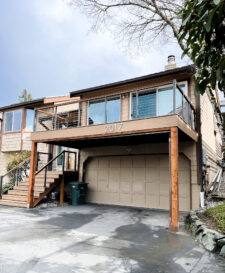
What This Site Does to a Deck
Salt Air and Metal
Orcas Island sits in salt air even away from the immediate shoreline, and lake-adjacent lots around Cascade Lake still get enough of it to matter. Standard zinc-coated fasteners and joist hangers corrode faster here than in a dry inland climate — you'll see the rust bleed through decking within a couple of years if the wrong hardware went in. Every fastener, hanger, and bracket in a deck we build gets picked for corrosion resistance, not just code minimums.
Driving Rain and Hidden Rot
The failure point on most decks isn't the decking boards — it's the ledger board where the deck attaches to the house, and the framing members that sit underneath the boards where nobody looks. Wind-driven rain gets pushed sideways into gaps that would stay dry in a calmer climate. Without proper flashing behind the ledger and moisture barrier tape on the joists, water tracks in and rots the structure from the inside while the surface still looks fine.
Shade, Humidity, and Moss
Many lots near Cascade Lake sit under heavy tree canopy, which is part of the area's appeal but is also exactly the combination moss needs — filtered sun, still air, and moisture that lingers longer than it would on an open, wind-exposed deck. Fallen needles and leaf litter collect in the gaps between boards and hold water against the wood or composite surface, feeding the moss and algae that make decks slick and, eventually, stained.
What a Correctly Built Deck Includes Here
Whatever material you choose, the details underneath and around it are what determine whether the deck is still solid in fifteen years. On a Cascade Lake project, we treat these as non-negotiable:
- Self-adhering flashing membrane behind the ledger board, with proper counter-flashing where it meets the siding
- Stainless steel or hot-dip galvanized fasteners and structural hardware, not standard zinc-coated
- Joist tape over the tops of all framing members to shed water before it reaches end grain and fastener holes
- Board spacing wide enough to let debris flush through rather than pack the gaps and hold moisture
- A slight slope away from the house so water sheds off the surface instead of pooling
- Footings sized and set for the actual soil or ledge rock on the lot, not a one-size assumption
- Railings and guards built to current code height and baluster spacing, in a material that won't corrode in salt air
Skip any one of these and the deck may still look fine on installation day — the problems just take a year or two longer to show up.
Choosing the Right Decking Material
There's no single "best" decking material for every lot — the right call depends on how much sun the deck gets, how much upkeep you want to do, and your budget. Here's how the common options actually perform under Cascade Lake's shade-and-moisture conditions:
| Material | Moss/Algae Resistance | Maintenance | Typical Lifespan | Notes |
|---|---|---|---|---|
| Cedar | Fair — needs regular cleaning and sealing to resist staining | High — cleaning and resealing every 1–2 years in this climate | 15–25 years with upkeep | Natural rot resistance, warm look, ages to silver-grey if left unsealed |
| Pressure-treated pine | Poor in heavy shade without regular cleaning | High — sealing needed to prevent checking and staining | 10–20 years | Lower material cost, needs the most consistent maintenance here |
| Composite decking | Good, but shaded/damp spots can still develop surface algae | Low — periodic washing, no sealing or staining | 25–30+ years, varies by manufacturer warranty | Higher upfront cost, consistent appearance, some products handle moisture better than others |
| PVC/capped composite | Very good — non-porous surface sheds moisture and organic buildup | Low | 25–30+ years | Highest upfront cost of the group, best fit for heavily shaded lake lots |
On heavily shaded lots close to the lake, we usually steer homeowners toward composite or capped PVC for the field of the deck, because the maintenance gap versus wood is largest in exactly this kind of damp, low-sun environment. That said, plenty of Cascade Lake homeowners want the look of real wood and are willing to keep up with the cleaning and sealing schedule — that's a legitimate choice too, as long as you go in knowing the commitment.
Framing, Footings, and the Ground Underneath
San Juan County lots — including many around Cascade Lake — often mix shallow soil over glacial till or exposed ledge rock, which changes how footings get set. A generic footing depth pulled from a code table doesn't account for a boulder two feet down or a lot that slopes hard toward the water. We dig test holes before finalizing the footing plan, and where bedrock or large rock is close to the surface, we adjust footing design or move to a pier system that doesn't require the same excavation. Framing lumber itself is pressure-treated for ground contact where required, but the hardware connecting it — hangers, hurricane ties, ledger bolts — is what we upgrade for the salt air, since that's the part that fails first if it's undersized for the environment.
Design Considerations for a Lake-Adjacent Lot
Grade and Multiple Levels
Lots near Cascade Lake are frequently sloped, which often means a multi-level deck makes more sense than a single flat platform — stepping down toward the view or the yard rather than building one tall structure with a single long stair run. Multi-level designs also help manage drainage, since each level can be pitched independently instead of trying to shed water off one large surface.
Railings and Guards
Washington building code requires guardrails at 42 inches on decks more than 30 inches above grade, with baluster spacing that won't pass a 4-inch sphere. For material, we typically recommend powder-coated aluminum or stainless cable over untreated steel or basic wood balusters, since those hold up better against the salt-laden, damp air than raw metal will over time.
Debris Management
With fir and cedar overhead on many lots, needle and leaf litter is a year-round fact of life. Board spacing, gap width, and how close the decking sits to the wall line all affect how easily that debris flushes off in the rain instead of packing into corners and stair treads.
Permits Around Cascade Lake
Deck construction in San Juan County generally requires a building permit, and lots near the water — including lake frontage around Cascade Lake — can also fall under shoreline management review depending on the deck's size, height, and distance from the water. This isn't something to guess at: setback and permit requirements vary by parcel, and getting it wrong can mean a stop-work order mid-project. We pull the permit history and zoning for the specific lot before we finalize a design, so the deck you plan is the deck you're actually allowed to build.
Our Process for a Cascade Lake Deck Build
- Site visit and assessment — we look at grade, shade, soil/rock conditions, and the existing structure the deck will attach to
- Design and material selection — sized to the lot, matched to your maintenance preference and budget
- Permitting — building permit, and shoreline review if the location requires it
- Framing — footings set for the actual soil conditions, ledger flashing, corrosion-resistant hardware throughout
- Decking and railing installation — proper gap spacing, code-compliant guards
- Final inspection and walkthrough — including a maintenance plan specific to the material you chose
Because Orcas Island is ferry-served, material delivery and crew scheduling take a bit more lead time than a mainland job — we build that into the timeline up front so there are no surprise delays mid-project.
Keeping It Solid After We Leave
Whatever material you choose, plan on an annual cleaning at minimum given how long the moss season runs here — a soft wash with an appropriate cleaner, not a pressure washer, which can gouge wood fibers or damage the surface texture on composite boards. Wood decks need resealing on a 1–2 year cycle to keep water from tracking into the grain. Composite and PVC decks need far less, but it's still worth clearing debris from the gaps a few times a year so moisture doesn't sit and grow algae in the same spots repeatedly.
A deck built with the right flashing, hardware, and material for Cascade Lake's climate will ask very little of you beyond that. One built to a generic spec will ask a lot more, usually starting around year three.
If you're planning a new deck or replacing one that's showing its age, we're happy to come take a look and give you a straightforward, no-pressure estimate — just fill out the form below.