 Orcas Island
 Crow Valley's Climate Is Different From the Shoreline — Not Easier
Homeowners on Orcas Island sometimes assume that if a house isn't sitting on the water, it's spared the worst of what the Pacific Northwest throws at exterior surfaces. Crow Valley proves otherwise. The valley floor sits low, surrounded by forested slopes that hold in moisture and shade large stretches of wall for much of the day. Fog settles into the valley overnight and burns off slowly. Add San Juan County's long wet season and driving winter rain, and you get a microclimate that's arguably harder on siding than an open waterfront lot that at least gets steady sun and wind to dry things out.
Salt air still reaches Crow Valley — it travels further inland than most people expect on an island this size — but the bigger issue here is standing moisture. Tree cover, low light, and valley fog mean siding on north- and east-facing walls can stay damp for days after a storm passes. That combination is exactly what fiber cement siding was engineered to handle, and exactly what softer or moisture-sensitive materials struggle with.
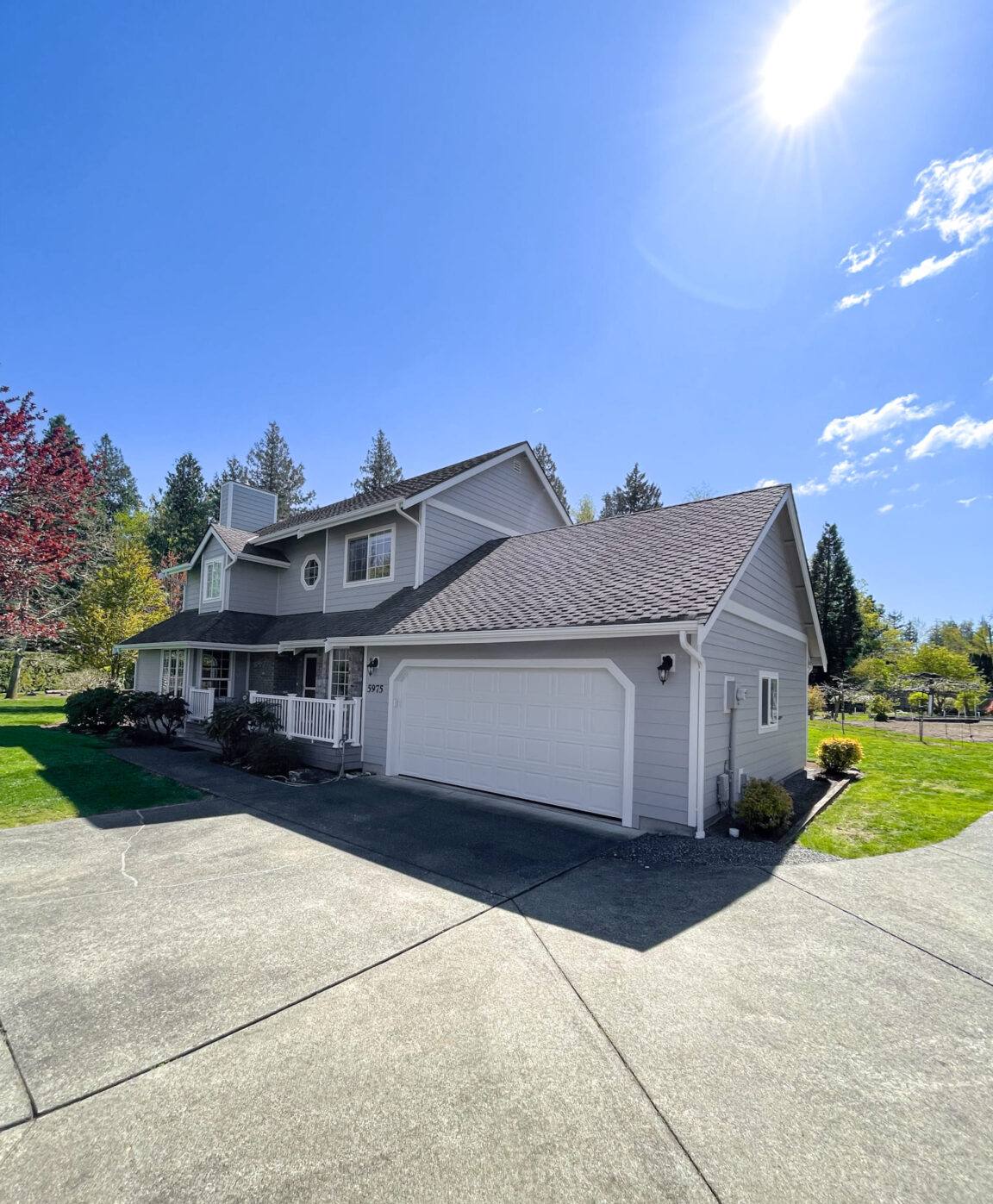
What Shade, Fog, and Moss Do to the Wrong Siding
Moss and Algae on Shaded Walls
Any organic or semi-organic siding surface exposed to prolonged dampness and low light will eventually host moss and algae growth. On Crow Valley properties tucked under fir and cedar canopy, this shows up first on north-facing walls, under eaves, and anywhere runoff from a roofline doesn't fully clear the wall below. Once moss takes hold, it holds moisture against the surface even longer, accelerating whatever damage was already starting underneath.
Moisture That Doesn't Fully Dry Out
Wood-based and wood-adjacent siding products need dry-out time between rain events to stay stable. In a valley where fog and shade cut into that drying window, swelling, cupping, and paint failure show up faster than the manufacturer's climate assumptions account for. This is less about any one storm and more about cumulative days of dampness over a wet season that, on this island, runs long.
Fasteners and Edges Take the First Hit
Cut edges, fastener heads, and butt joints are where most siding failures start, regardless of material. In a damp, shaded environment those vulnerable points stay wet longer between dry spells, which is why correct sealing and fastening detail work matters more in Crow Valley than it would on an exposed, sun-dried lot elsewhere on the island.
Why We Install Only James Hardie Fiber Cement Siding
We standardized on James Hardie fiber cement for every home we side, including in Crow Valley, and we don't install LP SmartSide, vinyl, Cemplank, Allura, primed spruce, or cedar. That's not a marketing position — it's a call we made after years of watching which products actually hold up in San Juan County's damp, shaded, moss-prone conditions and which ones require more upkeep than most homeowners expect going in.
Fiber cement is non-combustible, dimensionally stable in wet-dry cycling, and doesn't feed moss and algae the way organic-content products can. James Hardie's ColorPlus factory-applied finish is baked on under controlled conditions rather than field-painted, which matters directly in Crow Valley: less on-site painting means less dependence on a dry weather window that, in this valley, doesn't always cooperate on a job's schedule. James Hardie also backs its siding with a strong limited warranty that's transferable to a new owner, which matters on an island where properties change hands and buyers want to know what they're inheriting.
The Hardie Product Lines We Use Locally
James Hardie builds its siding in different climate-engineered formulations, and the product we specify accounts for the moisture load typical of a marine, high-humidity environment like the San Juan Islands rather than a drier or harsher-winter region. We select the specific plank, panel, and trim combination based on the individual home — architectural style, wall exposure, and how much shade and moisture a given elevation actually sees.
| Product | Typical Use | Why It Fits Crow Valley |
|---|---|---|
| HardiePlank lap siding | Most traditional and farmhouse-style homes | Classic look, factory finish resists the moss/algae staining common on shaded walls |
| HardiePanel vertical siding | Modern builds, accent walls, gable ends | Fewer horizontal laps to trap runoff on steep or shaded rooflines |
| HardieTrim boards | Corners, window and door surrounds, fascia | Matches the dimensional stability of the field siding so trim doesn't fail first |
| HardieSoffit panels | Eaves and overhangs | Resists the persistent dampness under deep, shade-covered eaves |
What a Correct Installation Actually Involves
Fiber cement performs well on paper, but its real-world lifespan depends almost entirely on installation detail. This is where a lot of siding jobs — on any material — quietly go wrong, and it's the part homeowners can't easily inspect once the siding is up.
- Proper starter strip and water table detail so the bottom course sheds water correctly
- Correct fastener type, spacing, and depth per Hardie's published installation instructions
- Rain screen or drainage gap where wall assembly and code call for it, so moisture behind the siding can escape
- Flashing at every window, door, deck ledger, and roof-to-wall intersection — not just caulk covering a gap
- Field-cut edges primed or sealed before installation, since factory finish doesn't extend to a fresh cut
- Correct clearance from grade, decks, and roof lines to keep the bottom edge of the siding out of standing moisture
- Joint and seam treatment that accounts for expansion rather than relying on caulk alone
Skip any one of these steps and you can end up with a product that's rated for decades performing far below that in practice — and in a valley that holds moisture the way Crow Valley does, mistakes show up faster than they would in a drier location.
Our Process for Crow Valley Homes
- On-site assessment — we walk the property, note which walls get the least sun and airflow, check existing moisture damage, and look at the current wall assembly.
- Material and layout plan — we choose the plank/panel combination and trim details suited to the home's exposure, not a one-size-fits-all spec.
- Prep and removal — old siding comes off, the sheathing underneath gets inspected and repaired if needed before anything new goes on.
- Weather barrier and flashing — this stage determines whether the siding will actually stay dry behind the surface, and it's non-negotiable.
- Installation to manufacturer spec — fastening, gaps, and joint treatment done to James Hardie's published requirements, not shortcuts.
- Final detail and walkthrough — trim, caulking, and a walk-through with the homeowner before we consider the job finished.
Cost Factors on a Crow Valley Project
Every home is different, and we won't quote a number without seeing the property, but these are the factors that most often move a Crow Valley job's cost up or down.
| Factor | Why It Matters |
|---|---|
| Existing siding removal and disposal | Older cedar or wood siding often needs full tear-off, adding labor |
| Sheathing condition | Moisture-damaged sheathing found during removal needs repair before new siding goes on |
| Access and site conditions | Long driveways, tree cover, and rural staging areas common in Crow Valley affect logistics |
| Wall height and complexity | Gables, dormers, and multiple roof-to-wall intersections add cutting and flashing time |
| Product mix | Plank, panel, trim, and soffit combinations vary in material cost per square foot |
| Color and finish | Factory ColorPlus finishes and custom color-match options price differently than standard primed product |
Signs Your Current Siding May Already Be Failing
- Dark green or black staining that keeps returning after cleaning, especially on shaded walls
- Soft spots, bubbling, or visible swelling near the bottom courses or around windows
- Paint that's peeling or alligatoring faster than a normal repaint cycle would suggest
- Visible gaps at seams, corners, or trim where caulking has pulled away
- A musty smell or soft drywall on an interior wall that backs onto an exterior wall
- Siding that flexes or feels spongy when pressed near the base of the wall
Any one of these on its own isn't necessarily an emergency, but on a Crow Valley property they're worth having looked at before another wet season adds to the damage.
Why Hiring a Crew That Already Works Crow Valley Matters
Fiber cement installation isn't exotic work, but installing it correctly in a low, shaded, fog-prone valley on San Juan County's largest island is a different job than installing the same product on an open, sun-exposed lot. A crew that already knows which walls in Crow Valley hold moisture longest, how rural access and staging typically work here, and how the valley's drainage and tree cover interact with a wall assembly is going to make fewer assumptions and fewer mistakes than a crew seeing the terrain for the first time. That familiarity shows up in the small decisions — where extra flashing goes, how a rain screen gap is detailed, which walls get prioritized — that ultimately decide how long the siding actually lasts.
If you're weighing a siding replacement or want a second opinion on what's currently on your Crow Valley home, we're happy to take a look and put together a straightforward, no-pressure estimate using the form below.