 Orcas Island
 Why West Beach Decks Wear Out Faster Than Most
Homes along West Beach sit in one of the more exposed corners of Orcas Island, and their decks take a beating that inland San Juan County properties simply don't see. Salt-laden air corrodes fasteners and hardware from the inside out, long stretches of driving rain drive moisture into end grain and joints, and the region's extended moss season keeps surfaces damp for months at a time. A deck that might last two decades in a drier, inland climate can start failing structurally in half that time out here if it wasn't built or maintained with these conditions in mind.
We've replaced enough decks in this specific stretch of Orcas Island to know the failure patterns are predictable: soft ledger boards where the deck meets the house, rusted or degraded fasteners, joists that look fine on top but are punky underneath, and railing posts that have rotted at the base. None of this is unusual for the area — it's just what salt air, rain, and moss do over time. The question isn't whether a West Beach deck will eventually need attention, it's whether the next one is built to slow that process down.
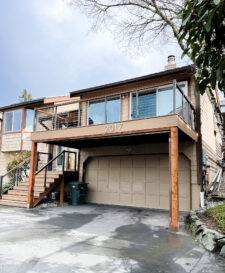
Signs a Deck Needs Replacement, Not Another Repair
Homeowners often ask us to patch a board or two, and sometimes that's genuinely all that's needed. But there's a point where spot repairs stop making sense and a full replacement is the more honest answer. Here's how we tell the difference on a typical visit:
- Soft or spongy decking in multiple, unrelated areas — not just one board near a planter or downspout
- Visible rot or corrosion at the ledger board connection to the house, which is a structural safety issue, not cosmetic
- Joists or beams that flex noticeably underfoot or show rot when probed with a screwdriver
- Railing posts loose at the base, which usually means the post itself or the framing it's anchored to has failed
- Fasteners that are rusted, bleeding stains into the wood, or have lost their heads
- A deck that's more than 15–20 years old and was never rebuilt or re-fastened with corrosion-resistant hardware
If the problems are isolated to a few boards and the substructure underneath is sound, repair is the right call and we'll say so. If the framing itself is compromised, patching the surface just hides the problem for another season.
Decking Material Choices for Salt Air and Moisture
There's no single "best" decking material for every West Beach home — it depends on budget, how much upkeep you want to do, and how close the deck sits to the water. What we can do is lay out the honest trade-offs of each option under the conditions this area actually produces.
| Material | How It Handles Salt Air & Rain | Moss & Maintenance | Typical Lifespan Here |
|---|---|---|---|
| Pressure-treated wood | Holds up reasonably well if sealed and re-sealed on schedule; end grain and fastener points are the weak spots | Needs annual cleaning and re-sealing to resist moss and graying | 10–20 years with upkeep |
| Cedar | Naturally resists rot better than most softwoods but still needs finish maintenance in this climate | Moss and mildew form without regular cleaning; finish needs renewing every few years | 15–20 years with upkeep |
| Composite decking | Doesn't absorb moisture like wood, so it's less prone to rot; performs well in salt air | Low maintenance, but can stay damp on the surface longer, which favors moss growth if not rinsed periodically | 25+ years, manufacturer-dependent |
| PVC/capped decking | Fully resists moisture absorption; among the most stable choices in wet, salty conditions | Very low maintenance; occasional rinsing keeps moss from taking hold | 25+ years, manufacturer-dependent |
Whatever surface material a homeowner chooses, we're stricter about what goes underneath. The substructure — joists, beams, ledger, and fasteners — is what actually determines whether a deck lasts. We use fasteners and connectors rated for coastal exposure regardless of which decking product sits on top, because a beautiful composite deck on corroding hardware is still a deck on borrowed time.
Why We're Selective About Certain Products
Some decking and railing systems on the market are more sensitive to installation technique than others — tight tolerances for expansion gaps, specific fastener requirements, or coatings that need to be handled carefully during construction to keep the warranty intact. We stick to systems where we can install to spec every time and stand behind the workmanship. That's a standard we hold ourselves to, not a knock on any particular manufacturer.
What a Correct Deck Replacement Actually Involves
A deck replacement done right is a rebuild from the ground up, not just a resurfacing job. Here's what we account for on every project in this area:
Substructure First
Posts, footings, beams, and joists get evaluated and replaced as needed before a single new board goes down. On older West Beach properties, this is often where we find the real problem — a deck surface that looks tired but is actually sitting on framing that's already failed underneath.
Ledger Board and Flashing
The connection between the deck and the house is the single most common failure point we see in this climate, because it's where water gets trapped against the structure. Proper flashing and a sealed, correctly fastened ledger board are non-negotiable — this detail alone determines whether water intrudes into the house framing over time.
Fasteners and Hardware
Everything gets rated for coastal, high-moisture exposure — not the standard hardware that might be fine forty miles inland. This is a small cost difference upfront and a major difference in how long the deck holds together.
Drainage and Airflow
Decks that sit low to the ground or trap moisture underneath rot faster and grow moss sooner. We build in the spacing and drainage paths that let a deck actually dry out between the rain events this region gets so many of.
Our Process for a West Beach Deck Replacement
- On-site assessment — We inspect the existing deck, probe the framing for hidden rot, and give an honest read on repair versus replacement before any work starts.
- Design and material selection — We walk through material options and layout changes with the homeowner, being upfront about cost, maintenance, and lifespan trade-offs for this specific site.
- Permitting — Deck work in San Juan County typically requires permitting depending on size and height; we handle that process rather than leaving it to the homeowner.
- Tear-out — The old deck comes down, and we take a close look at what's revealed underneath — this is when hidden rot or structural issues get confirmed.
- Rebuild — New footings, framing, ledger connection, decking, and railing go in to current code and to the material manufacturer's installation specs.
- Final walkthrough — We go over the finished deck with the homeowner, including what maintenance (if any) the chosen material needs going forward.
Cost Factors Worth Understanding
Every deck replacement is different, but the same handful of variables drive most of the cost swing we see on West Beach jobs:
| Factor | Why It Matters |
|---|---|
| Deck size and footprint | Straightforward — more square footage means more material and labor |
| Height and grade | Taller decks or sloped sites need more substantial framing, footings, and often railing systems |
| Decking material | Composite and PVC cost more upfront than wood but typically cost less in maintenance over the deck's life |
| Access for equipment and delivery | Tighter or more remote sites on the island can add time for material staging and hauling debris |
| Extent of substructure damage | Hidden rot found at tear-out can add scope — this is why an honest upfront assessment matters |
We'd rather give a homeowner a realistic range up front, including what could change once we open things up, than a number that looks good on paper and grows once the old deck comes off.
Living With a New Deck Through Moss Season
A correctly built deck still needs some seasonal attention on Orcas Island — the climate doesn't change just because the materials are better. A short list of habits keeps a new deck looking and performing the way it should:
- Sweep off fallen leaves and debris regularly, especially in fall, so moisture and organic matter don't sit on the surface
- Rinse composite or PVC decking periodically to discourage moss and algae film, particularly on shaded sections
- Check railing posts and stair connections once a year for any looseness, especially after a hard winter
- Keep gutters and downspouts near the deck clear so runoff isn't dumping extra water onto or under the structure
- Re-seal wood decking on the schedule the product calls for — skipping a cycle is when rot gets a foothold
Why Local Experience on This Stretch of Orcas Island Matters
A crew that only occasionally works on the island doesn't necessarily know how differently West Beach behaves compared to a more sheltered lot elsewhere on Orcas Island, let alone the mainland. We've seen firsthand which fastener grades actually hold up here, which ledger details fail first, and how much moss buildup to expect in the shaded and low-airflow spots specific to this area's terrain and tree cover. That local pattern recognition is what keeps a deck replacement from repeating the same failure a decade down the road. It also means fewer surprises on scheduling and material delivery, since we already know the logistics of working on this part of the island.
If your West Beach deck is showing its age — soft spots, rusted hardware, or just years of moss and weather catching up with it — we're happy to take a look and give you a straight assessment of what it needs. Reach out for a free, no-pressure estimate using the form below.