 Orcas Island
 Metal Roofing in Obstruction Pass: What the Site Actually Demands
Obstruction Pass sits on the exposed southeast shoulder of Orcas Island, where forested lots run close to the water and the weather doesn't split the difference between seasons. Homes here take a combination that's hard on any roof: salt-laden air off the water, long stretches of driving rain pushed sideways by wind, and deep shade from conifers that keeps moss and moisture working on the roof deck almost year-round. A metal roof, installed correctly for this specific exposure, handles that combination better than most alternatives — but "installed correctly for this exposure" is doing a lot of work in that sentence, and it's the part that separates a roof that lasts decades from one that starts leaking at year eight.
This page is about metal roofing specifically for Obstruction Pass properties — what the climate asks of the system, what a correct installation involves, and why local experience with this stretch of San Juan County actually changes the outcome.
Why Salt Air and Rain Change the Calculation
Corrosion from Marine Exposure
Salt-laden air is persistent and doesn't need direct ocean spray to do damage — moisture in the air carries chloride inland and settles on any exposed metal. Over years, that accelerates corrosion at cut edges, fastener heads, and any spot where a coating has been scratched during handling or installation. The fix isn't complicated, but it has to be deliberate: factory-finished panels with a marine-grade coating system, stainless or coated fasteners rated for coastal exposure, and careful field handling so edges aren't left bare. Skipping any one of those steps is how a metal roof on the water side of the island starts showing rust streaks well before it should.
Driving Rain and Wind-Driven Water
Metal sheds water fast, which is a strength — but wind-driven rain doesn't always fall straight down, and it will find any gap in flashing, any under-lapped seam, or any fastener that's backed out even slightly. On exposed lots near Obstruction Pass, we plan flashing details and underlayment coverage assuming rain will hit the roof at an angle, not just vertically. That means extra attention at valleys, wall-to-roof transitions, chimneys, and any roof penetration — the places where most metal roof leaks actually originate, almost never the open field of panel.
Moss, Shade, and a Long Wet Season
Forested lots on this side of the island stay damp longer after a rain than open ones, and shaded roof sections are where moss and algae take hold first. Moss on a metal roof doesn't rot the panel the way it can rot shingles or wood, but it does trap moisture against the surface and against fasteners, and it can lift below improperly seated seams over time. Panel profile, slope, and how the roof sheds standing debris all matter more on a shaded, tree-lined lot than they do on an open one.
Standing Seam vs. Exposed Fastener: What We Actually Recommend
Both systems are legitimate metal roofing options, and the right choice depends on budget, roof slope, and how exposed the site is. We're straightforward with homeowners about the trade-offs rather than upselling one system across the board.
| Factor | Standing Seam | Exposed Fastener |
|---|---|---|
| Fasteners | Hidden, clipped — no exposed penetrations in the field of the panel | Visible screws through the panel face |
| Long-term maintenance | Very low — no fastener seals to monitor | Fastener washers age and need periodic checking/replacement |
| Upfront cost | Higher | Lower |
| Best fit for this area | Full sun and rain exposure, waterfront and higher-wind lots | Secondary structures, budget-driven projects, well-protected roof sections |
| Expected service life here | 40-60+ years with proper install | 25-40 years, dependent on fastener maintenance |
For a primary residence with real exposure to salt air and driving rain, we generally steer homeowners toward standing seam — the absence of exposed fasteners removes the single most common long-term failure point in coastal metal roofing. Exposed-fastener panel still has a place, particularly on shops, garages, and additions where budget matters more than 50-year performance.
What a Correct Installation Involves
Deck Assessment First
Before any panel goes down, the roof deck needs an honest look. Years of moisture from shade and moss can soften sheathing in spots that aren't visible from the ground or even from inside an attic without a close inspection. Installing metal over a compromised deck just hides the problem under a durable skin — it doesn't fix it.
Underlayment Built for Wet Climates
We use a high-temperature synthetic underlayment across the full roof, with self-adhered ice-and-water membrane at eaves, valleys, and around every penetration. On a site that sees this much sustained rain, underlayment isn't a formality — it's the actual secondary defense if wind ever drives water past a seam.
Flashing Details
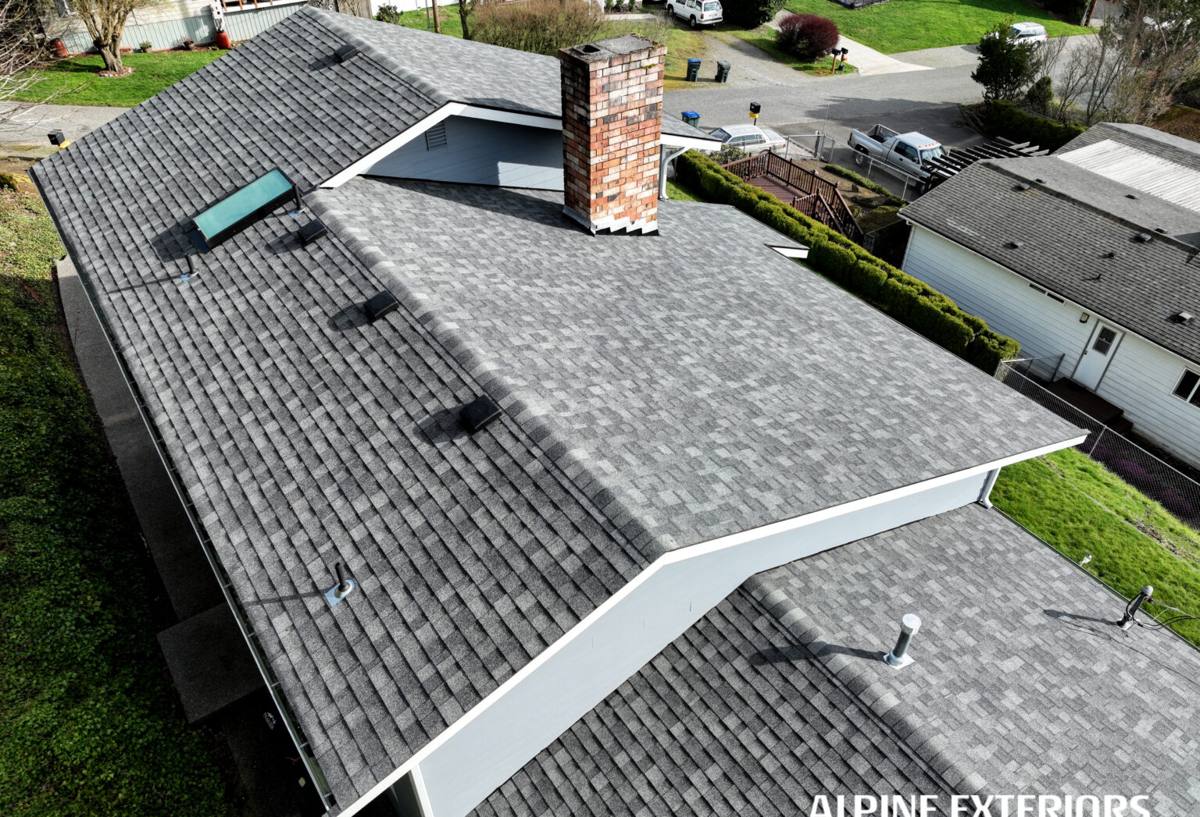
Chimneys, skylights, wall intersections, and vents are where metal roofs earn or lose their reputation. Correct step flashing, counter-flashing, and properly lapped transitions matter more than the panel choice itself. This is also where rushing a job shows up first — and where it costs the most to fix later.
Fastening Pattern for Wind Exposure
Lots directly facing the water or sitting in a wind funnel need a tighter fastening pattern and clip spacing than a sheltered inland lot. We adjust the install spec to the specific site rather than using one standard pattern for the whole island.
Ventilation
Ridge and soffit ventilation keeps moisture from condensing on the underside of the deck, which matters even more under a metal roof than under other materials because metal doesn't breathe or absorb any moisture itself — trapped attic moisture has nowhere to go but into the wood.
Practical Considerations Specific to Metal Roofs Here
- Snow and ice slide off metal roofs quickly — snow guards should be installed above entries, decks, and walkways so accumulated snow doesn't shed all at once.
- Dissimilar metals in contact (copper gutters against steel panel, for example) can cause galvanic corrosion — flashing and gutter materials need to be compatible with the panel system, not just whatever's on hand.
- Overhanging branches should be trimmed back from the roofline — falling limbs can dent panel, and constant leaf litter in valleys holds moisture against seams.
- Gutters need to be sized and pitched for the volume of water a metal roof sheds quickly — undersized gutters overflow faster under metal than under shingle.
- A metal roof's fire resistance is a genuine advantage on a forested, tree-lined lot, but it doesn't replace defensible-space practices like keeping the roof and gutters clear of needles and debris.
Why Local Experience Matters on This Job
Working on Orcas Island means every material delivery and every crew trip depends on ferry scheduling, and a job planned without that in mind either stalls mid-installation or gets rushed to avoid a second sailing. A crew that already works this island plans material orders, scaffolding, and crew days around the actual logistics, not around a mainland schedule that doesn't apply here.
Just as important is knowing the microclimates within San Juan County. A roof detail that holds up fine on a sheltered inland lot elsewhere on the island can fail within a few years on an exposed, water-facing lot near Obstruction Pass. That's not a guess — it's the kind of thing you only know by having worked roofs on both sides of the same island and having gone back to see which details held up and which didn't.
Our Process for a Metal Roofing Project Here
- On-site assessment — we look at the existing roof, deck condition, exposure direction, tree cover, and drainage before recommending a system.
- Straightforward proposal — panel type, underlayment spec, flashing plan, and a real cost range, explained in plain terms.
- Material and logistics planning — ordering and scheduling built around ferry timing so the job runs without unnecessary delays.
- Tear-off or prep — deck repairs handled before anything is covered up, with photos so you know what was found and what was done.
- Installation — underlayment, flashing, and panel installed to the spec for your specific site's exposure, not a generic standard.
- Final walkthrough — a review with you before we call the job done, not before we leave the island.
Signs Your Current Roof Needs Attention
- Rust streaking at seams, fasteners, or cut edges
- Heavy moss buildup, particularly on shaded slopes
- Water stains on interior ceilings after wind-driven rain
- Panels that look loose, wavy, or lifted at the seams
- Gutters overflowing during heavy rain even when clear of debris
- Visible daylight or gaps at flashing around chimneys or vents
If you're weighing a metal roof for a home near Obstruction Pass, we're happy to take a look and give you a straight assessment — what your specific site needs, what it will cost, and what trade-offs are actually worth considering. There's no pressure and no obligation. The estimate form below gets you a real conversation, not a sales pitch.