 Orcas Island
 Lopez Island's Climate Is Harder on Siding Than It Looks
From a distance, San Juan County weather looks mild — no hurricanes, no hail storms, nothing dramatic. But mild and easy are not the same thing. Lopez Island homes sit in a marine environment that works on siding slowly and constantly: salt-laden air off the water, driving rain that comes in sideways during winter storms, and a damp, shaded moss season that can stretch for months on north-facing walls and tree-lined lots. None of that shows up as a single bad event. It shows up five, ten, fifteen years later as swollen trim, peeling paint, soft spots at the bottom of wall panels, and siding that never quite dries out between storms.
That combination — salt exposure plus sustained moisture plus organic growth — is exactly what wears out the wrong siding choice and exactly what James Hardie fiber cement, installed correctly, is built to handle. This page is specifically about what that looks like for a Lopez Island home, not a generic overview of the product.
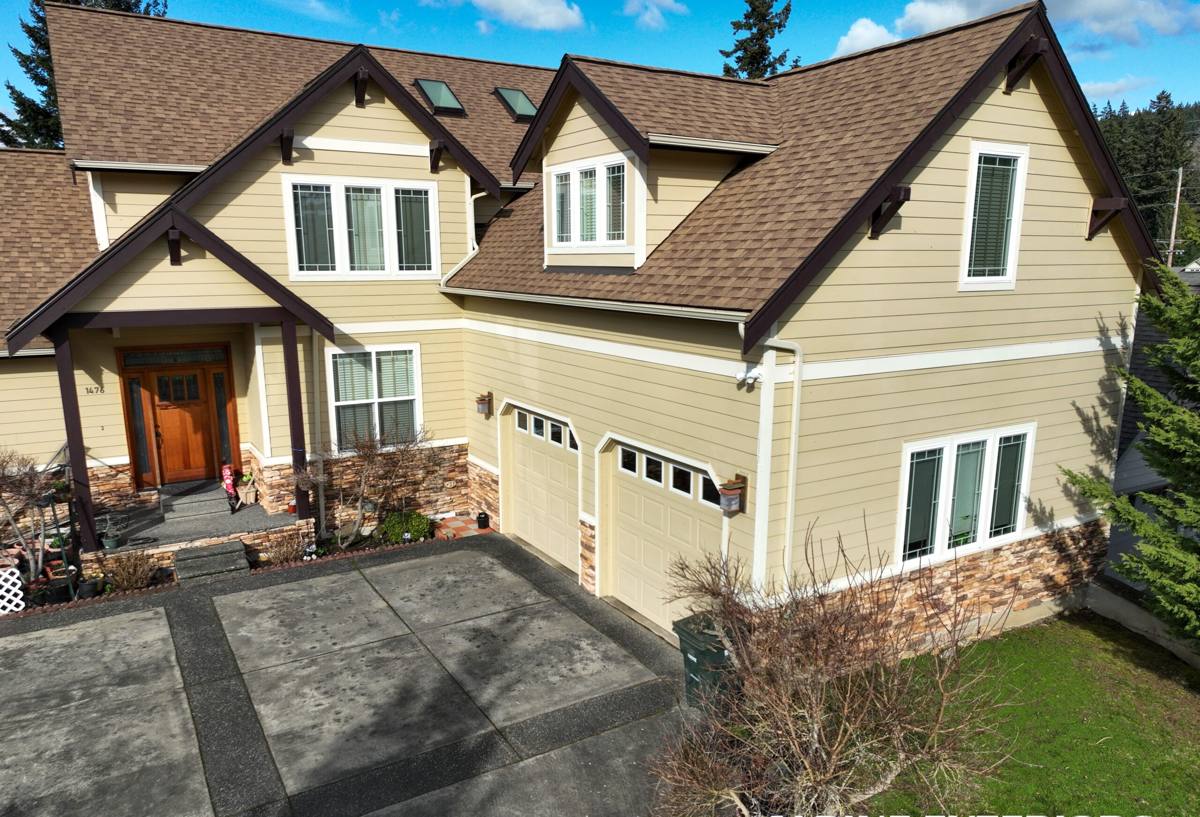
What Salt Air, Rain, and Moss Actually Do to a Wall
Salt air
Airborne salt is corrosive to fasteners and hardware, and it accelerates the breakdown of paint films and caulk over time. Siding that depends on a surface-applied coat of paint for its weather resistance will chalk, fade, and lose adhesion faster in a salt-air environment than the same product would inland.
Driving rain
Wind-driven rain doesn't just fall on a wall, it gets pushed into every gap, lap joint, and unsealed penetration. Water management — how a wall sheds and drains water rather than absorbing it — matters more here than in a calmer climate. A siding job that looks fine on a dry day can be failing behind the surface if the flashing and drainage details were done wrong.
Long moss season
Shaded, tree-covered lots common on Lopez Island stay damp longer after every rain. That extended dampness is what moss and algae need to take hold, especially on north and west elevations. Siding that absorbs moisture gives moss something to root into; siding that resists moisture gives it far less to work with.
Why We Install Only James Hardie
We don't install LP SmartSide, vinyl, Cemplank, Allura, primed spruce, or cedar. That's a deliberate standard, not a lack of options. Each of those products has real strengths, but each also has a real weakness that shows up faster in a marine climate like this one — wood-based products that swell and rot at moisture entry points, vinyl that becomes brittle and can crack in cold snaps and fade unevenly under UV and salt exposure, and composite panels with less-proven long-term performance in wet coastal conditions.
James Hardie fiber cement is non-combustible, dimensionally stable, and doesn't feed moss and mold the way wood-based products do. Its ColorPlus factory-applied finish is baked on under controlled conditions, which holds up better against salt air and UV than field-applied paint. Hardie also builds climate-specific HZ product lines and backs the material with a strong, transferable warranty. That combination is why we standardized on it and why it's what we recommend for Lopez Island homes specifically.
HZ5 vs. HZ10: Getting the Right System for This Site
James Hardie engineers its siding for different climate zones. Getting the right HZ designation matters more here than in a dry inland market — it affects how the product handles moisture cycling over the life of the siding.
| Factor | HZ5 System | HZ10 System |
|---|---|---|
| Designed for | Colder, wetter, freeze-cycle climates | Wet, humid coastal and southern climates |
| Typical fit for Orcas/Lopez Island | Common baseline for the Pacific Northwest | Considered on very exposed, high-moisture sites |
| What it changes | Formulation tuned for freeze-thaw and sustained damp conditions | Formulation tuned for constant humidity and moisture load |
| Our approach | Confirmed on-site based on exposure, elevation, and tree cover | Confirmed on-site based on exposure, elevation, and tree cover |
We don't guess at this from a spec sheet — we look at how exposed the specific wall is to wind-driven rain, how much shade and moss pressure it gets, and how the site drains before recommending a system.
What a Correct Installation Actually Involves
Fiber cement performs exactly as well as its installation. Most siding failures we get called to inspect trace back to installation shortcuts, not the material itself. On Lopez Island in particular, the following details are non-negotiable:
- Correct fastener spacing and type — matched to Hardie's specifications and resistant to the corrosive effects of salt air
- Proper starter strips and clearances — siding held off decks, patios, and grade to avoid wicking moisture
- Flashing at every penetration and horizontal joint — the single biggest factor in whether wind-driven rain stays out of the wall assembly
- A drainable weather-resistive barrier — so any moisture that does get past the siding has a path to drain and dry out
- Factory-cut and factory-primed edges wherever possible — field cuts sealed properly, since an unsealed cut edge is a moisture entry point
- Correct caulking at joints, not paint used as a substitute for sealant
Skip any one of these and the siding may look fine for a few years before problems surface — which is exactly why installation quality matters more than most homeowners realize when comparing bids.
Trim, Flashing, and the Details Most Bids Skip
Corner boards, window and door trim, and roof-to-wall transitions are where water intrusion actually starts on most homes — not the flat field of siding. On a Lopez Island property, we pay particular attention to:
- Kick-out flashing where roof lines meet siding, directing water away from the wall instead of behind it
- Head flashing above windows and doors, sized and installed to shed water past the opening
- Butt joints between siding boards sealed and, where possible, backed with flashing tape rather than caulk alone
- Bottom-of-wall clearance from decks, soil, and hardscape to prevent standing moisture
These are the details that separate a siding job that looks good at handoff from one that's still performing correctly in year fifteen.
Moss, Algae, and Keeping ColorPlus Finish Looking Right
No siding is moss-proof if it's shaded and damp enough, but ColorPlus finish gives homeowners a real advantage: it's less porous than field-applied paint, so algae and moss have a harder time getting a foothold, and the color itself resists fading from UV and salt exposure far longer. On Lopez Island's shadier, tree-covered lots, we still recommend simple homeowner maintenance:
- Gentle rinsing of north- and west-facing walls once or twice a year, especially near tree cover
- Keeping gutters and downspouts clear so roof runoff isn't dumping extra water onto the siding
- Trimming back vegetation that keeps a wall section shaded and damp longer than the rest of the house
- Avoiding pressure washing directly at the siding surface — a gentle rinse is enough and won't drive water behind laps
What It Costs — and What Drives the Range
Every Lopez Island home is different, and we don't quote sight-unseen, but these are the honest factors that move a project up or down in price:
| Factor | Why It Matters |
|---|---|
| Home size and wall complexity | More corners, gables, and dormers mean more cutting, flashing, and labor time |
| Current siding removal | Tear-off of failing wood or vinyl adds labor and disposal versus a clean substrate |
| Substrate condition | Rotted sheathing found underneath old siding needs repair before new siding goes on |
| Trim and detail work | Board-and-batten accents, extensive trim, or custom color mixing add time |
| Site access | Ferry-dependent scheduling and material delivery logistics factor into project timelines here more than on the mainland |
| HZ system selected | Site-specific exposure can call for a different product spec, which affects material cost |
Why a Crew That Already Works Lopez Island Matters
Working in San Juan County isn't the same as working on the mainland. Material deliveries, crew scheduling, and even weather windows for installation all have to account for ferry logistics. A contractor who hasn't planned around that will either quote optimistically and blow the timeline, or avoid island jobs altogether. A crew that already works Lopez Island and the wider Orcas Island area has that logistics figured out — deliveries timed to ferry schedules, crew days planned around tide and weather windows, and a working knowledge of which sites tend to run wetter or shadier than they look on paper.
That local familiarity also shows up in smaller ways: knowing which elevations on typical island lots take the worst of the driving rain, and sizing the flashing and clearance details accordingly instead of applying a one-size-fits-all approach.
How Our Process Works
- On-site evaluation — we look at current siding condition, wall exposure, moisture and moss patterns, and any sheathing concerns before recommending a system
- Written scope and product spec — including HZ designation, trim details, and color
- Scheduling around ferry and weather logistics — realistic timelines, not mainland assumptions applied to an island job
- Installation to manufacturer specification — flashing, fastening, and clearances done right the first time
- Final walkthrough — so you know exactly what was done and what simple maintenance keeps it looking right
If your Lopez Island home is due for new siding, or you're seeing early signs of trouble — swollen trim, peeling paint, moss creeping up the lower courses — we're happy to take a look and give you a straight, no-pressure estimate. Use the form below to get started.