 Orcas Island
 Siding That Has to Work in a Marine Climate, Not Just Look Good on Day One
San Juan Island sits out in the Salish Sea, and that location shapes everything about how siding performs here. Salt-laden air moves off the water and settles on exterior surfaces year-round. Rain doesn't just fall straight down — wind-driven rain off Haro Strait and the surrounding channels drives moisture sideways into wall assemblies, seams, and trim joints that a calmer inland site would never test. Add San Juan County's long, cool, damp shoulder seasons and you get months at a time where siding stays wet, shaded, and cool enough for moss and algae to take hold. A siding product that's rated fine for a dry inland suburb is being asked to do a different job out here.
This page is about one thing specifically: installing James Hardie fiber cement siding on San Juan Island homes, correctly, for this climate. We're not going to cover every siding material on the market or repeat a generic installation overview — you can find that elsewhere on this site. What matters here is what island conditions actually do to a wall system over ten, twenty, thirty years, and what has to happen at install time to make sure fiber cement holds up to it.
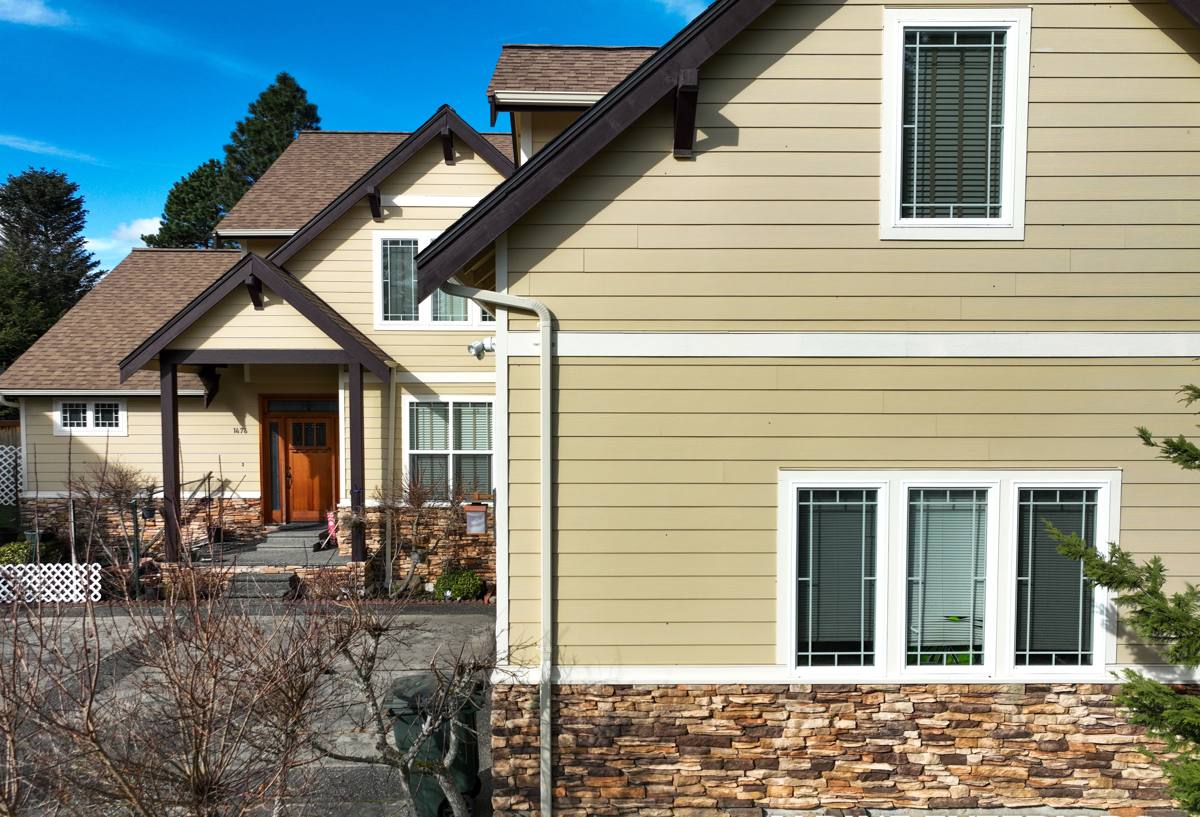
What Salt Air, Driving Rain, and Moss Actually Do to Siding
Each of these three factors stresses siding in a different way, and they compound each other.
Salt Air
Airborne salt is corrosive to exposed metal — fasteners, flashing, trim connectors — and it accelerates the breakdown of finishes that aren't formulated to resist it. On homes closer to the water or in more exposed, wind-facing positions, that exposure is constant, not occasional.
Driving Rain
Wind-driven rain doesn't behave like still-air rainfall. It gets pushed up under laps, into butt joints, and around penetrations that a standard installation might treat as low-risk. On San Juan Island, siding details that would be adequate in a sheltered inland yard need to be treated as high-exposure details as a default, not an exception.
Moss and Organic Growth
Shade, moisture, and cool temperatures for a large part of the year are exactly what moss, lichen, and algae need to establish. Any material that stays damp longer — because of poor drainage, tight clearances, or a finish that holds moisture at the surface — becomes a growth surface faster. This is a maintenance and appearance issue more than a structural one, but it's a highly visible one, and it's one homeowners here deal with on roofs, decks, and siding alike.
How Different Siding Materials Hold Up to That Combination
| Factor | Vinyl | Wood / Cedar | James Hardie Fiber Cement |
|---|---|---|---|
| Moisture absorption | Does not absorb, but seams and laps can trap moisture behind panels | Absorbs and releases moisture, driving swelling, cupping, and rot over time | Engineered to resist moisture-driven swelling and rot when properly installed and sealed |
| Salt air exposure | Can become brittle and discolored over years of UV and salt exposure | Salt accelerates weathering, checking, and finish breakdown | Factory finish (ColorPlus) formulated to hold up to coastal UV and salt exposure |
| Moss and organic growth | Smooth surface sheds growth better, but seams still collect debris | Textured, absorbent surface is highly prone to moss and algae | Dense, engineered surface resists moisture retention that feeds growth, though it still needs periodic cleaning |
| Impact and wind resistance | Can crack or blow off in high wind and impact events | Reasonably durable but softens with rot over time | Rigid, dense material with strong wind and impact performance when installed to spec |
| Maintenance cycle | Low maintenance but limited repair options once damaged | Frequent repainting, sealing, and rot repair | Repaint cycle measured in decades with ColorPlus finish; occasional wash-down for growth |
Why This Company Installs Only James Hardie Fiber Cement
We don't install vinyl, LP SmartSide, Cemplank, Allura, primed spruce, or cedar. That's a deliberate standard, not a lack of options. Vinyl and wood each have real strengths — vinyl is inexpensive and low-maintenance in mild climates, cedar has a look a lot of homeowners genuinely love — but in a marine environment like San Juan Island, both ask a homeowner to accept trade-offs we're not comfortable building a reputation on: wood's ongoing repainting and rot exposure, or vinyl's seam vulnerabilities and limited service life under sustained UV and salt.
James Hardie fiber cement is non-combustible, dimensionally stable in the freeze-thaw and wet-dry cycling this region sees, and available in HZ product lines engineered for specific climate zones — which matters on an island where wind and moisture exposure can vary block to block. The ColorPlus factory finish holds color and resists the fading and chalking that field-applied paint struggles with out here, and it comes with a strong, transferable manufacturer warranty. When it's installed to spec, it's the product we're willing to put our name behind on this island.
What Correct Installation Involves Here
Fiber cement is only as good as the installation, and in a high-exposure marine climate, the details matter more than they would in a milder setting.
- Proper water-resistive barrier and drainage plane behind the siding, so any moisture that does get past the cladding has somewhere to go
- Correct fastener type and spacing — using fasteners rated to resist the corrosive effects of salt air, not standard hardware
- Manufacturer-specified clearances from grade, roofing, and decks, which keep the bottom edge of the siding out of standing moisture and splash-back
- Properly lapped and sealed joints, especially at butt joints and around windows and doors, since these are the points wind-driven rain finds first
- Correct caulking and sealant at penetrations, using products rated for the exposure rather than whatever's on hand
- Painted or factory-finished cut edges, so field cuts don't become the weak point in an otherwise weather-resistant wall
Skip any one of these and you can still end up with a wall that looks right for a few years and then starts showing problems — trapped moisture, staining, early growth — that trace directly back to install-day shortcuts rather than the material itself.
Working on San Juan Island: What Our Process Looks Like
Island work has logistics that mainland jobs don't. Material has to be ordered and staged ahead of time rather than picked up same-day, and crews plan around ferry schedules rather than just drive time. We account for that in scheduling and material ordering up front, so a project doesn't stall out mid-job waiting on a delivery that missed a ferry slot. We also plan around San Juan County's weather windows — getting a wall properly dried in and sequenced during a stretch of workable weather matters more here than it would somewhere with a longer dry season.
We also walk each home's specific exposure before we spec the job — a wall facing open water or prevailing wind gets treated differently in terms of flashing detail and fastener spec than a more sheltered elevation on the same house.
Living with Moss Season: Maintenance That Actually Matters
Correct installation reduces how much moss and algae take hold, but it doesn't eliminate the need for occasional care in a climate like this. A realistic maintenance routine:
- Rinse siding down periodically, especially on shaded, north-facing, or tree-covered walls where growth establishes first
- Keep gutters clear so overflow isn't running down the siding face and keeping it wet longer than it should be
- Trim back vegetation and tree cover that keeps a wall section shaded and damp
- Inspect caulking at trim and penetrations every year or two, since sealant is the first line of defense against wind-driven rain and it doesn't last forever
- Address any moss or algae promptly with a gentle wash rather than pressure that can damage the finish
Cost Factors Specific to This Project Type
| Factor | Why It Matters on San Juan Island |
|---|---|
| Home exposure | Waterfront or wind-exposed elevations may need upgraded flashing and fastener detail versus sheltered walls |
| Existing siding removal | Rot or moisture damage found behind old wood or vinyl siding can add sheathing repair before new siding goes on |
| Material logistics | Island delivery timing affects scheduling more than material cost itself |
| Trim and detail work | Homes with more window/door penetrations and architectural trim take more install time to seal and flash correctly |
| Access | Multi-story homes or difficult site access can add staging and equipment time |
We won't quote a number without seeing the home, but these are the honest variables that move a bid up or down, and we'll walk through them with you directly.
Why It Matters That Your Crew Already Works This Island
A crew that regularly works San Juan Island already knows the ferry logistics, has relationships with local material suppliers and staging, and has seen firsthand how different exposures around the island — waterfront, wooded, open hillside — actually perform over time. That's different from a mainland crew treating an island job as a one-off: the scheduling risk is higher, the learning curve on exposure details is starting from zero, and callbacks are a lot more expensive to service when a crew has to plan an entire ferry trip to fix a punch-list item.
If you're planning a siding project on San Juan Island or elsewhere in the county, we're glad to walk your home, look at its specific exposure, and put together a straightforward, no-pressure estimate — just fill out the form below.