 Orcas Island
 Why Deer Harbor's Climate Is Hard on Siding
Deer Harbor sits on the water, ringed by conifer canopy that keeps much of the shoreline shaded for a good part of the year. That combination — salt-laden marine air, wind-driven rain coming straight off the water, and long stretches of shade and moisture that keep moss thriving from fall through spring — is a tougher environment for exterior siding than most inland San Juan County properties see. It's not one big storm that causes problems here; it's the slow, repeated exposure. Salt air works into fasteners and joints. Driving rain finds any gap in flashing or caulk that wasn't detailed correctly. And moss, especially on north-facing walls or anywhere a tree canopy blocks sun and airflow, holds moisture against a wall surface far longer than it would on a drier, more open lot.
None of that means siding can't hold up here — it means the material and the installation both have to be chosen with this specific climate in mind, not a generic Pacific Northwest average.
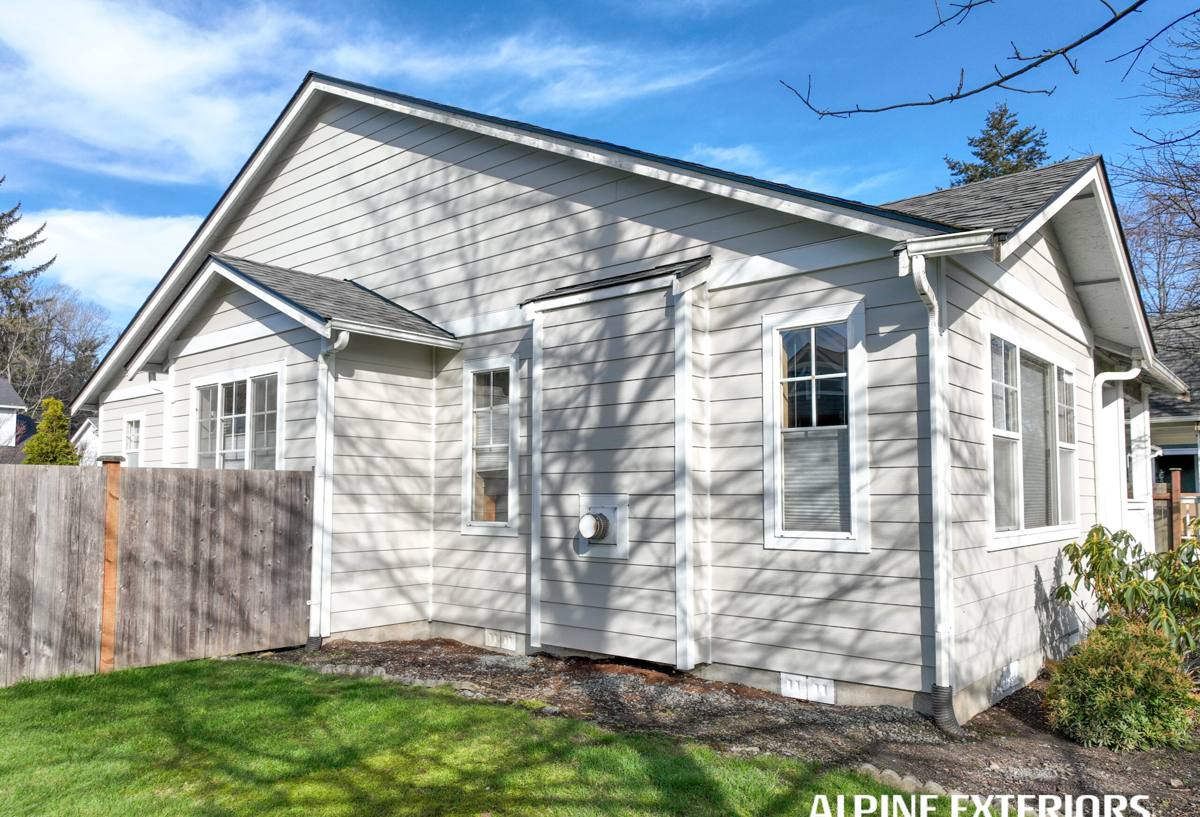
Why We Install James Hardie Fiber Cement, and Only That
James Hardie fiber cement is made from cement, sand, and cellulose fiber — there's no wood core to rot, swell, or feed decay organisms. Moss can still land on any exterior surface exposed to enough shade and moisture, siding included, but it doesn't compromise the substrate underneath the way it can with wood-based products. That matters a lot in a spot like Deer Harbor where moss season runs long.
Climate-Engineered for This Region
Hardie's HZ5 product line is engineered specifically for wetter, higher-moisture climates like the Pacific Northwest, with a formulation designed to resist moisture-related damage better than the company's standard-climate boards. We spec HZ5 on Orcas Island work because it matches what the marine environment actually demands, not because it's an upsell.
ColorPlus Factory Finish
Rather than relying on field-applied paint that has to be reapplied every several years, Hardie's ColorPlus finish is baked on at the factory under controlled conditions, which gives it better resistance to fading and weathering from sun and salt exposure than most site-applied coatings, and it carries its own finish warranty separate from the substrate warranty.
What a Correct Installation Actually Involves
Fiber cement performs the way it's supposed to only when it's installed to spec — the material isn't the whole story. In a high-moisture, salt-air environment like Deer Harbor, the details that get skipped on a rushed job are exactly the ones that matter most:
- Proper clearance from grade, decks, and roof lines so water and moisture-holding debris can't sit against the bottom edge of the siding
- A weather-resistive barrier installed correctly behind the siding, with a drainage plane so any water that does get past the surface can drain and dry out
- Fastening per Hardie's published schedule — correct nail type, spacing, and depth, not whatever's fastest
- Flashing at every window, door, and roof-to-wall intersection, including kick-out flashing where a roofline meets a wall — this single detail is one of the most common failure points in driving-rain climates
- Caulk used only where Hardie specifies it as part of the system, not as a substitute for flashing that was left out
- Field-cut edges sealed before installation, since an unsealed cut edge is a weak point for moisture intrusion
Skip any one of these and the siding can still look fine for a while — the problems show up years later, usually behind the wall where they're expensive to find and fix.
Why We Don't Install Vinyl, LP SmartSide, or Cedar Here
We get asked about all three regularly, and each has a real place in the market — just not on the homes we build for in this climate.
Vinyl is inexpensive and low-maintenance in mild conditions, but its seams and fastening system depend on hardware that has to resist ongoing salt exposure, and vinyl doesn't offer the same impact resistance or finish depth as fiber cement. LP SmartSide is a legitimate engineered-wood product with resin treatment built into the strand board, but it's still a wood-based core at heart — its long-term performance depends on the field-applied caulking and paint staying intact indefinitely, and in an environment with this much sustained moisture and moss-holding shade, any breach in that seal gives water a wood substrate to work on. Cedar is genuinely beautiful and plenty of Deer Harbor homes still wear it well, but it asks for refinishing on a real schedule, and salt air speeds up graying and weathering between coats — a heavier ask for owners who split time off-island and can't always keep up with it.
We standardized on Hardie because it removes that maintenance gamble. It's the product we're comfortable standing behind on a marine site like this one.
Getting Crew and Material to Deer Harbor: Logistics That Matter
Orcas Island work isn't the same as a mainland job, and pretending otherwise is how timelines slip. Material has to come over by ferry, which means orders get planned and staged around sailing schedules rather than a same-day supply run. Crews working the island need to plan efficient trips, batch tasks to make the most of the time they're on-site, and build in margin for weather windows that can close a job down for a day or two at a time.
Deer Harbor adds its own wrinkles on top of that: tree-canopy-covered lots that limit staging space, waterfront and near-shoreline properties where San Juan County's site and critical-area considerations can come into play, and access roads that aren't always built for a full material delivery truck. A crew that already works this area has already solved these problems on other jobs — a crew seeing it for the first time solves them on your dime.
Our Process, Start to Finish
- On-site walkthrough and measurement, including a look at existing siding condition and sheathing where it's exposed
- Material takeoff and order, scheduled around ferry and delivery timing so the crew isn't standing around waiting on boards
- Removal of existing siding (or prep of new sheathing) with an inspection for any hidden moisture damage before anything new goes up
- Installation of the weather-resistive barrier and all flashing details
- Hardie panel or lap siding installation to manufacturer fastening spec
- Trim, corner detail, and caulking per the Hardie system
- Final walkthrough and punch list with the homeowner
- Site cleanup and haul-away
If hidden moisture damage turns up once old siding comes off, we stop and talk it through with you before covering anything up — that's not an upsell tactic, it's the only honest way to handle it.
What Drives Cost on a Deer Harbor Siding Job
| Factor | Why It Matters Here |
|---|---|
| Home size and wall area | Directly drives material and labor totals |
| Removal of existing siding | Tear-off and disposal add time versus new construction |
| Site access | Tree cover, slope, and narrow access roads common around Deer Harbor can slow staging and material handling |
| Trim and corner complexity | More corners, dormers, and detail work mean more cutting, fitting, and flashing |
| Siding profile and ColorPlus color | Profile choice and premium factory colors carry different material costs |
| Flashing and moisture detailing | Driving-rain exposure on waterfront lots may call for extra flashing work at roof-wall intersections and penetrations |
We walk every property before quoting — a phone estimate can't account for tree cover, access, or the condition of what's already on the wall.
Living With Salt Air and Moss: Maintenance That Actually Helps
Fiber cement is low-maintenance, not no-maintenance. A little upkeep goes a long way toward getting the full life out of the installation in this environment:
- Rinse siding periodically with a garden hose to clear salt residue, especially on walls facing open water
- Keep gutters and downspouts clear so water sheets off the roof instead of running down the wall face
- Trim back branches and vegetation near the siding to keep airflow moving and discourage moss buildup
- Check caulking annually at windows, doors, and trim joints — small gaps are easy to catch early and cheap to fix
- Address moss on roofs and decks promptly so it doesn't spread down onto lower siding courses
- Avoid aggressive pressure washing directly at joints and edges; a soft brush and hose is usually enough
Why It Matters That We Already Work on Orcas Island
None of the above is complicated in theory. In practice, a crew unfamiliar with island work tends to underestimate ferry and weather timing, miss the access constraints common on Deer Harbor lots, or apply generic mainland assumptions to a site that doesn't behave like one. A crew that already works Orcas Island regularly has already worked through those variables — the schedule, the material logistics, and the moisture details that matter most in San Juan County's marine climate — on other jobs nearby. That experience shows up in fewer surprises, a more realistic timeline, and siding that's actually detailed for the conditions it has to survive.
If you're weighing a siding project for a home in Deer Harbor, we're happy to walk the property, look at what's there now, and give you a straight, no-pressure estimate — use the form below to get started.